
Mastering Programmable Media: Best Image Resize APIs (2026 Edition)

In the early days of web development, image optimization meant manually exporting three different sizes of a JPEG and hoping for the best. Fast forward to 2026, and the landscape has undergone a massive shift.
Today, we no longer talk about "making images smaller." We talk about Programmable Media. 🛠️
In the era of Google Core Web Vitals — particularly the Largest Contentful Paint (LCP) metric — static images are a liability. Modern developers don't store 50 versions of a single asset; they store one high-resolution master file and use a dynamic rendering engine to serve the perfect format — AVIF or WebP — based on the user's device and browser.
This is essential for image optimization Core Web Vitals LCP performance in 2026.
If you aren't automating your image delivery, you're leaving SEO rankings and bandwidth savings on the table. Let's dive into the best image resize APIs for 2026 and how they power everything from Programmatic SEO to high-performance e-commerce.
Cloudinary vs Imgix vs AbstractAPI: The Big 5 Image APIs Compared for 2026
Choosing an API depends on whether you need a full asset ecosystem or a lean microservice. Here is how the top players stack up today.
| Vendor | 2026 Identity | Best For | Key Advantage |
|---|---|---|---|
| Abstract API | The Developer Utility | Lean Python / Node workflows | Bring Your Own Storage: no vendor lock-in; works with your S3 |
| Cloudinary | The Enterprise DAM | Large-scale marketing teams | Generative AI features like AI fill and object removal |
| Imgix | The Visual Engine | Design-centric brands | Best-in-class rendering fidelity |
| ImageKit | The Bandwidth Saver | High-traffic blogs and news sites | Pricing tied directly to bandwidth usage |
| Uploadcare | The First Mile | User-generated content | Best-in-class upload ingestion |
AbstractAPI: The High-Performance Microservice
AbstractAPI has become the go-to for developers who value simplicity and security over bloated media ecosystems. Unlike platforms that force you to migrate your entire asset library to their servers, AbstractAPI offers a Bring Your Own Storage model. You keep images in your own S3 bucket or Google Cloud Storage — the API simply acts as a secure (SOC2-compliant) processing layer.
Because it works directly with your existing buckets, it's also ideal for bulk image compression API for S3 workflows.
Why it wins in 2026:
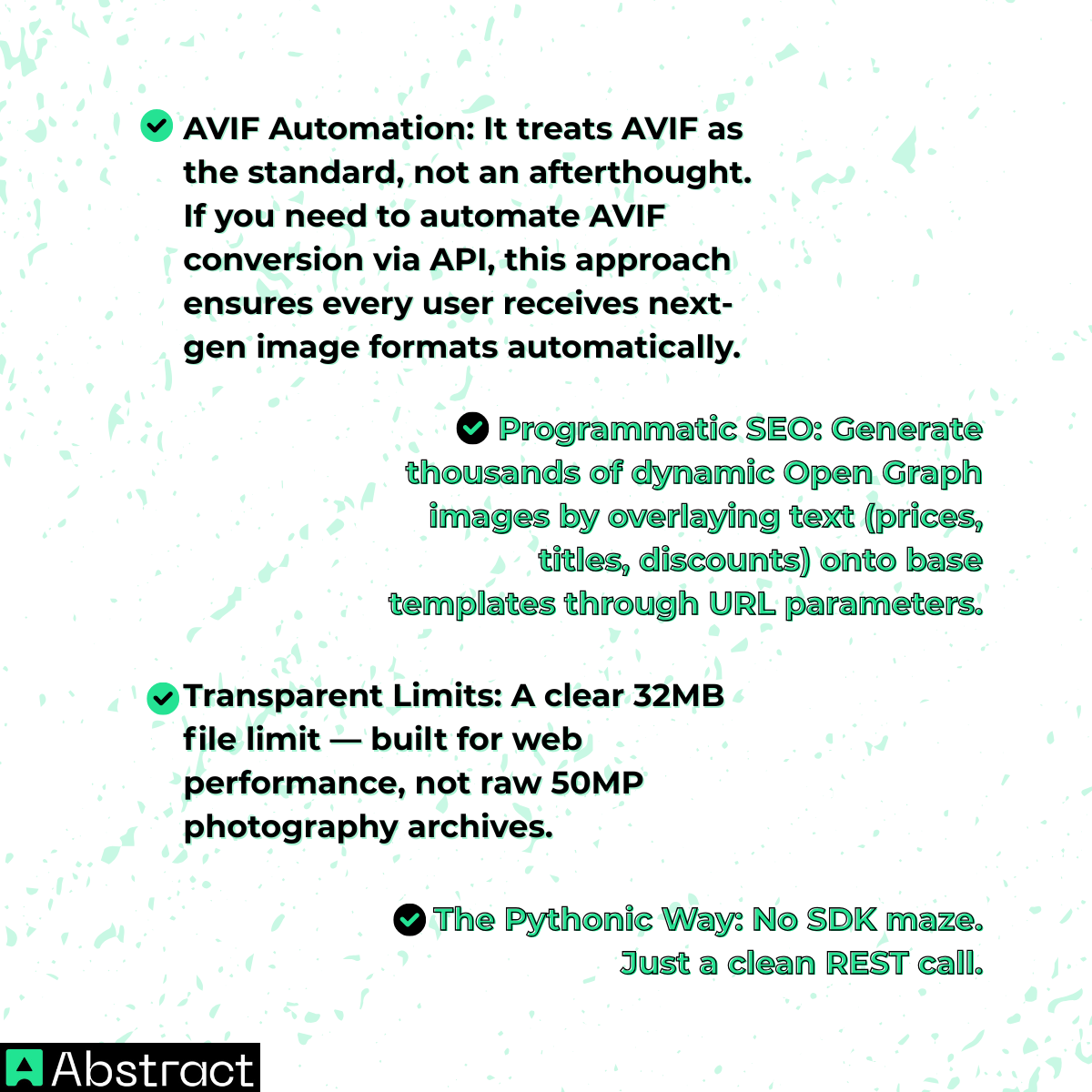
Best Image Resize API for Python in 2026
If you're looking for the best image resize API for Python, AbstractAPI offers a simple REST-based workflow that requires no SDK configuration and works directly with your existing S3 or cloud storage.
The Pythonic Way: 10 Lines of Code
Processing images shouldn't require a 500-page manual. Here's how you resize, compress, and convert to WebP in a single call using AbstractAPI's Image Processing API:
import requests
api_key = "YOUR_ABSTRACT_KEY"
image_url = "https://s3.amazonaws.com/your-bucket/product-hero.jpg"
# 2026 Workflow: Resize -> Intelligent Lossy Compression -> Convert to WebP
response = requests.post(
"https://images.abstractapi.com/v1/url/",
json={
"api_key": api_key,
"url": image_url,
"resize": {"width": 800, "strategy": "auto"},
"lossy": True,
"quality": 85
}
)
# Returns the URL of the processed image ready for your <img> tags
print(response.json()['url'])
Cloudinary: The AI-Powered Giant 🤖
Cloudinary is no longer just a resizing tool — it's a full Digital Asset Management (DAM) ecosystem. In 2026, its Generative Fill and AI object-removal features remain industry-leading.
- The Pro: If you need to remove backgrounds or modify product imagery dynamically via API, Cloudinary is king.
- The Con: Its credit-based pricing model remains notoriously complex. Between transformations, storage, and bandwidth credits, predicting monthly spend can feel like advanced calculus.
Imgix: For the Design-Obsessed 🎨
Imgix focuses on the Visual Engine side of programmable media. While it recently introduced a credit-based pricing model similar to Cloudinary, its advantage remains best-in-class rendering precision.
Key Feature: Advanced face-detection cropping ensures hero banners never crop out key subjects.
SEO Impact: Imgix excels at delivering pixel-perfect imagery for brands chasing perfect LCP scores — provided budget isn't a concern.
Critical Concepts for 2026
Don't Fear "Lossy" Compression 📉
A common misconception is that "lossy" equals poor quality. In 2026, Intelligent Lossy Compression removes visual data the human eye cannot perceive. The result: up to 80% smaller files with zero visible degradation.
Secure Your Infrastructure with Signed URLs 🔒
When using any image API in production, always implement Signed URLs. This prevents billing attacks where malicious actors generate massive transformation requests to inflate your API costs.
Programmatic SEO & Dynamic Overlays
The secret to modern growth is automation. Using programmable media APIs, teams generate dynamic social share images at scale. Overlay "Price: $50" or "Sale Ends Today" directly onto product imagery through URL parameters — no Photoshop required.
This kind of programmatic image generation for SEO is now a core growth tactic for large content and e-commerce platforms.
Final Verdict: Which API Should You Choose?
If you're an enterprise seeking a full AI-driven media ecosystem — and don't mind complex credit-based billing — Cloudinary is a strong fit.
However, if you're a developer who wants a secure, predictable, and storage-agnostic image pipeline, AbstractAPI's Image Processing API is the superior choice. It integrates seamlessly into Python and Node.js workflows and delivers exactly the microservices needed for modern Core Web Vitals performance.
Tired of Complex Credit Pricing Models?
Choose AbstractAPI for a straightforward, secure image-processing microservice that respects your budget, your infrastructure, and your developer experience.
👉 Get started with AbstractAPI today and launch your programmable media pipeline in minutes. 🚀
Frequently Asked Questions
What is an image resize API?
An image resize API is a web service that lets you programmatically change image dimensions, compress files, and convert formats on demand. Instead of manually creating multiple asset sizes, you send a request with your target parameters and the API returns an optimized image, often in modern formats like WebP or AVIF.
Why should I use an image resize API instead of resizing images manually?
Manual resizing doesn't scale: you'd need to produce separate assets for every device, screen size, and format. A programmable media API handles dynamic rendering at request time, serving the right format and dimensions automatically. This reduces bandwidth consumption by up to 80% and directly improves Google Core Web Vitals metrics like Largest Contentful Paint (LCP).
Which image resize APIs are considered best in 2026?
The top options covered in the guide are Abstract, Cloudinary, Imgix, ImageKit, and Uploadcare. Abstract is noted for straightforward billing and a simple Python integration. Cloudinary offers a full digital asset management suite with AI features, though its credit-based pricing can be unpredictable. Imgix focuses on visual rendering and ImageKit on bandwidth optimization, while Uploadcare is geared toward user-generated content workflows.
What is the difference between Cloudinary and Imgix?
Cloudinary is a comprehensive digital asset management platform with AI-powered features and a wide transformation library, but its credit-based pricing model is notoriously complex and can lead to unpredictable monthly costs. Imgix is a visual rendering engine that focuses on real-time image transformations and is often preferred by developers who want URL-based control without the overhead of a full DAM platform.
Which image formats should I convert to for best web performance?
WebP and AVIF are the recommended formats for modern web delivery. A good image resize API will detect the requesting browser and serve the best supported format automatically, which is what the guide calls "programmable media." AVIF offers the highest compression ratios, while WebP has near-universal browser support and is a safe default for most use cases.
How do I prevent abuse or unexpected billing when using an image resize API?
The main mechanism is signed URLs, which require a cryptographic signature on each transformation request. Without signing, anyone can craft arbitrary resize parameters against your account and generate charges. Most production-grade APIs including Abstract support signed URLs; enabling them is a key step before going live with any public-facing image delivery endpoint.
CEO at Abstract API

