Oops! Something went wrong while submitting the form.
No credit card required
Introduction: The Evasion Arms Race 🛡️🤖
For years, fighting automated abuse on the internet was relatively straightforward. If traffic came from a suspicious country, you geo-blocked it. If it originated from Amazon AWS, DigitalOcean, or another cloud provider, you added those IP ranges to a denylist. Problem solved—or so it seemed.
Today, those strategies barely scratch the surface.
Why simple IP blocking no longer works
Modern bots don't behave like yesterday's noisy scrapers. Fraud rings, credential-stuffing groups, and ticket scalpers have evolved into highly adaptive systems. They rotate IPs, mimic human browsers, and intentionally avoid the "obvious" infrastructure that defenders learned to block.
As a result, blocking datacenter IPs alone is no longer effective. Attackers noticed how easy it was to detect VPNs and hosting providers, so they moved their infrastructure closer to real users.
The shift: from datacenters to living rooms 🏠
Instead of routing traffic through servers in cloud providers, attackers now rely on residential proxies—connections that exit the internet from real homes, using IP addresses assigned by consumer ISPs like Comcast, AT&T, Telefónica, or Orange.
These IPs look clean. They belong to everyday users. They pass basic reputation checks. And that's exactly why they're dangerous.
Often, the end user doesn't even know their connection is being used. Their smart TV, router, or a "free" mobile app has been turned into an exit node for someone else's traffic via proxyware SDKs or compromised IoT devices.
The core challenge
Not all anonymization traffic is malicious.
A VPN user might simply care about privacy.
A residential proxy is often used for large-scale evasion, scraping, or account takeover.
To stop sophisticated fraud without hurting real users, you need to classify IP signals, not just block them. That's where understanding the architectural difference between VPNs and residential proxies—and using tools like AbstractAPI's IP Intelligence — becomes critical.
Architecture Analysis: What Are We Actually Detecting? 🧠
Before talking about detection techniques, we need to be precise about what we're detecting. VPNs and residential proxies are often lumped together, but architecturally they are very different.
Datacenter IPs (VPNs)
Source: Datacenter VPN traffic originates from servers owned by hosting providers such as DigitalOcean, OVH, Leaseweb, or Hetzner.
Network signal: The Autonomous System Number (ASN) associated with the IP clearly belongs to a hosting or business network. These ASNs advertise large IP ranges and are publicly known.
Behavioral profile
High bandwidth
Stable uptime
Predictable routing paths
Risk profile
Low to medium risk
Can be used for abuse, but also widely used by legitimate users for privacy, remote work, or travel
Blocking all VPNs often leads to unnecessary friction and false positives.
Residential Proxies
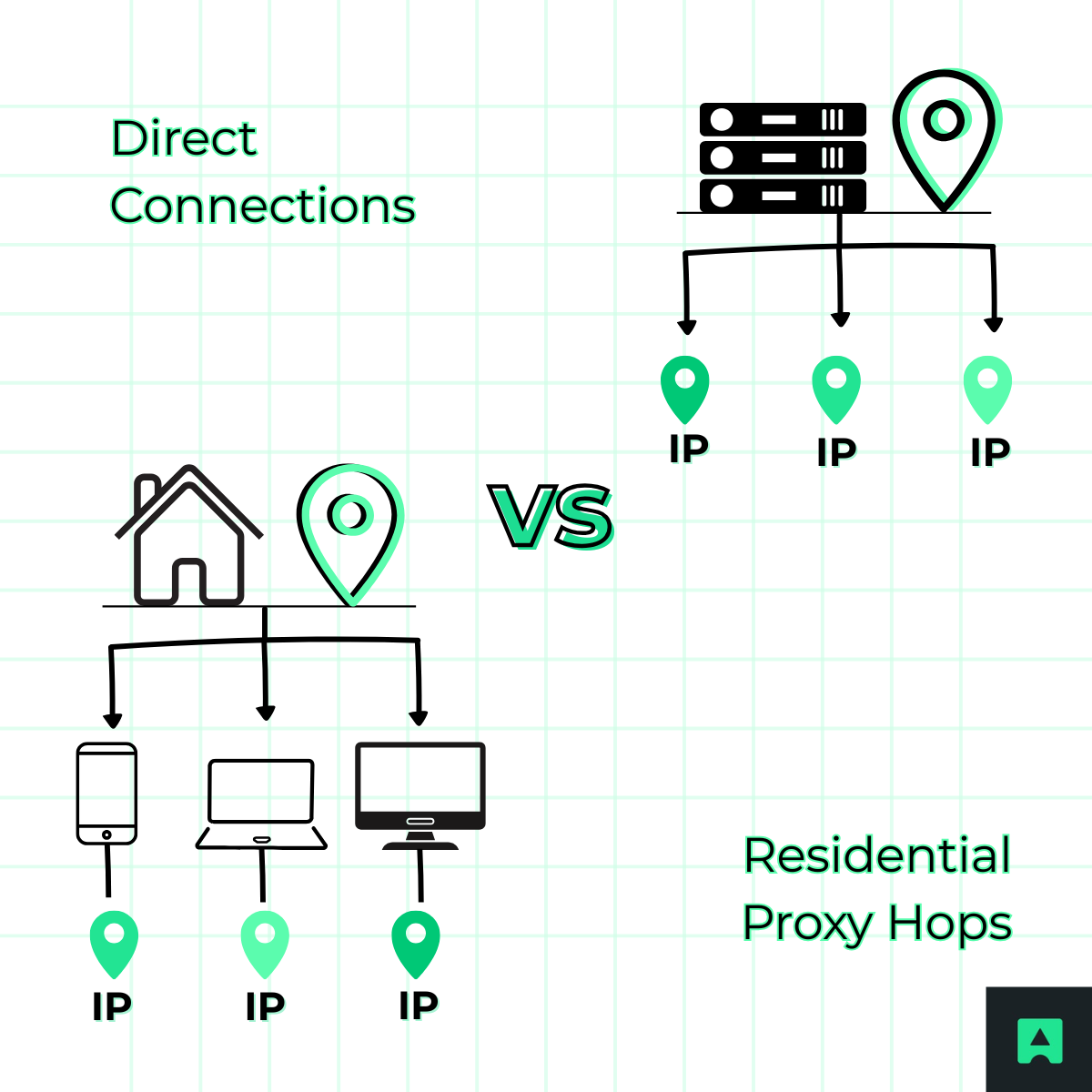
Source: Residential proxy traffic exits from IPs assigned to consumer ISPs—exactly the same pool used by real households.
How it works
Traffic is tunneled through a chain:
Bot or scraper
Proxy provider's back-connect server
Residential device (router, phone, IoT)
Your application
This is often called a back-connect residential proxy.
How attackers get these IPs
Proxyware SDKs embedded in free apps
Compromised smart devices
Large botnets (e.g., 911 S5, which leveraged hijacked residential nodes at massive scale)
Risk profile
High risk when combined with automation
Designed specifically to evade IP-based detection
Enables fast residential IP rotation
Unlike VPNs, residential proxies are rarely about privacy. They're about scale and evasion.
Technical Detection Methods (The "Secret Sauce") 🧪
Detecting residential proxies is not about a single magic flag. It's about correlating multiple network-level signals.
⚠️ Important: No provider can detect every residential proxy. What you can do is identify signals that strongly suggest proxy abuse with high probability.
1. ASN & ISP Classification 🧾
The first step is understanding who owns the IP.
Datacenter IP → ASN type: Hosting / Business
Residential IP → ASN type: ISP
This alone isn't enough—but it sets the foundation.
If traffic claims to come from a residential ISP like Comcast, but:
Maintains server-like uptime
Handles thousands of sessions per hour
Never changes behavior across time zones
…the IP may belong to a household, but the usage pattern does not.
2. Passive OS Fingerprinting (TCP/IP Mismatch) 🧬
Every operating system has subtle quirks in how it constructs TCP/IP packets:
Default TTL values
TCP window size
TCP option ordering
These characteristics act like a network fingerprint.
When:
The User-Agent claims iOS Safari
But the TCP stack looks like a Linux server
…it strongly suggests a proxy tunnel between layers.
This technique is especially effective against residential proxies because the exit node and origin system rarely match.
3. Latency Analysis & Hop Count ⏱️
Residential proxy networks introduce extra hops—and hops introduce latency.
Real user → ISP → Your server
Bot → Proxy infra → Residential device → Your server
If a "local" residential IP consistently shows:
Elevated round-trip times
Highly variable latency
…it's likely part of a back-connect proxy chain.
Using AbstractAPI for Signal Classification ⚙️
AbstractAPI provides real-time IP intelligence signals that map directly to these detection techniques.
return "Residential Proxy - HIGH RISK (Potential Botnet)"
return "Clean User"
The "Grey Area": Privacy vs. Fraud ⚖️
Not everything that looks suspicious is malicious.
Some legitimate privacy technologies—such as Apple Private Relay—can resemble residential traffic patterns under certain conditions. Blocking all residential signals outright risks false positives and degraded user experience.
Context + velocity = clarity 🚦
Instead of asking "Is this a residential IP?", ask: "How is this residential IP behaving?"
Velocity checks add crucial context:
Login attempts per minute
Requests per session
Endpoint sensitivity
👉This is why IP intelligence should never operate in isolation—when combined with behavioral analysis and velocity-based fraud detection strategies, such as those outlined in AbstractAPI's fraud prevention guides, teams can dramatically reduce false positives without giving sophisticated bots room to operate.
Example:
One residential IP → 50 login attempts in 60 seconds
🚨 Almost certainly proxy rotation.
Conclusion: From Binary Blocking to Signal Intelligence 🧠✨
IP reputation is no longer binary.
VPNs ≠ residential proxies
Residential IPs ≠ real users
Context and correlation matter
By combining ASN classification, passive OS fingerprinting, latency analysis, and real-time IP intelligence from AbstractAPI, security teams can finally detect residential proxy abuse without blocking legitimate users.
🚀 Don't let bots hide behind "clean" residential IPs.
Use AbstractAPI's IP Intelligence to reveal the true network signal behind every connection.
What is the core difference between a VPN and a residential proxy?
A datacenter VPN routes traffic through servers owned by hosting providers like DigitalOcean or OVH, making the ASN clearly identifiable as a business or hosting network. A residential proxy exits through IP addresses assigned to real consumer ISPs such as Comcast or AT&T, making the traffic appear indistinguishable from a normal household user.
Why are residential proxies harder to detect than datacenter VPNs?
Because residential proxy traffic shares the same IP pool as real households, standard IP reputation and geolocation checks cannot reliably flag it. Blocking based on ISP or connection type alone would also block legitimate users. No provider can detect every residential proxy, which is why multi-signal analysis is required.
How can developers classify IP signals to distinguish proxy traffic?
The guide recommends combining three technical approaches: ASN and ISP classification to identify network ownership, passive OS fingerprinting to detect TCP/IP stack mismatches between the claimed and actual system, and latency and hop analysis to spot the overhead introduced by proxy chains. APIs like AbstractAPI's IP Intelligence endpoint return fields such as security.is_vpn, security.is_proxy, and connection.connection_type to streamline this.
When should behavioral velocity checks be combined with IP classification?
IP classification alone can produce false positives. Pairing it with velocity signals (such as 50 login attempts from one residential IP within 60 seconds) helps confirm automation abuse rather than penalizing a real user browsing normally from the same address. The guide treats IP reputation as input to a decision, not the decision itself.
What are the false positive risks of blocking all residential IP traffic?
Blanket residential blocking harms genuine users, especially when legitimate privacy tools like Apple Private Relay produce signals similar to proxy patterns. The guide explicitly warns that "IP reputation is no longer binary" and recommends context-aware analysis rather than categorical blocks.
Are there legitimate use cases for residential proxies that developers should account for?
Yes. Ad verification, regional QA testing, and localization checks are common legitimate uses for residential proxies. Because the same IP signals appear in both benign and malicious contexts, developers should avoid treating every residential proxy hit as a threat and instead layer classification with session behavior and request patterns to assign appropriate risk scores.