
The Developer’s Guide to OSINT Tools for Risk Scoring

The Developer's Guide to OSINT (Open Source Intelligence) for Risk Scoring 🕵️♂️💻

Introduction: From Manual Investigation to API Automation 🚀
For decades, OSINT (Open Source Intelligence) was the domain of human analysts. Fraud investigators manually browsed forums, checked breach dumps, reviewed social profiles, and cross-referenced IP addresses to answer a fundamental question:
- Is this user risky?
That workflow made sense in a low-volume world.
It completely collapses at modern scale.
The problem with manual OSINT 🧱
Today's fintech platforms, SaaS tools, and marketplaces onboard hundreds—or thousands—of users per hour. Each signup, password reset, or payment attempt represents potential abuse.
Manual OSINT introduces serious limitations:
❌ Impossible to scale with growth
❌ Inconsistent judgments across analysts
❌ High operational and staffing costs
❌ Slow fraud response times
You can't investigate 1,000 users per hour by hand—and fraudsters know it.
The shift: Automated OSINT ⚙️
Modern fraud prevention relies on automated OSINT pipelines.
Instead of human investigators collecting breadcrumbs, developers now:
- Enrich user data in milliseconds
- Analyze a user's digital footprint automatically
- Convert OSINT signals into a real-time risk score
APIs become your investigators.
Using Abstract API, developers can replace manual tooling (like visual OSINT platforms or one-off scripts) with high-performance intelligence APIs that enrich IP addresses, emails, and phone numbers instantly.
The result is automated risk scoring that operates quietly in the backend—protecting your platform without disrupting legitimate users.
The Three Pillars of Automated OSINT 🧠
Automated OSINT is built on signal enrichment.
Each user interaction provides raw inputs. Your system enriches those inputs with context, history, and reputation.
Abstract API focuses on three foundational OSINT data points.
IP Intelligence — The Connection 🌍
An IP address reveals far more than geographic location. It exposes how a user connects to your system—and whether that connection looks human or automated.
Using an IP address intelligence API, developers can detect:
- VPNs, proxies, and Tor exit nodes
- Residential vs data center IPs
- Hosting providers and ASNs
- Country, region, and city
👉 This data is available via Abstract's IP Geolocation API and IP Intelligence API, both optimized for real-time fraud detection.
Risk heuristics from IP data
Common red flags include:
🚩 Data center IPs used for consumer signups
🚩 VPN usage during onboarding or payments
🚩 Location mismatches between IP and user-provided country
Distance-based checks are especially effective:
- User claims to be in Spain 🇪🇸
- IP resolves to Eastern Europe 🌍
- Risk score increases automatically
This type of connection-level OSINT is one of the strongest early fraud indicators available to developers.
Email Intelligence — The History 📧
Email addresses are easy to create—and that's precisely why they're abused at scale.
With an email intelligence API, developers can extract:
- Domain age and DNS configuration
- Disposable or temporary inbox usage
- SMTP deliverability
- Typosquatting patterns
👉 Abstract's Email Validation API provides these signals in a single, low-latency request.
Email OSINT risk signals
High-risk patterns include:
🚩 Disposable email providers
🚩 Domains registered days ago
🚩 Emails failing SMTP checks
🚩 Typosquatting attempts (e.g. googlemail.com vs gmail.com)
Email history becomes a behavioral signal.
Legitimate users rarely rely on burner inboxes for financial or business products.
This makes email OSINT a cornerstone of automated fraud prevention.
Phone Intelligence — The Identity 📱
Phone numbers are often treated as strong identity anchors—but not all numbers are equal.
With a phone number OSINT API, developers can detect:
- Carrier type (Mobile, Landline, VoIP)
- Country and region
- Line validity and status
👉 Abstract's Phone Number Validation API and Phone Verification API make phone intelligence instantly actionable.
Why VoIP detection matters
VoIP numbers are:
- Cheap to acquire
- Easy to rotate
- Common in account farming and social engineering
Risk teams typically assign higher risk weights to:
🚩 VoIP numbers
🚩 Prepaid or burner lines
🚩 Phone country mismatches with IP data
This makes phone number OSINT one of the most powerful identity signals in risk scoring.
Building a Risk Scoring Engine (Hands-On Tutorial) 🧪
Collecting OSINT signals is only the first step.
The real value comes from combining those signals into a unified risk decision.
Let's walk through a simple, extensible approach.
Step 1: Start with a neutral score ⚖️
Every user begins with: Risk Score = 0
Each suspicious signal adds weight.
Step 2: Apply heuristic-based scoring 🧠
Here's a simplified Python example showing how OSINT data can be combined:
def calculate_risk(ip_data, email_data, phone_data, user_input_country):
score = 0
# IP Factors
if ip_data['security']['is_vpn']:
score += 30
if ip_data['country_code'] != user_input_country:
score += 20
# Email Factors
if email_data['is_disposable_email']:
score += 50
if not email_data['is_smtp_valid']:
score += 20
# Phone Factors
if phone_data['type'] == 'VoIP':
score += 40
return score # >60 triggers manual review or step-up verification
This approach is:
✅ Transparent
✅ Auditable
✅ Easy to tune over time
Unlike black-box platforms, developers retain full control over heuristics and thresholds.
Step 3: Define decision thresholds 🎯
Typical ranges might look like:
- 0–30: Low risk → allow
- 31–60: Medium risk → challenge (2FA, email or phone verification)
- 60+: High risk → manual review or KYC
These thresholds evolve as your fraud patterns—and data—change.
Advanced Technique: Cross-Referencing ("The Sherlock Move") 🔍
Once basic enrichment is in place, cross-referencing transforms good detection into high-confidence intelligence.
Velocity rules ⏱️
Velocity checks track how often a signal appears:
- Same IP used for 20 signups in 10 minutes
- Same phone number reused across accounts
- Same email domain dominating registrations
Velocity rules dramatically reduce false negatives without introducing user friction.
Correlation analysis 🔗
Cross-check signals against each other:
- IP country ≠ phone country
- Email domain region ≠ billing country
- Carrier type ≠ expected user profile
Example:
- IP resolves to Nigeria 🇳🇬
- Phone number is +1 (USA) 🇺🇸
- Email domain registered yesterday
Individually, these might pass.
Together, they form a high-confidence fraud pattern.
Structured OSINT data from Abstract APIs makes correlation fast, reliable, and scalable.
The Invisible Security Layer 🫥
One of the biggest advantages of OSINT-based risk scoring is stealth.
Why invisible security wins
- CAPTCHAs frustrate real users 😤
- Extra steps reduce conversion 📉
- Fraudsters quickly learn and adapt
OSINT enrichment happens:
- Server-side
- In real time
- Without alerting attackers
Legitimate users never notice it.
Fraudsters get filtered quietly.
This makes automated OSINT a frictionless fraud prevention layer, especially when combined with Abstract's APIs.
Ethical & Legal Considerations ⚖️
OSINT must always be used responsibly.
Best practices include:
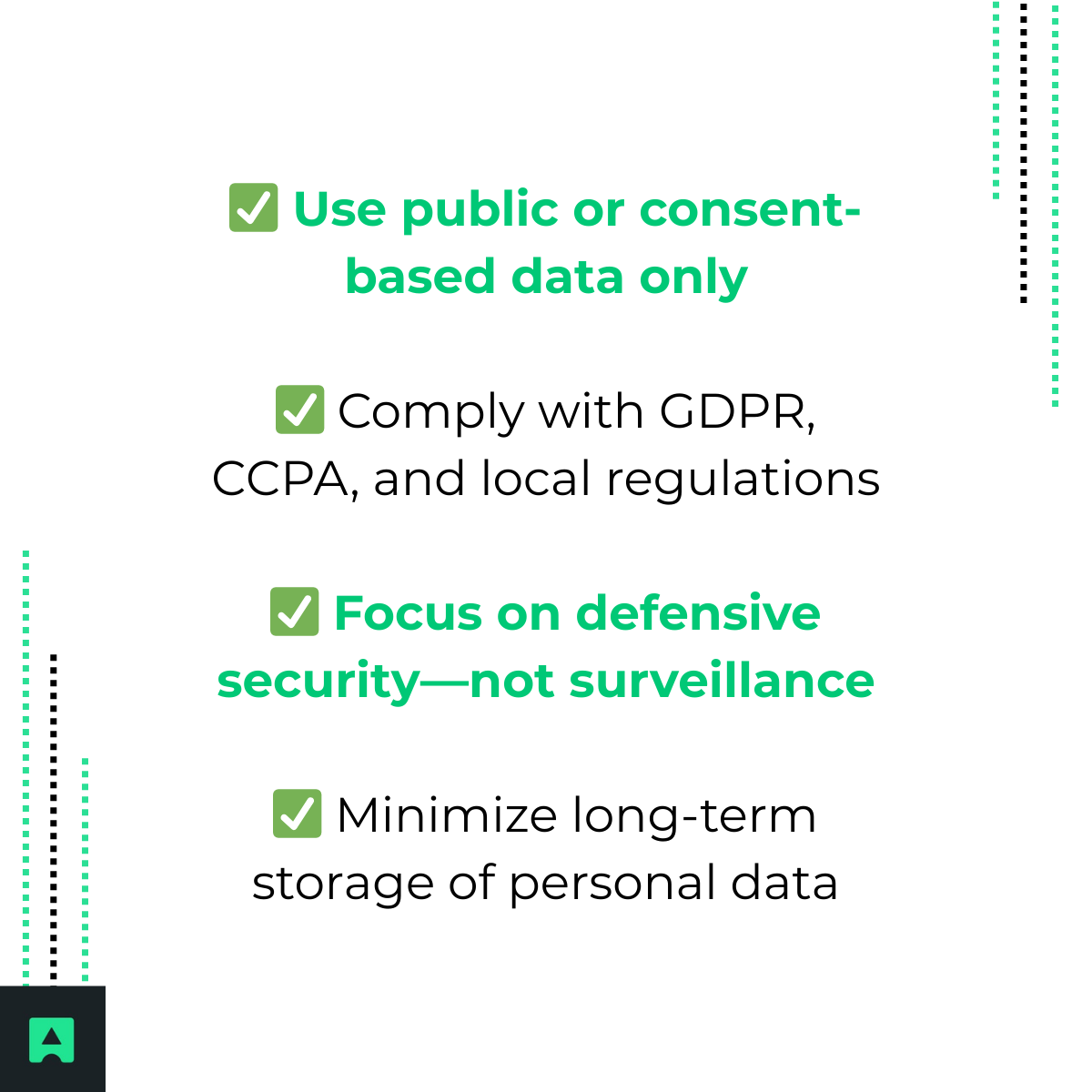
Abstract API is designed for compliance-first intelligence enrichment, helping teams reduce risk while respecting privacy.
Abstract API vs Enterprise Fraud Platforms 🧩
Enterprise platforms like Seon or Sift provide powerful detection—but often:
- Operate as opaque black boxes
- Require long contracts
- Limit customization
- Obscure scoring logic
The builder's alternative 🛠️
Abstract API takes a different approach:
- Modular OSINT APIs
- Clear documentation
- Transparent pricing
- Full developer control
You don't buy a verdict—you build intelligence.
This makes Abstract ideal for:
- Fintech and crypto platforms
- Risk-Ops and fraud teams
- Security engineers
- Custom fraud pipelines
Conclusion: Better Intelligence Beats Stronger Passwords 🧠🔐
Modern security isn't about adding friction—it's about better intelligence.
By automating OSINT:
- Investigations scale effortlessly
- False positives decrease
- Legitimate users stay happy
Abstract API empowers developers to transform raw data into actionable risk signals—in milliseconds.
Frequently Asked Questions
What is OSINT-based risk scoring and how does it work?
OSINT-based risk scoring uses publicly available data signals (IP address reputation, email validity, and phone carrier type) to assign a numeric risk score to each user or transaction. Each signal is weighted by severity (for example, a disposable email adds 50 points, a VPN adds 30), and the total score maps to a decision: allow, challenge with 2FA, or flag for manual review.
Why should developers automate OSINT instead of doing manual investigations?
Manual OSINT investigation cannot scale to thousands of signups per hour. Automated enrichment via APIs runs in milliseconds at signup time, letting you flag risky accounts before they cause damage rather than discovering fraud after the fact. It also removes the need for large analyst teams to review every account.
What are the three core OSINT signals used in developer risk scoring?
The three foundational signals are IP intelligence (detects VPNs, proxies, data center IPs, and geolocation mismatches), email intelligence (identifies disposable domains, SMTP validity, and newly registered addresses), and phone intelligence (flags VoIP numbers and carrier or country mismatches). Cross-referencing all three (for example, checking if the IP country matches the phone country) produces much stronger risk signals than evaluating any one in isolation.
How should developers set risk score thresholds?
A common starting point is: 0 to 30 allow the user through, 31 to 60 challenge with two-factor authentication, and above 60 route to manual review or block entirely. These thresholds are not fixed; developers retain full control and should tune them based on their fraud rates, false-positive tolerance, and business context.
How does using modular OSINT APIs differ from enterprise fraud platforms like Seon or Sift?
Enterprise fraud platforms operate as opaque black boxes with limited ability to customize scoring logic, and typically require long contracts. Using modular APIs like Abstract's IP, email, and phone validation endpoints gives developers full transparency into how scores are calculated and the flexibility to adjust weights and rules as fraud patterns evolve.
What are velocity rules in OSINT fraud detection?
Velocity rules track how frequently the same signal appears across multiple signups within a time window, for example, ten accounts created from the same IP address in one hour. A single VPN-connected signup may be acceptable, but a burst of them from one IP is a strong indicator of coordinated abuse. Combining per-signal enrichment with velocity tracking catches fraud patterns that point-in-time checks alone would miss.
CEO at Abstract API

