



Top Providers Reviewed
Fixer.io – The Corporate Standard
Fixer.io is widely adopted as a stable, enterprise-ready currency API. It offers reliable real-time rates and historical data with secure HTTPS access. Many developers appreciate its stability, though the free tier often restricts the base currency to EUR, which is limiting for global applications.
Pros
- Strong reliability and uptime
- Clean JSON responses
- Historical data
Cons
- Free tier base currency restrictions
- Premium plans can be expensive
Open Exchange Rates – The Scaler's Choice
Open Exchange Rates stands out with a unique flat-fee unlimited request pricing model ideal for very high volume applications. It also supports crypto pricing and a wide range of fiat pairs.
Pros
- Unlimited requests on flat plan
- Good coverage of currency and crypto data
- JSON and time series data
Cons
- Real-time frequency depends on plan
AbstractAPI – The Modern Utility
Ideal for developers building microservices, AbstractAPI pairs excellent documentation with easy integration. It supports both fiat and cryptocurrency data. Be aware its free tier enforces a 1 request per second limit, so you will want caching in production.
Pros
- Developer-friendly docs
- Combined fiat and crypto support
- Consistent JSON responses
Cons
- Free tier rate limits require caching
ExchangeRate-API – The Startup Favorite
ExchangeRate-API offers great value at lower price points, with a reasonable number of requests per month and historical data included. It is simple to use and can be a strong choice for startup products that need clean JSON outputs without enterprise pricing.
Pros
- Affordable plans
- Clean JSON integration
- Historical rates included
Cons
- Update intervals wider than enterprise real-time needs
CurrencyLayer – The Accountant's Choice
CurrencyLayer focuses on precision with up to six decimal places, an important feature for accounting accuracy and financial applications where rounding errors matter.
Pros
- High precision rates
- Secure HTTPS access
- Good documentation
Cons
- Price scales with frequency and volume
Key Features and Use Cases
Real-Time Forex and Currency Conversion
For real-time forex API JSON use cases, you want endpoints that consistently update as frequently as possible (sub-second for trading, 60s for e-commerce). Most modern APIs update every minute or faster with paid plans, powering dashboards, pricing engines, and conversion tools.
Historical Exchange Rate API
Historical data is critical for auditing, analytics, and backtesting models. Top providers offer historical endpoints going back years, allowing you to fetch past exchange values for compliance and insights.
Multi-Currency Pricing for E-commerce
E-commerce platforms often display prices in a visitor's local currency. You can use APIs to fetch rates and calculate multi-currency pricing for e-commerce dynamically. Always cache rates for several minutes or hours to reduce load and cost.
Free Currency Converter API Considerations
Free tiers are great for experimentation, but limitations like locks on base currency or fewer updates per hour are common. Avoid providers that do not support HTTPS or restrict usage in ways that break in modern browsers.
Integration Tutorial: Python Currency Converter
Below is a typical Python currency converter example using a live API:
import requests
api_key = "YOUR_ABSTRACT_API_KEY"
base = "USD"
target = "EUR"
amount = 100
url = f"https://exchange-rates.abstractapi.com/v1/live?api_key={api_key}&base={base}&target={target}"
try:
response = requests.get(url)
data = response.json()
if response.status_code == 200:
rate = data['exchange_rates'][target]
converted = amount * rate
print(f"{amount} {base} = {converted:.2f} {target} (Rate: {rate})")
else:
print(f"Error: {data.get('error', {}).get('message', 'Unknown error')}")
except Exception as e:
print(f"Connection failed: {e}")
Pro Tip on Caching
Store returned rates in a cache (like Redis) for 60 minutes. Do not call the API on each user request; repeated calls cost money and introduce latency.
Real-world example: Unifying fiat and crypto pricing with AbstractAPI
On a recent fintech project, our team built a multi-currency wallet that allowed users to hold USD, EUR, and BTC in a single interface. The product required showing real-time portfolio value in each user's local currency, updated frequently but without overwhelming our backend. We chose AbstractAPI's Exchange Rates API because it delivers both fiat and crypto rates through the same JSON endpoint. That eliminated the need for a separate crypto price provider and reduced our integration complexity immediately.
By caching AbstractAPI's rates for 60 minutes, we cut external API requests by roughly 45 percent compared to our initial prototype. Load times on the pricing dashboard improved, and we stopped seeing rounding mismatches between fiat and crypto balances. More importantly, the unified data source meant fewer edge-case bugs and fewer user reports of "incorrect totals." It turned currency conversion from a recurring engineering pain point into stable infrastructure we could trust.
Comparing Fixer, Open Exchange Rates, and CurrencyLayer
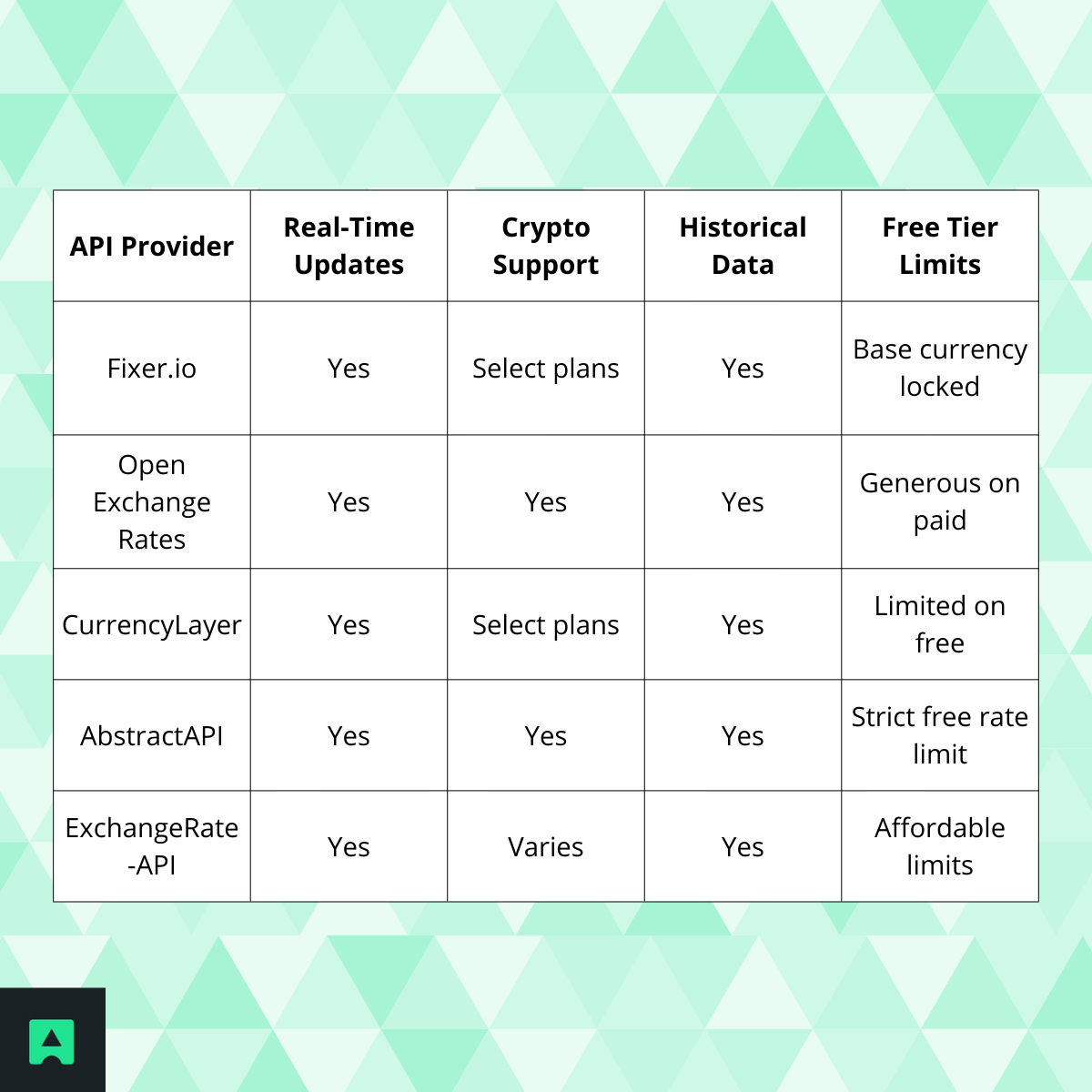
This table surfaces the core differences when choosing a Fixer.io alternative or deciding between Open Exchange Rates vs CurrencyLayer.
Pricing Complexity and Choosing the Right Plan
Cost considerations include request volume, update frequency, and precision. Unlimited flat plans benefit high-traffic apps, while smaller services may prefer affordable monthly limits. Always factor caching into your cost model to avoid surprises.
Final Thoughts
The best currency exchange APIs for developers in 2026 blend real-time accuracy with flexibility and crypto support. Whether you are building e-commerce pricing engines, financial dashboards, or algorithmic trading tools, these APIs give you the data you need. Remember to cache API responses to save money and latency.
Need a reliable, easy-to-integrate currency feed without the enterprise price tag? Start building today with AbstractAPI's Exchange Rates API — secure, fast, and developer-friendly.
Frequently Asked Questions
What is a currency exchange API?
A currency exchange API is a web service that returns live or historical foreign exchange rate data over HTTPS, typically in JSON format. Developers use these APIs to add real-time currency conversion to apps, e-commerce checkouts, accounting tools, and financial dashboards without building or maintaining their own rate feeds.
What are the main limitations of free-tier currency exchange APIs?
Free tiers often restrict the base currency (for example, Fixer.io locks free users to EUR as the base), cap the number of requests per day, or reduce update frequency. For production use, caching responses for 60 minutes or more is a practical way to stay within free-tier limits while keeping data reasonably fresh.
How does AbstractAPI compare to Fixer.io for currency exchange data?
AbstractAPI provides a unified endpoint covering both fiat and cryptocurrency pairs with a developer-friendly design, while Fixer.io is a more enterprise-focused option used by over 200,000 developers that updates every 60 seconds but restricts the base currency on its free plan. AbstractAPI's free tier allows 1 request per second, making it practical for low-volume projects and prototyping.
When do I need historical exchange rate data instead of live rates?
Historical rate endpoints are needed for audit trails, financial reporting, backtesting, and analytics that require rates at a specific past date. If you're building an accounting tool, a travel expense tracker, or a reporting dashboard, choose an API like ExchangeRate-API or Open Exchange Rates that includes multi-year historical data in addition to live rates.
How much decimal precision do I need for financial applications?
Most standard currency conversions work with four decimal places, but accounting and invoice systems typically require six decimal places to avoid rounding errors on large transaction volumes. CurrencyLayer is highlighted in this guide for its six-decimal precision, making it a strong fit for bookkeeping or high-value financial workflows.
Should I cache currency exchange API responses in my app?
Yes — caching is strongly recommended. Exchange rates rarely need to update more than once per minute for most use cases, so caching responses for at least 60 minutes significantly cuts API call volume, lowers costs, and improves response times for your users. A lightweight in-memory store or Redis instance is a common pattern for this.
