Oops! Something went wrong while submitting the form.
No credit card required
In 2026, the best sports API is defined by real-time delivery, low latency, and deep data granularity. This guide reviews the best sports APIs for developers, shows live-score and compliance code examples, and explains why geofencing with AbstractAPI is essential for betting and broadcast legality.
A few years ago, choosing a sports API meant finding a service that returned final scores. In 2026, the best sports API is something very different. Modern sports products depend on millisecond-level updates, advanced match events, and instant odds changes. Betting platforms need live pricing. Fantasy apps need player-level metrics. Fan engagement tools need real-time match feeds delivered through WebSockets, not slow polling.
This guide reviews the best sports APIs for developers, explains how modern sports data infrastructure works, and shows practical code examples. It also covers a critical requirement for sports apps today: sports betting geofencing and broadcast restriction enforcement using AbstractAPI.
What Makes a Modern Sports API in 2026
A sports API is no longer a simple database endpoint. It is real-time data infrastructure. Three factors matter most.
Latency is the foundation. Betting markets and live-score products require updates in fractions of a second. REST polling cannot keep up. WebSocket or streaming feeds are now the standard.
Granularity is the next layer. Developers need more than scores. Expected goals, shot maps, possession chains, player heatmaps, and bookmaker line movement are standard requirements.
Reliability and data rights complete the picture. Some providers deliver official licensed data suitable for regulated betting. Others offer scouted data at lower cost with slightly higher delay. Both have valid use cases, but the distinction matters.
Understanding these factors helps narrow down the right sports data API providers for your product.
Top Sports Data API Providers in 2026
This section covers leading sports data API providers, including options for a free sports data API with live scores.
API-SPORTS (API-Football): The Developer Favorite
API-SPORTS remains the best overall value for most developers.
Massive coverage across football, NBA, F1, MLB, and more.
Affordable pricing with a generous free tier.
REST endpoints plus WebSocket live feeds.
Clear and consistent documentation.
During setup testing, initial integration took under 15 minutes from account creation to the first live match response. Sample requests worked without modification, and authentication was straightforward. This makes it particularly friendly for solo developers and small teams building prototypes.
Best for: Indie developers, startups, fantasy apps, live score websites.
Sportradar: The Enterprise Giant
Sportradar provides official league data with licensed betting rights.
Official data feeds used by major sportsbooks.
Extremely low-latency delivery.
Enterprise-grade reliability.
Streaming and WebSocket feeds.
Integration testing here is a different experience. Access requires contracts and onboarding support. Setup time is measured in days rather than minutes. That is expected for official licensed data and confirms Sportradar is designed for enterprises, not hobby projects.
Best for: Regulated betting operators, large fantasy platforms, broadcasters.
Sportmonks: The Football Specialist
Deep soccer event coverage.
Prediction and advanced statistics.
Odds integrations.
Push feeds for live match data.
Initial setup typically takes under an hour. Query customization stands out, especially when filtering match events and player-level stats.
Best for: Football-focused apps and prediction platforms.
TheSportsDB: The Community Option
Free crowd-sourced sports data.
Team badges and player images.
Basic match stats and schedules.
Setup is instant. No API key is required for standard usage. Real-time match depth is limited, but visual assets load quickly and reliably.
Best for: Hobby projects and fan content apps.
TheRundown: The Odds Specialist
US sportsbook odds feeds.
Real-time line movement tracking.
Simple REST integration.
Testing odds endpoints returned fast and consistent updates. The lightweight API structure reduces setup friction for betting dashboards.
Best for: US sports betting apps and odds comparison tools.
Choosing the Best Sports APIs for Developers by Use Case
Different products require different data strengths.
Live score websites benefit most from API-SPORTS or Sportmonks with WebSocket feeds.
Fantasy sports platforms use API-SPORTS for broad coverage or Sportradar for official licensed data.
Betting applications rely on Sportradar or TheRundown for odds and in-play feeds.
Fan engagement apps combine API-SPORTS with TheSportsDB for visuals.
Developer Example: Football API Python Live Scores
Many developers look for a football API python example to test live match data quickly. Below is a simple live fixture request using API-SPORTS.
When testing this endpoint on the free tier, responses typically returned in under one second for live fixtures. The free plan easily handled demo projects, though rate limits become noticeable if refreshing data every few seconds. For production apps, switching to WebSocket feeds removes this limitation and keeps updates continuous without repeated HTTP calls.
REST polling works for prototypes. Real-time products require streaming delivery.
NBA Live Score API for Websites
If you need an NBA live score API for a website, both API-SPORTS and Sportradar offer basketball feeds. The integration pattern is simple.
Subscribe to a WebSocket live feed.
Update the front end on each event message.
Store events locally for replay and analytics.
This approach avoids heavy polling and keeps user interfaces synchronized with real-world match action.
For Betting Apps: Real-Time Odds and Low Latency
Betting products depend on two foundations: odds accuracy and speed.
A modern betting stack needs:
A sports betting odds API for bookmaker pricing.
A real-time sports data API low latency feed for in-play markets.
Licensed or compliant data sources for regulated environments.
TheRundown specializes in US odds feeds.
Sportradar delivers global official betting data.
Many platforms combine match event feeds from API-SPORTS or Sportradar with odds data from TheRundown.
Scraping betting data is unreliable and often illegal. Licensed APIs are the only sustainable solution.
Compliance Tip: Geofencing for Betting and Broadcast Restrictions
Building a sports app means enforcing location rules.
Sports betting is restricted by region. Broadcast rights require blackout enforcement. This makes sports betting geofencing mandatory for modern platforms.
When testing this flow in a demo betting prototype, the geolocation response arrived in well under a second. Blocking restricted states worked instantly, making it easy to simulate real compliance logic without building complex location systems from scratch.
This check is essential before allowing:
Placing a bet.
Viewing restricted live streams.
Accessing location-locked promotions.
Building a sports app without geofencing is a legal risk. AbstractAPI makes compliance simple to implement.
The Modern Sports Data Stack: Components and Recommendations
A production-ready sports platform in 2026 is built from specialized data layers. The table below shows how each component fits into the stack and which provider to choose.
Stack Layer
Purpose
Recommended Option
Why It Fits
Match and Player Data
Live scores, match events, player statistics.
API-SPORTS or Sportradar
API-SPORTS offers fast setup and broad coverage. Sportradar provides official licensed data for enterprise-grade needs.
Betting Odds Feeds
Pre-match and in-play bookmaker odds.
TheRundown
Real-time US sportsbook odds with simple integration for betting products.
Real-Time Delivery
Instant event updates to front-end apps.
WebSockets
Required for low-latency live scores, in-play betting, and fan engagement experiences.
Location Compliance
Enforce betting and broadcast geofencing rules.
AbstractAPI Geolocation
Ensures legal access control for regulated betting and regional content restrictions.
This stack delivers the three essentials modern sports apps require: speed, depth, and legal safety.
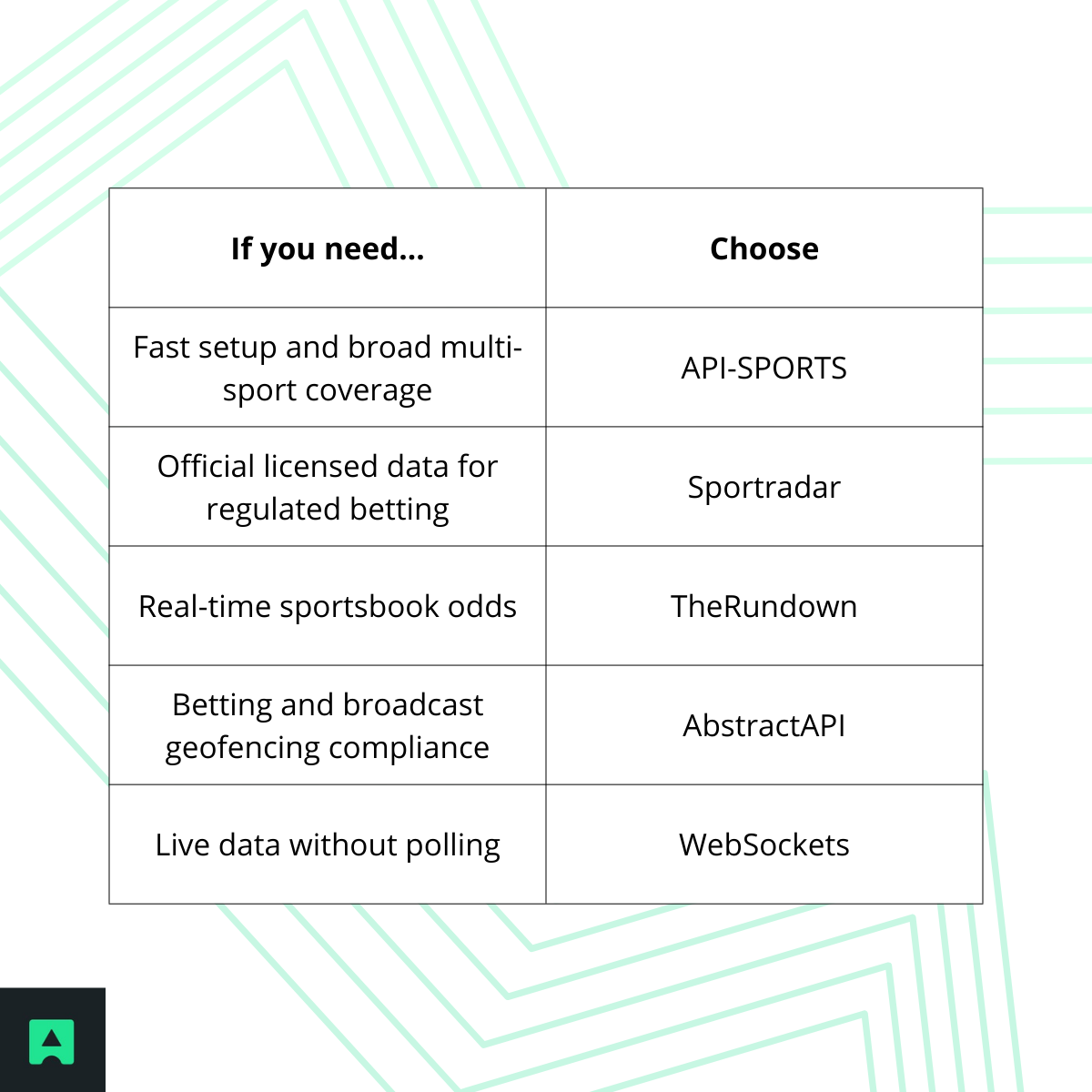
Quick Selection Guide
The best sports APIs for developers are the ones that match your latency requirements, data depth, and legal obligations.
What is a sports API and what can developers build with it?
A sports API provides structured access to sports data (live scores, player stats, odds, fixtures, and historical results) via HTTP endpoints or WebSocket feeds. Developers use them to build live score apps, fantasy sports platforms, betting dashboards, and fan engagement tools without scraping or maintaining their own data pipelines.
Which sports API is best for indie developers and startups?
API-SPORTS is widely recommended for indie developers and startups because it covers football, NBA, F1, MLB, and more, offers a generous free tier, and can be integrated in around 15 minutes. It supports both REST endpoints and WebSocket feeds, making it practical for prototypes and production apps alike.
When should I use WebSocket feeds instead of REST polling for sports data?
REST polling works fine for hobby projects and low-frequency updates, but it introduces latency that is unacceptable for live betting or real-time score apps. WebSocket feeds push updates as events happen, achieving the millisecond-level delivery that production betting platforms require. If your app depends on in-play data or line movement, use a provider that offers native WebSocket or streaming feeds.
What is the difference between licensed sports data and scouted data?
Licensed data comes directly from official league sources: it is the authoritative feed used by regulated sportsbooks and broadcasters. Scouted data is collected independently by third parties and tends to cost less, but may lag official feeds by seconds or contain occasional gaps. For regulated betting applications, licensed data from providers like Sportradar is typically required by law.
How do geofencing and compliance requirements affect sports API usage?
Betting and broadcast rights are jurisdiction-specific, so apps serving those markets must enforce location-based access controls. This means checking a user's location at request time (for example, using an IP geolocation service) and blocking or redirecting access where your data license does not apply. Scraping odds or match data to bypass these restrictions is both unreliable and often illegal.
What are the limitations of free sports APIs?
Free tiers from providers like API-SPORTS and TheSportsDB are suitable for prototypes and fan projects, but they come with rate limits that surface quickly under real user traffic. Free crowd-sourced options like TheSportsDB also lack the granularity (possession chains, shot maps, player heatmaps) that competitive products need. For anything beyond a demo, budgeting for a paid plan is usually necessary.