
Preventing AI Hallucinations: Enriching RAG Pipelines with Real-Time Geo Data

Large Language Models (LLMs) are remarkably good at generating fluent, confident answers. But that confidence often hides a fundamental weakness: they lack real-world context.
Ask an AI assistant, "Is the store open right now?"
Or, Ask an AI assistant, "Is the store open right now?"
Without knowing where the user is — or even when — the model is forced to guess. Sometimes it produces a generic answer. Other times, it confidently delivers something that's completely wrong. This is one of the most common causes of AI hallucinations in production systems.
The problem isn't the model itself.
It's the context gap.
In this article, we'll explore how Retrieval-Augmented Generation (RAG) pipelines can be significantly improved by injecting real-time geolocation data. We'll focus on IP-based geolocation as a grounding layer, and show how the Abstract IP Geolocation API fits naturally into modern LLM architectures built with tools like LangChain, vector databases, and Python-based inference stacks.
The Context Gap in Modern AI Systems
LLMs are frozen in both time and space.
Even the most advanced models don't know:
- Where the user is located
- What timezone they're in
- Which laws, regulations, or logistics apply locally
Unless that information is explicitly provided, the model can only infer — and inference without constraints is exactly where hallucinations emerge.
This limitation becomes especially risky in:
- Customer support chatbots
- Legal or compliance assistants
- E-commerce recommendation engines
- Autonomous AI agents interacting with real users
Context-aware RAG addresses this by enriching the pipeline before retrieval or generation happens. Instead of asking the model to guess, we provide it with ground truth — such as city, country, and timezone — so it can reason accurately.
Geolocation is one of the most reliable and lowest-friction ways to achieve this grounding.
Why Geolocation Reduces Hallucinations
Grounding as a Guardrail 🧱
In AI system design, grounding means anchoring model outputs to verifiable, external reality.
By injecting structured location data — city, region, country, timezone — into the system prompt or the retrieval layer, we constrain the model's reasoning space. This acts as a guardrail against implausible or irrelevant answers.
For example:
- Business hours depend on timezone
- Legal advice depends on jurisdiction
- Shipping and tax rules vary by country and state
Without location context, hallucinations aren't just possible — they're statistically likely.
Disambiguation at Scale
Geolocation also solves ambiguity problems that pure semantic search can't handle:
- Paris, France vs. Paris, Texas
- Employment law in California vs. New York
- VAT rules in the EU vs. U.S. sales tax
Advanced RAG pipelines discussed by search and observability platforms increasingly emphasize metadata-driven retrieval. AbstractAPI provides this metadata in milliseconds, making it feasible to inject before LLM inference without hurting Time to First Token (TTFT).
Strategy 1: Prompt Injection (The Easy Fix)
Best for: General chatbots, customer support assistants, internal productivity tools.
How It Works
- Detect the user's IP address
- Resolve it to a precise geographic location
- Inject that information into the system prompt
This approach doesn't require changes to your vector database or retriever logic. You simply give the model better instructions.
Example System Prompt
- You are a helpful assistant. The user is currently located in Berlin, Germany (Timezone: CET). Answer all questions using information relevant to this region.
Even this minimal context dramatically improves answers related to:
- Opening hours
- Local currencies
- Regional regulations
- Product or service availability
Fetching Location Data with AbstractAPI (Python)
The Abstract IP Geolocation API is purpose-built for fast, real-time enrichment and is commonly used as a pre-LLM context layer.
import requests
def get_user_location(ip_address: str) -> dict:
response = requests.get(
"https://ipgeolocation.abstractapi.com/v1/",
params={
"api_key": "YOUR_ABSTRACT_API_KEY",
"ip_address": ip_address
},
timeout=1
)
response.raise_for_status()
return response.json()
This request typically completes in under 100 ms globally, which is critical for conversational systems. As discussed in Abstract's guide on API rate limits and performance, latency directly impacts perceived responsiveness and user trust.
👉 Related: Abstract IP Geolocation API
Strategy 2: Vector Database Metadata Filtering
Best for: Legal tech, real estate platforms, compliance systems, AI-powered search engines.
The Core Idea
Instead of letting the LLM see all documents, you filter them before retrieval using location metadata.
This ensures the model never even processes irrelevant content.
Hybrid Search in RAG Pipelines
Modern RAG systems increasingly rely on hybrid search:
- Semantic similarity via vector embeddings
- Structured filters via metadata
Instead of querying globally for "shipping laws", you query:
- "shipping laws"
- AND country = "US"
- AND state = "CA"
This significantly improves precision and dramatically reduces hallucinated legal or regulatory advice.
Conceptual LangChain Example
# Conceptual example
retriever.get_relevant_documents(
query,
search_kwargs={
"filter": {
"country_code": user_location["country_code"]
}
}
)
LangChain's metadata filtering and self-querying retrievers make this pattern easy to implement with vector stores like Pinecone, ChromaDB, or pgvector.
Implementation Tutorial: Python + AbstractAPI 🧑💻
Let's walk through a simplified end-to-end flow.
Step 1: Install Dependencies
pip install requests langchain openai
Step 2: Fetch User Context
def get_user_context(ip_address: str) -> dict:
data = get_user_location(ip_address)
return {
"city": data.get("city"),
"country": data.get("country"),
"country_code": data.get("country_code"),
"timezone": data.get("timezone", {}).get("name")
}
Latency is critical here.
The IP lookup happens before LLM inference, so it must be fast. AbstractAPI is optimized for low-latency global responses, making it suitable for real-time AI agents.
Step 3: Inject Context into the RAG Chain
At this point, you can:
- Add location data to the system prompt
- Use it as metadata for vector retrieval
- Or combine both approaches
This flexibility is what makes geolocation such a powerful grounding layer in RAG architectures.
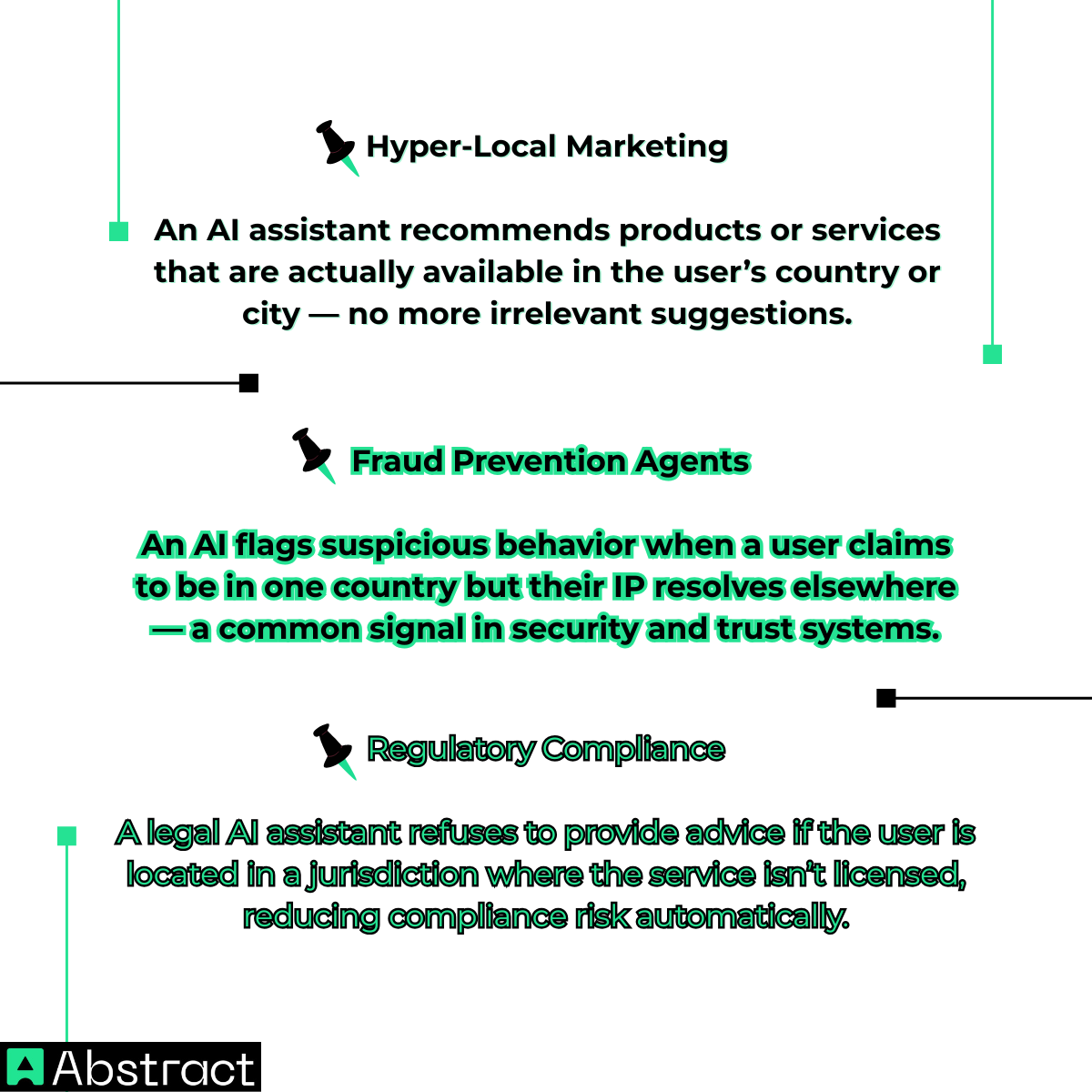
Real-World Use Cases
Conclusion: Grounding Turns RAG into Intelligence
RAG without context is essentially a smarter search engine.
RAG with context becomes an intelligent, reliable agent.
By enriching your pipeline with real-time geolocation data, you:
- Reduce hallucinations
- Improve relevance
- Enforce regulatory boundaries
- Increase user trust
The Abstract IP Geolocation API provides a fast, developer-friendly way to add this grounding layer — without sacrificing latency or architectural simplicity.
👉 Don't let your AI guess. Ground it in reality.
Get started with a free API key from Abstract and build context-aware AI systems that understand not just what users ask — but where they are.
Frequently Asked Questions
What does it mean to enrich a RAG pipeline with geo data?
Geo enrichment means injecting real-time location context (such as a user's country, region, or timezone) into your RAG pipeline so the model retrieves and generates responses relevant to that user's actual situation. Without this, an LLM has no awareness of where a user is, which can lead to legally or geographically incorrect answers.
Why does adding location context reduce AI hallucinations?
Hallucinations often happen because the model lacks grounding in verifiable, real-world facts. When you anchor retrieval to structured location metadata (filtering documents by country or jurisdiction before generation), the model works from a narrower, more accurate set of sources rather than guessing from broad training data.
What is the difference between prompt injection and vector database filtering for geo context?
Prompt injection appends location details (country, timezone, state) directly into the system prompt before calling the model (it is simple to implement and typically adds around 100ms of latency). Vector database filtering is a pre-retrieval step that uses geographic metadata stored alongside embeddings to constrain which documents are even considered, giving more precise results for large knowledge bases.
How do you get a user's location to use in a RAG pipeline?
The most reliable approach for server-side pipelines is to resolve the user's IP address against an IP geolocation API, such as Abstract's IP Geolocation API, which returns country, region, city, and timezone in a single request. This works without requiring any browser permissions and fits naturally into the request handling layer before retrieval begins.
What happens if you run a RAG pipeline without any location or user context?
A RAG pipeline without context behaves like a smarter search engine, retrieving semantically relevant documents but with no way to filter out results that are irrelevant to the user's jurisdiction, language, or local regulations. The result is responses that may be accurate in general but wrong for a specific user's situation.
Which vector databases support geographic metadata filtering?
Pinecone, ChromaDB, and pgvector all support structured metadata filters that can be applied at query time, including fields like country or region. You store the geographic metadata alongside each document's embedding at index time, then pass filter conditions when querying so only geographically relevant chunks are retrieved before the generation step.
CEO at Abstract API

