



Core Features
Let's take a look at the pivotal components that make each tool worth considering.
Neverbounce
Neverbounce's suite of features can be broadly categorized into three main pillars: bulk email validation, real-time verification, and automated list cleaning. Each pillar offers a rich set of features designed to clean email lists effectively.
Bulk Cleaning
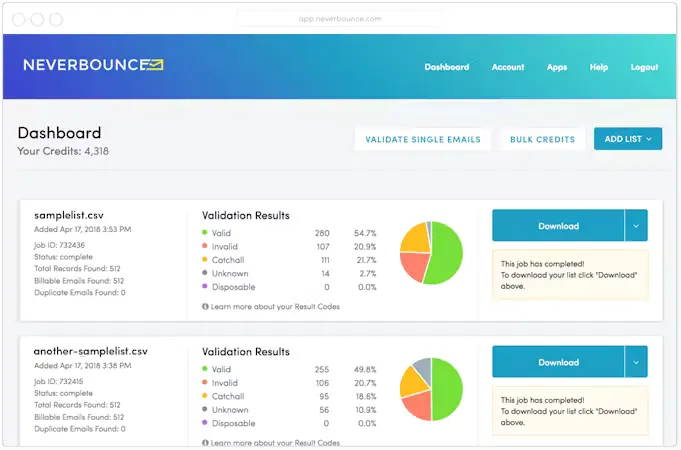
Neverbounce offers two ways to manage bulk list cleaning: via a dashboard on their website, or via the API. The dashboard is clean, intuitive, and simple to use, offering a drag-and-drop interface or file uploader. You can also easily integrate other SAAS email marketing platforms like Mailchimp and Mailerlite to import lists from there.
Real-Time Validation
The real-time validator is implemented in four ways: through a dashboard, through the API, through a Zapier integration, or by a Javascript widget. That makes it very easy to incorporate real-time validation into your app, or to do painless verification anytime an email makes its way onto your list.
Automated List Cleaning
Simply connect your email marketing service provider and select your options for easy, automated list cleaning on a schedule. Fully comprehensive email verification is run every day against your list, so you can have the confidence that any time you press send, your list is up to date.
These implementations gives you access to the following set of features:
- Bounce detection: Identify hard and soft bounces for actionable insights.
- Disposable email detection: Flag disposable or temporary email addresses.
- Spam trap detection: Prevent emails from being flagged as spam by avoiding known traps and catch-all email addresses.
- Syntax and format checks: Ensure emails follow the correct structure.
- Domain health checks: Assess the overall health of sender domains.
Zerobounce
Zerobounce also offers an array of email list cleaning features designed to maintain healthy email lists. Zerobounce breaks their offerings down into the following categories: email validation, email finder, email activity data, email score, email testing tools, blacklist monitor.
Email Validation
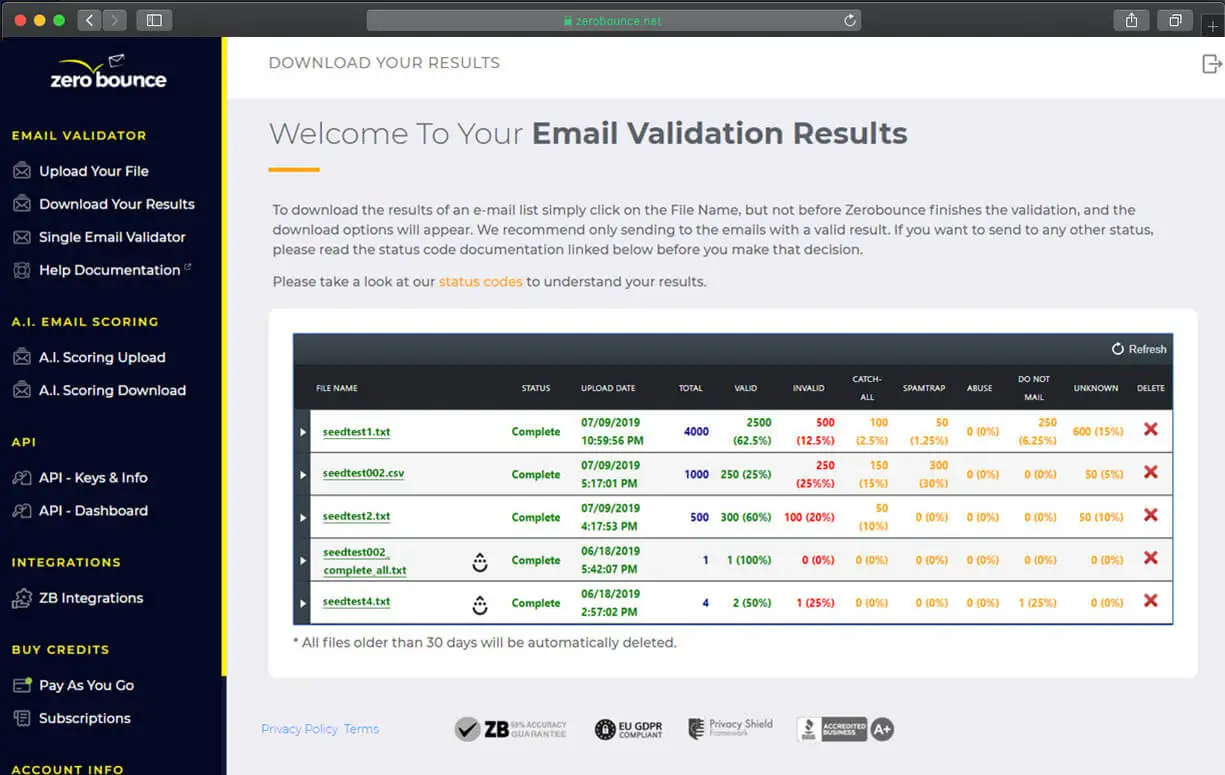
Similar to Neverbounce, Zerobounce offers an email verifier for bulk lists, real-time, and through an API. They also have an automated list cleaning option that will check the validity and email deliverability of the addresses in your list every day.
Email Finder
Zerobounce offers data enhancement by allowing you to look up email addresses for contacts within an organization, gather details about their IP address, determine the likely gender of the email owner, or fill in gaps in your existing data.
Blacklist Monitor
Make sure your sender address never ends up on an email blacklist. Zerobounce will conduct daily scans of all known blacklists and alert you if your address has been found on any of them. This helps protect your sender reputation and email deliverability score.
Email Testing
Find out how many of your emails will actually make it to users' inboxes, and make sure your own email server is configured correctly with Zerobounce's inbox testing and deliverability testing tools.
To sum up, Zerobounce gives you access to the following features:
- Email scoring: Assign a quality score to email addresses to gauge their value.
- Abuse and fraud detection: Detect potential threats and email abuse.
- IP information: Gather details about the sender's IP address.
- Gender information: Determine the likely gender of the email owner.
- Social append: Add social media profiles to email contacts.
- GDPR compliance tools: Ensure data privacy and compliance.
Bottom line: Both platforms provide a robust set of features, but Zerobounce's additional services such as email scoring, abuse detection, and social append can be advantageous for businesses seeking comprehensive email data enrichment.
Pricing Comparison
Rates below were checked in September 2026. Both vendors change their pricing more often than articles like this one get updated, so treat these as a starting point and confirm on the vendor's own page before you buy.
Neverbounce
Neverbounce sells credits, with no card needed to verify your first list.
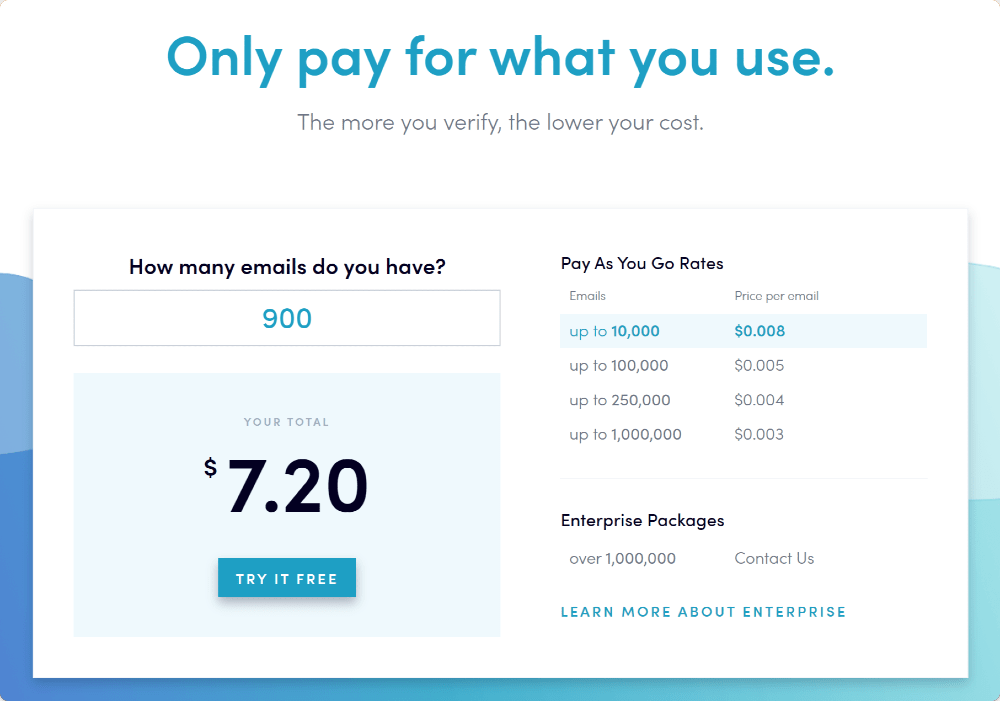
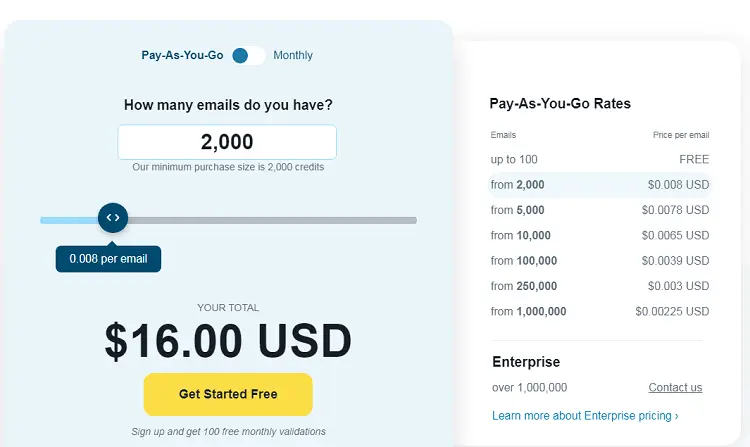
- Pay as you go: $8 per 1,000 credits, which is $0.008 an address, with no commitment and up to 10 lists cleaned at once.
- Growth: $49 a month for up to 10,000 addresses, adding AI scoring and an automatic sync with your CRM. On that plan you pay only for new, unique addresses, so duplicates cost nothing.
- Enterprise: custom pricing, which Neverbounce says is typically for 250,000 or more addresses a month.
One term is easy to miss and worth planning around: Neverbounce credits expire 12 months after purchase. Buying a large block at the cheaper rate only saves money if you use it inside the year. Current rates are on Neverbounce's pricing page.
Zerobounce
Zerobounce also sells credits, across a free tier, pay as you go, and a bundled monthly plan.
- Free: 100 validation credits, refilling every month, no card required.
- Pay as you go: from $39 for 2,000 addresses, which is the minimum purchase and works out at about $19.50 per 1,000 at that entry point.
- Zerobounce ONE: from $99 a month, minimum 10,000 credits, bundling validation with inbox placement tests, blacklist monitoring and DMARC monitoring.
Two terms are worth knowing, and both run the opposite way to Neverbounce. Zerobounce credits do not expire, and addresses that come back as unknown are not charged. Figures are from Zerobounce's pricing page.
Bottom line: At the entry point Neverbounce is much cheaper per address, $8 per 1,000 against about $19.50 per 1,000 for Zerobounce's minimum purchase. The difference narrows once you account for the terms. Zerobounce credits never expire and unknown results are free, while Neverbounce credits expire after 12 months. If you clean lists in bursts with long gaps between them, work out the cost on what you will actually use inside a year rather than on the headline rate.
Accuracy and Validation Process
Email validation accuracy is paramount in ensuring the success of your email campaigns.
Neverbounce
Neverbounce boasts an accuracy rate of over 98%. They utilize multiple validation methods, including SMTP checks and MX record lookups, to verify email addresses. Real-time verification ensures that only valid email addresses are accepted during data entry.
Zerobounce
Zerobounce advertises 99.6% validation accuracy. Their validation process includes domain checks, syntax verification, and SMTP authentication. Email scoring is an additional feature that helps gauge the quality of email addresses.
Bottom line: Treat both figures as vendor claims rather than measurements. Each is calculated on the vendor's own test set, and neither publishes the list, so the number that matters is how each performs on your addresses. Both let you test before you buy, which is the only way to find out.

Integrations and Compatibility
The need to integrate with other SAAS platforms might be a deciding factor for businesses utilizing a lot of online tools. Let's look at how Neverbounce and Zerobounce handle integrations.
Neverbounce
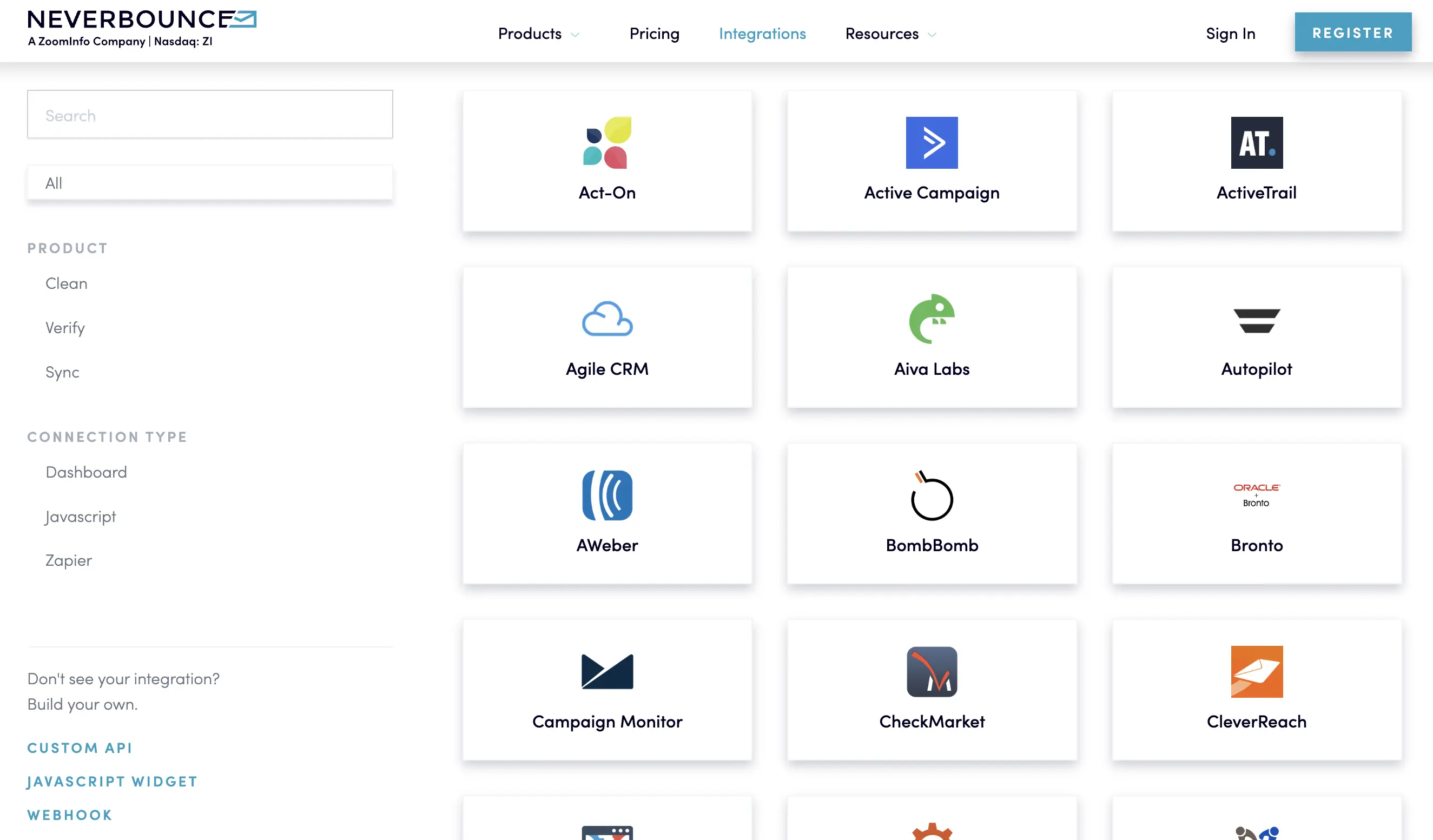
Neverbounce provides integrations with popular email marketing platforms such as Mailchimp, HubSpot, Marketo, Shopify, WordPress, Excel, and nearly 100 other services. They also offer a developer-friendly API for custom integrations. Integration options are generally robust and user-friendly.
Zerobounce
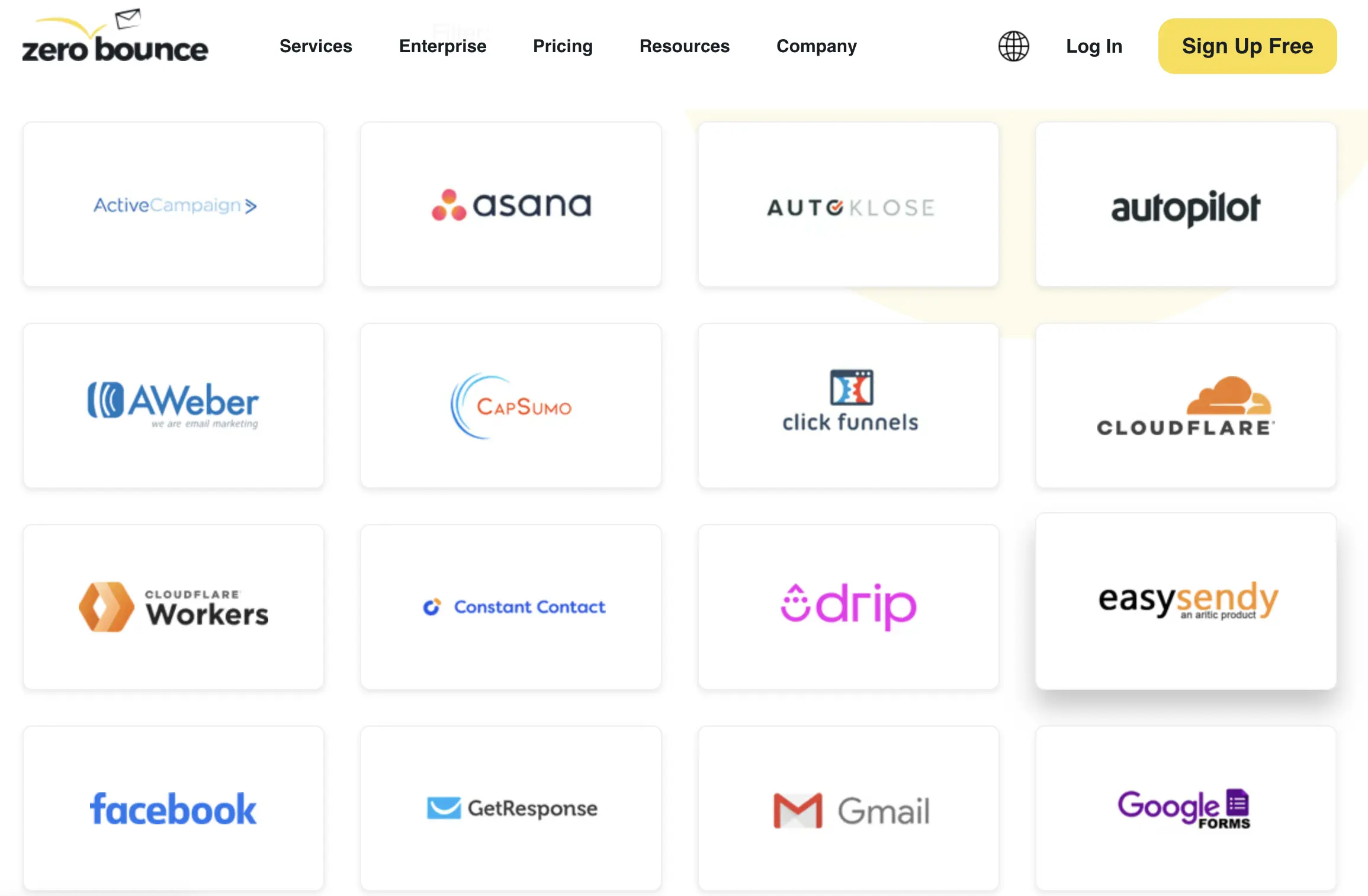
Zerobounce offers integrations with a wide range of platforms, including Salesforce, Shopify, WordPress, and around 50 other platforms. They provide detailed documentation for developers looking to integrate their API. Zerobounce's extensive integration options make it adaptable to various marketing ecosystems.
Bottom line: The ease of integration and compatibility largely depends on your existing tech stack, but both platforms offer ample options for integration. Neverbounce offers a few more integrations, but both integrate with the popular and in-demand SAAS platforms you are likely to be using.
Customer Feedback and Reviews
Neverbounce
Customer feedback for Neverbounce is generally positive, with users praising its accuracy and ease of use. However, some have mentioned concerns about pricing for high-volume usage. Customer support has received mixed reviews, with some users reporting slower response times.
Here are a few examples, pulled from G2:
Appreciate that NeverBounce allows me to upload a list and do a free check before paying for a cleansing. I also love that they provide source data for the email domain so we can see if the email is hosted via a large provider like Google or Microsoft.
The point system for payments is a credit system and a bit confusing. I wish they'd have a cost per record and skip the credit system altogether. I just want to know how many records I can clean.
I think the prices are high and just like any other email verification services out there, the accuracy is good but not perfect just like all the others.
Zerobounce
Zerobounce also enjoys positive feedback regarding accuracy and features. Users appreciate the email scoring and abuse detection capabilities. However, there have been occasional reports of false positives in their validation results. Customer support is generally well-received, with prompt responses noted by many users.
The platform is super user-friendly. You get to perform the task with just a few clicks. The support group is great and they offer bonus credits too! Integrations and API availability are also a huge plus!
There is no option to download a direct csv file with the result of your choice. I like that they proactively group them per result type but downloading the result in a zip file takes more time and effort.
The only thing I dislike about ZeroBounce is the need to purchase credits ahead of time. I want to be able to upload the contact list and be presented with the cost of cleaning the list.
Bottom line: Both platforms receive both positive and negative feedback from users. It's important to consider the specific needs and expectations of your business when evaluating customer feedback.
Unique Selling Points (USPs)
Neverbounce
Neverbounce's unique selling points include a user-friendly interface and an emphasis on real-time verification. They also offer a white-label solution for agencies, allowing them to provide email validation services under their own branding. Name-recognition is also a selling point for this service, as they are one of the most trusted email checker solutions around according to agency reviews.
Zerobounce
Zerobounce stands out with its email scoring feature, which can help businesses prioritize and segment email lists effectively. They also offer data enrichment and analysis tools that Neverbounce does not. Additionally, their GDPR compliance tools are a valuable asset for companies operating in Europe.
Bottom line: Both platforms have their unique strengths, and the choice between them will depend on your specific requirements. Businesses seeking data enrichment tools in addition to email validation may be better off going with Zerobounce.
Why Abstract's Email Validation Stands Out
While Neverbounce and Zerobounce are reputable options, it's worth considering an alternative if their features are overkill for what you need, or the price point is too high. One such alternative is Abstract's Email Validation.

Abstract
Abstract differentiates itself through:
- The checks it runs: SMTP, MX record lookups, domain verification and syntax validation on every request.
- Competitive pricing: plans from $17 a month, billed annually.
- Ease of integration: one request returns the full result, with documentation and code samples.
- Compatibility: a REST endpoint that fits any stack, plus a bulk CSV uploader.
Ease of Use
Creating an account gives you 100 free requests with no card, granted once, which is enough to test the service against a sample of your own addresses before you commit to a plan.
Just sign up for a free account with your email and a password, and you'll gain an API key that gives you access to the API endpoint for real-time validation. There is also a bulk email uploader that accepts a CSV file and sends an email containing a results file.
Pricing
Abstract prices Email Validation by requests rather than by list size. Creating an account gives you 100 free requests, granted once rather than refilling each month, so treat it as a trial rather than an ongoing free tier. Paid plans are billed annually and start at $17 a month on Starter, with allowances from 60,000 to 1,800,000 requests a year. Standard is $32 a month and Professional is $36 a month, each adding more of the sender, domain and risk data to the response. Current plans are on the Email Validation API page.
Customer Reviews
Feedback from customers about Abstract is mostly positive, with a few complaints about customer service.
Love the simplicity and the pre-built code snippets.
Lots of beneficial tools here that every maker should be bookmarking and using.
More than 40% of emails are still bouncing after verification and charged me for 3 Months even after I don't want to use their service.
Bottom line: Abstract is worth a look if you want the core checks over a single request at a lower price point, and can do without the extras the other two bundle.
Support and Customer Service
Both Neverbounce and Zerobounce offer support through various channels, including email, chat, and phone. Response times may vary depending on the nature of the inquiry and the chosen support plan.
Tools compared side by side
Every figure below was taken from each vendor's own pricing page in September 2026. Accuracy is deliberately left out, because each vendor calculates it on a test set it does not publish, which makes the numbers impossible to compare.
| Neverbounce | Zerobounce | Abstract | |
|---|---|---|---|
| Free to start | Your first list, no card | 100 credits a month, no card | 100 requests at signup, one time, no card |
| Pay as you go | $8 per 1,000 addresses | From $39 for 2,000, about $19.50 per 1,000 | Plans only |
| Cheapest paid plan | $49 a month, up to 10,000 | $99 a month, minimum 10,000 credits | $17 a month, billed annually |
| Do credits expire | Yes, 12 months after purchase | No | Allowance runs for the year |
| Unknown results charged | Not stated | No | Not stated |
| Largest published tier | Custom, typically 250,000+ a month | Contact sales above 1,000,000 credits | 1,800,000 requests a year |
| Billing unit | Credits, bought in blocks | Credits, bought in blocks | Requests, allowance per year |
The row that decides most of it is credit expiry. Neverbounce is less than half the price per address at the entry point, but that only holds if you spend the block inside twelve months. If you clean in bursts with long gaps, Zerobounce's credits keep their value and its unknown results cost nothing. Note that only Zerobounce refills its free credits each month: Neverbounce covers your first list and Abstract grants its 100 requests once.
Conclusion
Both Neverbounce and Zerobounce are reliable email validation platforms with their own unique features and strengths. The choice between them will come down to your specific business needs, budget constraints, and preferences.
Given Zerobounce's more comprehensive suite of additional tools (including data enrichment, user analysis, email scoring and testing, and abuse detection, they may be a slightly better alternative for companies needing more than just email validation for their marketing lists.
Abstract's Email Validation is a viable alternative for businesses looking for a cheaper option with fewer features. With competitive pricing, straightforward integration and 100 free requests to test with when you create an account, it is worth evaluating alongside the other two.
Ultimately, your decision should be based on a careful assessment of your requirements and the features that align most closely with your goals.
Frequently Asked Questions
What is the main difference between ZeroBounce and NeverBounce?
NeverBounce focuses on fast, conservative bulk list cleaning with a straightforward pass/fail result, making it well-suited for teams that want quick batch processing without extra complexity. ZeroBounce goes further by adding features like email scoring, data enrichment, abuse detection, and inbox placement testing, making it a more complete deliverability platform rather than a pure verifier.
Which tool is more accurate: ZeroBounce or NeverBounce?
ZeroBounce advertises 99.6% validation accuracy and NeverBounce claims over 98%. Treat both as vendor claims rather than measurements: each is calculated on the vendor's own test set, and neither publishes the list. The figure that matters is how each one handles your addresses, which is why both let you test before you buy.
How does pricing compare between ZeroBounce and NeverBounce?
As of September 2026, NeverBounce charges $8 per 1,000 addresses on pay as you go, or $49 a month on Growth for up to 10,000. ZeroBounce gives 100 free credits a month, and its pay as you go starts at $39 for 2,000 addresses, its minimum purchase. NeverBounce is cheaper per address at the entry point, but its credits expire 12 months after purchase while ZeroBounce credits do not expire and unknown results are not charged.
When should I choose NeverBounce over ZeroBounce?
Choose NeverBounce when you clean large lists regularly and will use the credits inside a year, since that is where its $8 per 1,000 rate wins. Its Growth plan also charges only for new, unique addresses on an automatic CRM sync, so duplicates cost nothing, which suits teams re-cleaning the same list as it grows.
How do I integrate either service into my application via API?
Both ZeroBounce and NeverBounce offer RESTful APIs for real-time single-address validation as well as bulk upload endpoints that accept CSV files. Both provide code examples and documentation to help developers get started. Real-time requests return a validation result synchronously, making them suitable for validating emails at point of entry in signup forms or CRM integrations.
Is there a good alternative to ZeroBounce and NeverBounce for developers on a budget?
Abstract is one alternative worth considering. Creating an account gives you 100 free requests with no card, granted once rather than monthly, and paid plans start at $17 a month billed annually. It runs the same core checks, SMTP, MX records, domain and syntax, behind a single request. The trade-off is that it lacks the extras ZeroBounce bundles, such as email scoring, data enrichment and inbox placement testing.
What is the best email validation tool?
The best email validation tool will come down to your specific needs and budget constraints. Some of the top tools to consider for evaluation include:
- Abstract
- ZeroBounce
- Neverbounce
- GetEmail.io
- DeBounce
- MyEmailVerifier
- Pabbly Email Verification
- mailfloss
