


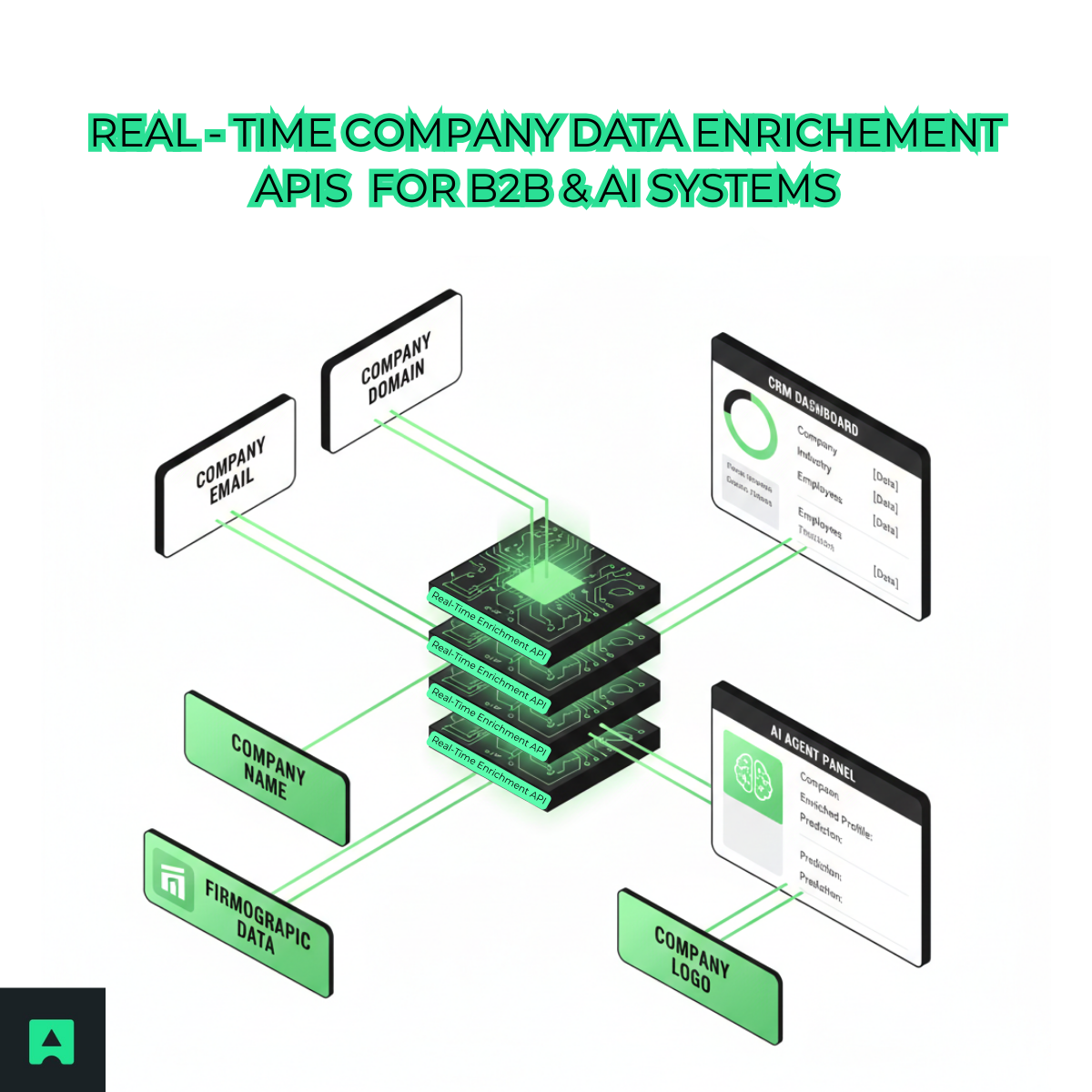
What "Best Data Enrichment APIs" Means in 2026
The phrase Best Data Enrichment APIs used to mean "who has the biggest contact database." That definition is outdated.
Today, the best data enrichment tools are measured by:
- Real-time data freshness
- Company level firmographic coverage
- AI readiness and structured outputs
- Waterfall compatibility across vendors
- Developer friendly API design
- Compliance with GDPR and CCPA
The most important shift is that enrichment now feeds AI agents and automated decision systems, not just CRM records.
Why Use Enrichment? Business and Technical Perspective
What Is B2B Data Enrichment?
B2B data enrichment means improving incomplete records with firmographic and contact context such as company size, industry, location, and logo. This is crucial for sales, marketing, and AI tasks where richer profiles improve decision accuracy.
B2B data enrichment today is less about list building and more about context building for automation and AI-driven decisions.
Real-Time vs Database-Driven Enrichment
There are two patterns:
- Real-Time Enrichment API delivers fresh data at the moment a lead arrives (e.g., during sign-up). It's ideal for form auto-fill, dynamic scoring, and feed into AI systems.
- Database-Driven Tools fetch from internal snapshots that may be refreshed periodically (monthly or quarterly). These are common in large systems like ZoomInfo but can lag for AI Agents because the data may be stale.
Modern lead pipelines often mix both patterns: use a real-time enrichment API first; if it fails to match, waterfall to a database source for coverage.
Benefits of Real-Time Lead Enrichment API
- Shorter forms and higher conversions through auto-fill
- Better lead scoring with instant firmographic context
- More accurate personalization in UI and outreach workflows
- Better inputs for AI agents and automated routing
- Immediate UX enhancement through company logo display
Real-time enrichment supports product workflows, not just CRM cleanup.
Compliance Matters
Compliance is non-negotiable. Always verify GDPR and CCPA alignment when selecting a provider. Modern developer-first APIs, including AbstractAPI, emphasize compliance as a core requirement rather than an afterthought.
Company Enrichment vs Contact Enrichment (Critical Difference)
This distinction is essential.
Company enrichment answers:
- Who is this company? Examples: industry, headcount, firmographics, logo, domain profile.
Contact enrichment answers:
- How do I reach this person? Examples: email address, phone number, job title.
Do not confuse the two. Many sales platforms focus on contact enrichment. Developer-focused enrichment APIs often specialize in company enrichment (firmographics), which is the correct layer for AI context and product UX.
The Waterfall Enrichment Model Explained
Waterfall enrichment means querying multiple providers in sequence until a match is found.
Example flow:
- Try Provider A real-time API
- If no match, try Provider B
- If still no match, query a large database provider
- Merge the best available fields
This model increases match rates and reduces blind spots. New aggregator platforms now orchestrate dozens of providers behind one workflow, making waterfall enrichment the default pattern for high coverage pipelines.
Migrating Off a Legacy Enrichment Vendor: Lessons Learned
Many teams first adopt a large enrichment database provider and only later see limitations when moving toward real-time and AI-driven workflows.
A common scenario is a B2B product team that relied on a legacy enrichment vendor with quarterly refresh cycles and contract-heavy pricing. The data worked for bulk prospecting, but problems appeared when they tried to power real-time signup enrichment and AI routing. Match rates were inconsistent for newer companies, API latency was too high for in-product calls, and per-request cost blocked experimentation.
The team migrated to a real-time company enrichment API combined with a waterfall enrichment strategy. Instead of calling one heavy provider every time, they queried a fast, developer-first API first and only fell back to larger databases when needed.
Key lessons from the migration:
- Real-time APIs fit product and AI workflows better than batch databases
- Usage-based pricing supports testing and iteration
- Waterfall enrichment improves coverage without vendor lock-in
- Developer-friendly APIs reduce integration time
- Separating company enrichment from contact enrichment simplifies architecture
Migration is usually not just a vendor change. It is a shift from static data thinking to real-time enrichment design.
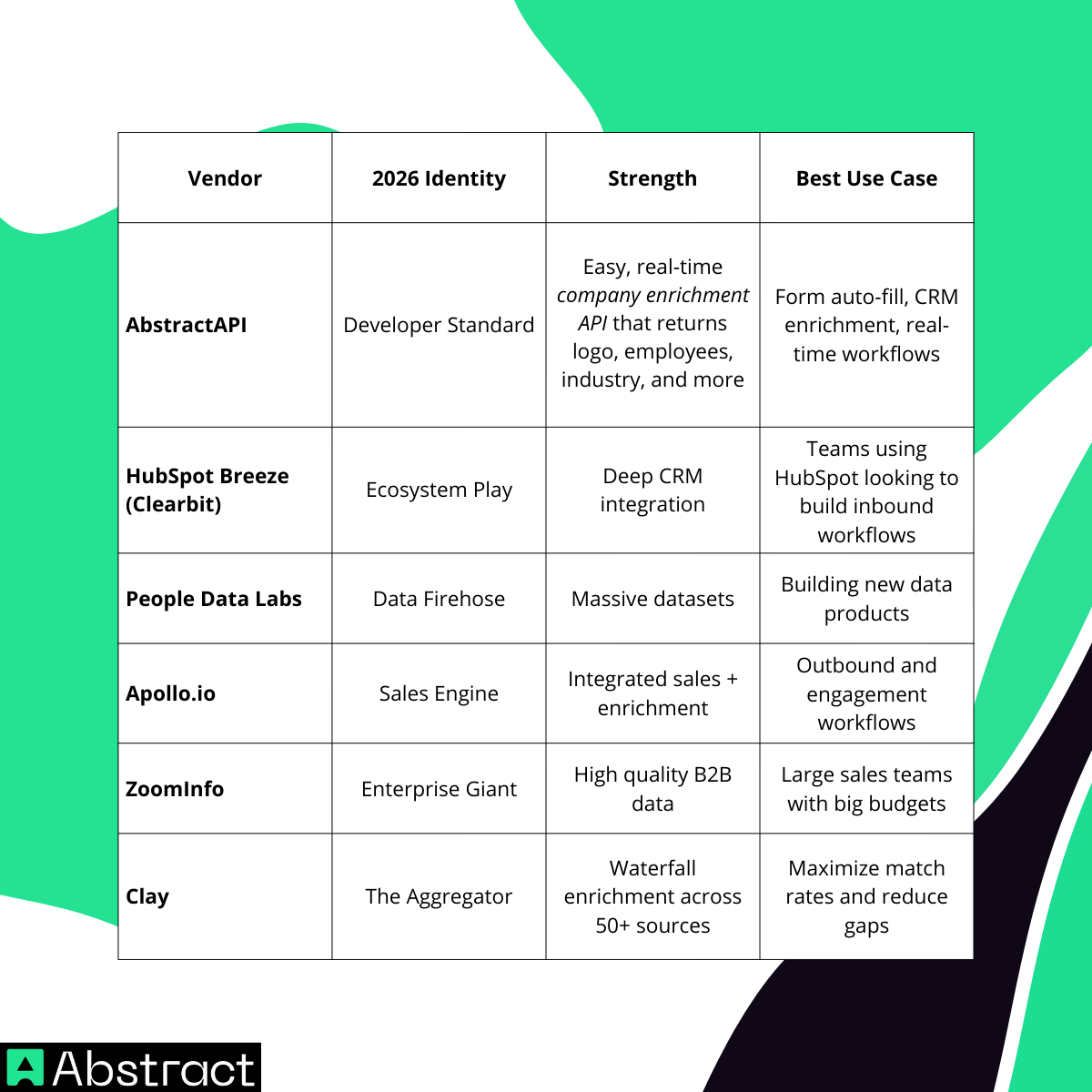
The Big 6 Data Enrichment APIs and Tools
Here's how the most relevant providers stack up:
What Crustdata Offers
Crustdata is a real-time B2B data provider built around one idea: query the data when you need it instead of storing it in a database that slowly goes stale. Requests pull live company and people data, so a lookup reflects what an account looks like today, not at the last refresh cycle.
Coverage centers on the signals that change fastest:
- Firmographics: industry, size, location, and company identifiers
- Headcount movements: hiring trends and team growth by function
- Web traffic and growth signals: how fast an account is actually expanding
- People data: profiles and role changes for contacts at target accounts
In a waterfall enrichment setup, that freshness makes Crustdata a strong first stop: query it for current signals, then fall back to larger databases for long-tail coverage. The trade-off is the usual one for request-time providers: you gain accuracy on fast-moving accounts and give up some of the raw breadth a decade-old database offers, which is exactly why the two work better in sequence than in competition.
Comparison: Clearbit Alternative Options and ZoomInfo API Pricing
When comparing the Best Data Enrichment APIs, pricing and capabilities matter more than raw database size. Some tools optimize for real-time API enrichment and lightweight integration. Others focus on bundled enterprise platforms.
ZoomInfo API pricing typically starts at enterprise contract levels, which makes it less flexible for startups. Clearbit alternative searches are increasing because Breeze Intelligence is now tightly tied to HubSpot credits and packaging.
In contrast, a free data enrichment API tier or startup data enrichment tools with trial credits allow early teams to validate enrichment without heavy upfront spend.
How to Implement a Company Enrichment API (Developer Tutorial)
This example shows a company enrichment API Python integration pattern for real-time form auto-fill.
import requests
api_key = "YOUR_ABSTRACT_API_KEY"
domain = "airbnb.com"
response = requests.get(
f"https://companyenrichment.abstractapi.com/v2/?api_key={api_key}&domain={domain}"
)
data = response.json()
company_name = data['name']
industry = data['industry']
employees = data['employees_count']
logo_url = data['logo']
print(f"New Lead: {company_name} ({industry}) - {employees} employees")
This pattern enriches based on domain, which is the 2026 standard. It can auto-fill CRM fields or UI components right after a user enters an email. The logo field is especially useful for dashboards and account views, and many large database vendors do not provide it reliably.
Sales Efficiency Gains from Real-Time Enrichment
Real-time company enrichment improves sales efficiency by:
- Reducing manual research
- Improving routing accuracy
- Enabling instant lead scoring
- Enriching accounts before first touch
- Giving AI agents better firmographic context
Teams that enrich at capture time spend less time cleaning data and more time acting on it.
Improve Conversions with Real-Time Company Enrichment
Tired of long, boring sign-up forms that make users drop off?
Use a real-time company enrichment API to auto-fill company details from just an email address or domain. With company enrichment, you can shorten forms, enrich records instantly, and boost conversion rates while improving downstream data quality. Developer-first options such as Abstract's company enrichment API make this straightforward with simple REST calls and predictable pricing.
Free and Startup-Friendly Enrichment Tools
If you are evaluating startup data enrichment tools or free tiers, consider:
- Trial credits from providers like Apollo.io
- Usage-based APIs with free starter plans
- Waterfall platforms that bundle multiple enrichment sources
- Developer-first APIs with no contract requirement
These options help smaller teams test enrichment strategies before committing to enterprise contracts.
Choosing the Best Data Enrichment API for Your Stack
- If you need lightweight, real-time enrichment: Choose a developer-first API that focuses on company firmographics.
- If you are enterprise with deep CRM integration: Enterprise platforms and Breeze (Clearbit within HubSpot) work well but may lock you into a larger ecosystem.
- If coverage is the priority: Waterfall enrichment platforms increase match rates by cascading across multiple services.
Every use case has trade-offs. Consider coverage, freshness of data, cost, and how easily you can integrate. A strategy that mixes real-time enrichment API calls with waterfall fallback sources often yields the best balance of accuracy and efficiency.
Frequently Asked Questions
What is the difference between real-time enrichment APIs and database-driven enrichment tools?
Real-time enrichment APIs return data on demand the moment a request is made, making them ideal for form auto-fill, AI pipelines, and instant lead routing. Database-driven tools rely on periodic data snapshots, which can work well for bulk CRM updates but may return stale records. Most modern pipelines combine both approaches to balance speed with coverage.
What is the difference between company enrichment and contact enrichment APIs?
Company enrichment returns firmographic data about an organization (such as industry, employee headcount, and revenue range) using a domain or company name as the lookup key. Contact enrichment focuses on reaching specific individuals via email or phone. Developer-focused APIs typically specialize in company-level data because it is more structured, consistent, and better suited to AI inputs and product interfaces.
What is waterfall enrichment and when should I use it?
Waterfall enrichment means querying multiple data providers in sequence: if Provider A returns no match, the request falls through to Provider B, and so on. This strategy maximizes match rates without creating hard dependency on a single vendor. It is especially useful when working with diverse lead sources where any one provider alone would leave significant gaps in coverage.
What criteria should I use to choose a data enrichment API?
The most important factors are data freshness, match rate, response latency, and cost structure. Match rate often matters more than raw speed: a fast API that misses 40% of records is less useful than a slower one with 85% coverage. For real-time product features like form auto-fill, aim for sub-200ms response times. Usage-based pricing models are generally better for experimentation than large enterprise contracts.
What are the main use cases for data enrichment APIs in a product or pipeline?
Common use cases include shortening signup forms by auto-filling company details from an email domain, improving lead scoring accuracy with firmographic context, personalizing onboarding flows with company logos or industry data, and routing inbound leads to the right sales rep automatically. Enrichment APIs also provide structured context that AI systems need to make reliable decisions without requiring users to enter it manually.
Why does AI readiness matter when evaluating a data enrichment API?
AI systems require clean, structured, and consistently formatted data to function reliably. An enrichment API with inconsistent schemas, missing fields, or stale records will degrade the quality of any downstream AI decision or generated output. Modern enrichment APIs are increasingly evaluated on structured JSON output quality and real-time freshness alongside traditional metrics like coverage and cost.
