


🔍 What Is Data Enrichment?
📌 Featured-Snippet Definition:
- Data enrichment is the process of enhancing existing data by adding valuable information from external sources to create a more complete, actionable dataset.
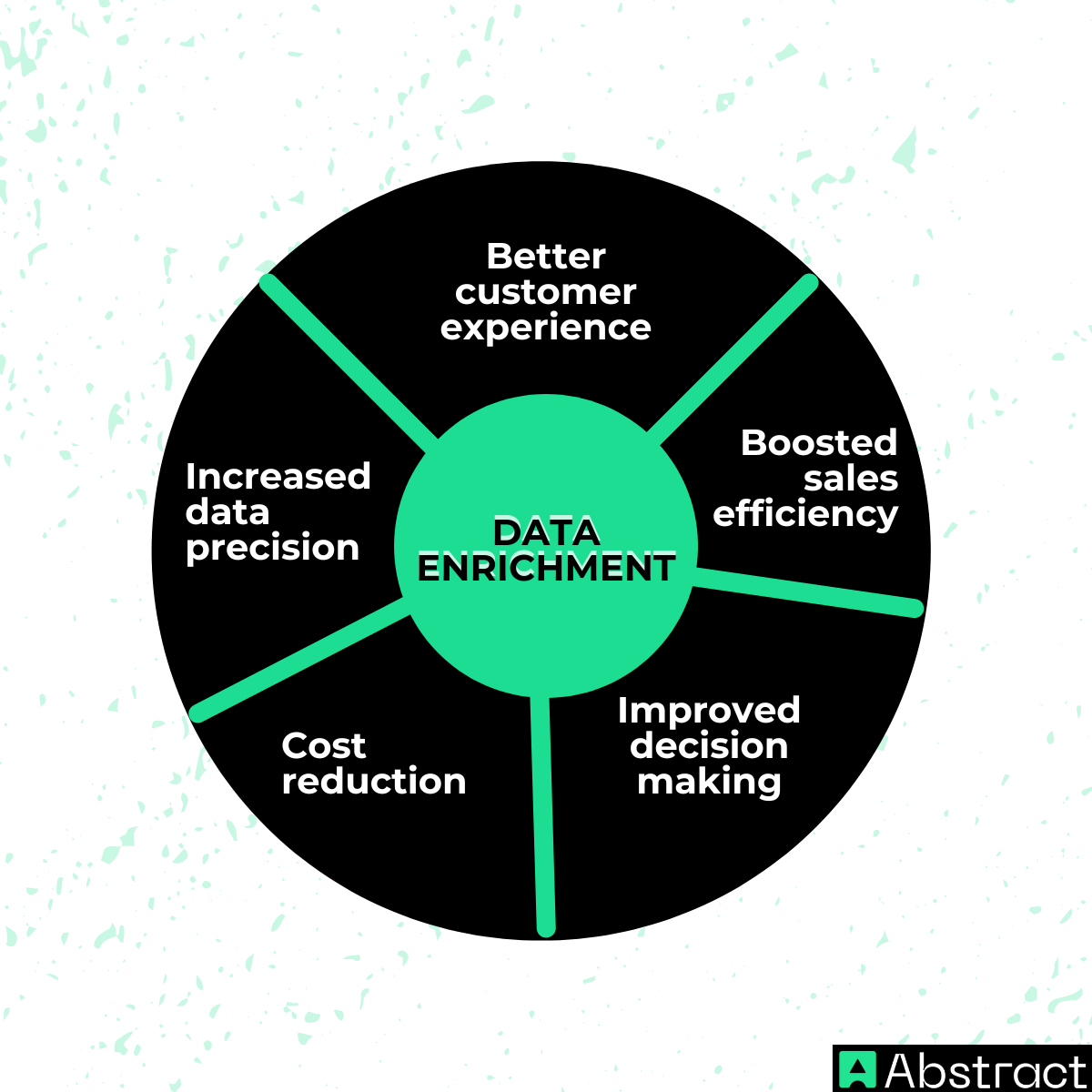
This could mean enriching a contact record with job title and company data, or appending firmographic attributes like company size, revenue, or industry classification to a business email.
Think of your CRM data as a puzzle. Without enrichment, you're working with just the corner pieces. Enrichment fills in the rest of the picture, giving teams across the business the visibility they need to act with confidence.
🔄 Data Enrichment vs. Data Enhancement
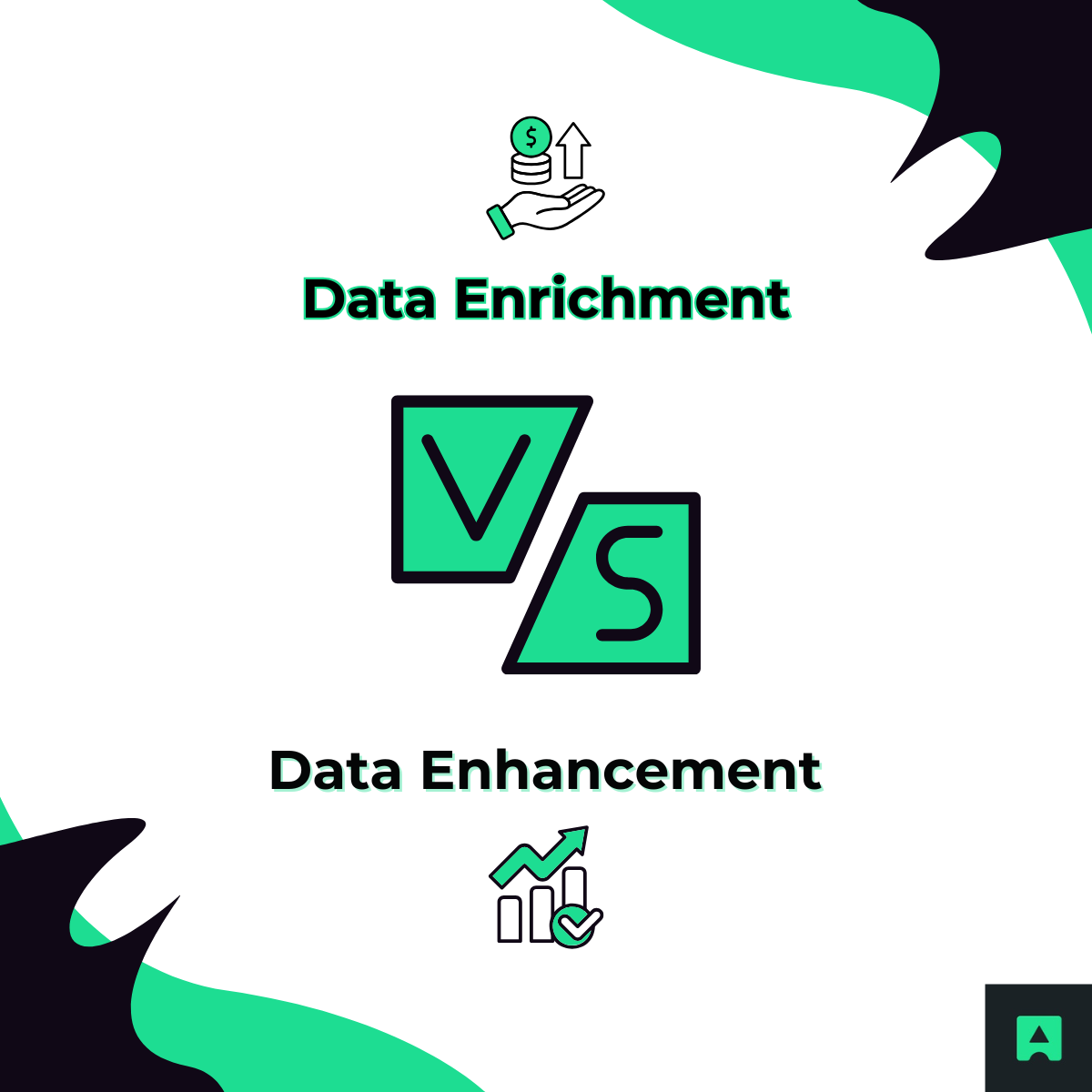
Although often treated as interchangeable, data enrichment and data enhancement serve different purposes within the broader scope of data optimization.
- Data enrichment refers specifically to adding new, related fields to your data using third-party sources. For instance, taking a company domain like cloudfin.io and appending attributes such as industry, LinkedIn profile, or employee count.
- Data enhancement is more holistic. It includes:
Cleansing: Fixing misspellings and formatting issues
Standardization: Applying consistent formats (e.g., country codes, phone numbers)
Validation: Ensuring emails are real, phone numbers exist, and companies are registered
Updating: Replacing outdated info (e.g., a company changed headquarters)
🧠 Analogy:
- Enrichment is like adding new toppings to a pizza 🍕
- Enhancement is like baking a better crust, using fresh ingredients, and cutting it evenly.
In practice, you'll often do both to ensure your data is accurate, complete, and useful across systems.
🧼 Data Quality vs. Data Enrichment
These concepts are deeply related but serve distinct functions:
- Data quality ensures the accuracy, consistency, and reliability of the data you already have. It focuses on:
Removing duplicates
Correcting errors (e.g., fixing "Gooogle" to "Google")
Ensuring fields are filled in correctly (e.g., ZIP codes match cities)
- Data enrichment builds on top of this by adding new, previously missing information to enhance decision-making and personalization.
📊 Example:
- Data Quality Task: Fixing the city from "San Francsico" to "San Francisco"
- Data Enrichment Task: Appending the time zone, local language, or GDP per capita to a customer record in San Francisco
✨ A strong enrichment strategy is only as good as the quality of your underlying data. That's why many teams perform validation (e.g., with AbstractAPI's Email Verification API) before enriching records.
🤖 What Is AI Data Enrichment?
With the explosion of machine learning and natural language processing, traditional data matching has evolved into something far more intelligent: AI-powered enrichment.
🧠 What It Is:
AI data enrichment uses advanced algorithms to:
- Predict unknown attributes using patterns in large datasets
- Analyze unstructured data (e.g., website content or job postings)
- Contextually validate company data across multiple sources
- Continuously learn from past enrichment outcomes to improve accuracy
This approach reduces the reliance on static datasets, which may be outdated or incomplete, and allows for more dynamic, real-time insights.
🧪 Practical Example:
Let's say your enrichment input is a domain: agilitycore.com. An AI model might:
- Crawl the website to detect product offerings
- Use textual analysis to infer that it's a B2B logistics platform
- Compare company descriptions with known industry keywords
- Validate employees and roles from public LinkedIn data
The result? A more intelligent and confident enrichment output—at scale.
🔥 Why It Matters in 2025:
With customer expectations evolving rapidly and companies scaling globally, traditional enrichment falls short. AI enables:
- Enrichment at massive volumes
- More granular segmentation and personalization
- Fewer false positives or incorrect matches
In short, AI enrichment allows businesses to go from reactive to predictive.
💡 Use Cases: Turning Raw Data into Real Revenue
Let's explore how enriched data becomes a growth engine across the organization.
🚀 For Sales Teams: Lead Qualification & Prioritization
Problem:
- Sales reps often waste time sifting through leads with incomplete or misleading data. Cold outreach is inefficient when you don't know whether a contact is even in your ICP (Ideal Customer Profile).
Solution:
Enrich leads with contextual details such as:
- Job title (to target decision-makers)
- Company size (to match pricing tiers)
- Industry (to tailor messaging)
- Tech stack (to identify compatibility)
Result:
Sales teams can:
- Automatically route leads to the right reps
- Score and prioritize leads more accurately
- Craft tailored pitches that convert
🔥 Example: A BDR sees a new inbound lead's email domain is greenhydro.ai. Enrichment reveals it's a 200-person renewable energy startup with $20M in funding. That's a hot lead, not just a newsletter subscriber.
📈 For Marketing Teams: Personalization & Segmentation
Problem:
Batch-and-blast marketing doesn't work anymore. Without enriched data, segmentation is broad, and personalization is weak.
Solution:
Enrich contact records with attributes like:
- Location
- Industry
- Job function
- Annual revenue
- Growth stage (e.g., startup vs. enterprise)
Result:
- Build hyper-targeted segments
- Create dynamic content based on role or industry
- Improve deliverability and engagement rates
💡 Example: Use enriched industry data to trigger campaigns tailored to SaaS founders vs. eCommerce executives—even if they originally signed up through the same lead magnet.
🛡️ For Compliance & Risk (KYB - Know Your Business)
Problem:
Onboarding new vendors or customers, especially in financial services, requires verifying the legitimacy and identity of a business. Doing this manually is slow and error-prone.
Solution:
Leverage company enrichment to:
- Confirm company registration and legal status
- Validate domains and physical addresses
- Cross-reference with watchlists or government records
- Identify shell companies or high-risk jurisdictions
Result:
- Faster onboarding
- Reduced compliance risk
- Streamlined regulatory reporting (e.g., AML, KYC)
🔐 Example: A fintech platform uses enrichment to flag a company that shares an address with 50 other businesses and lacks an online presence—potentially indicating fraud.
⚙️ The AbstractAPI Company Enrichment API: Simple, Fast, Reliable
The AbstractAPI Company Enrichment API is purpose-built for developers who want fast, plug-and-play access to enriched company data—without battling steep learning curves or bloated enterprise contracts.
🌟 Key Strengths
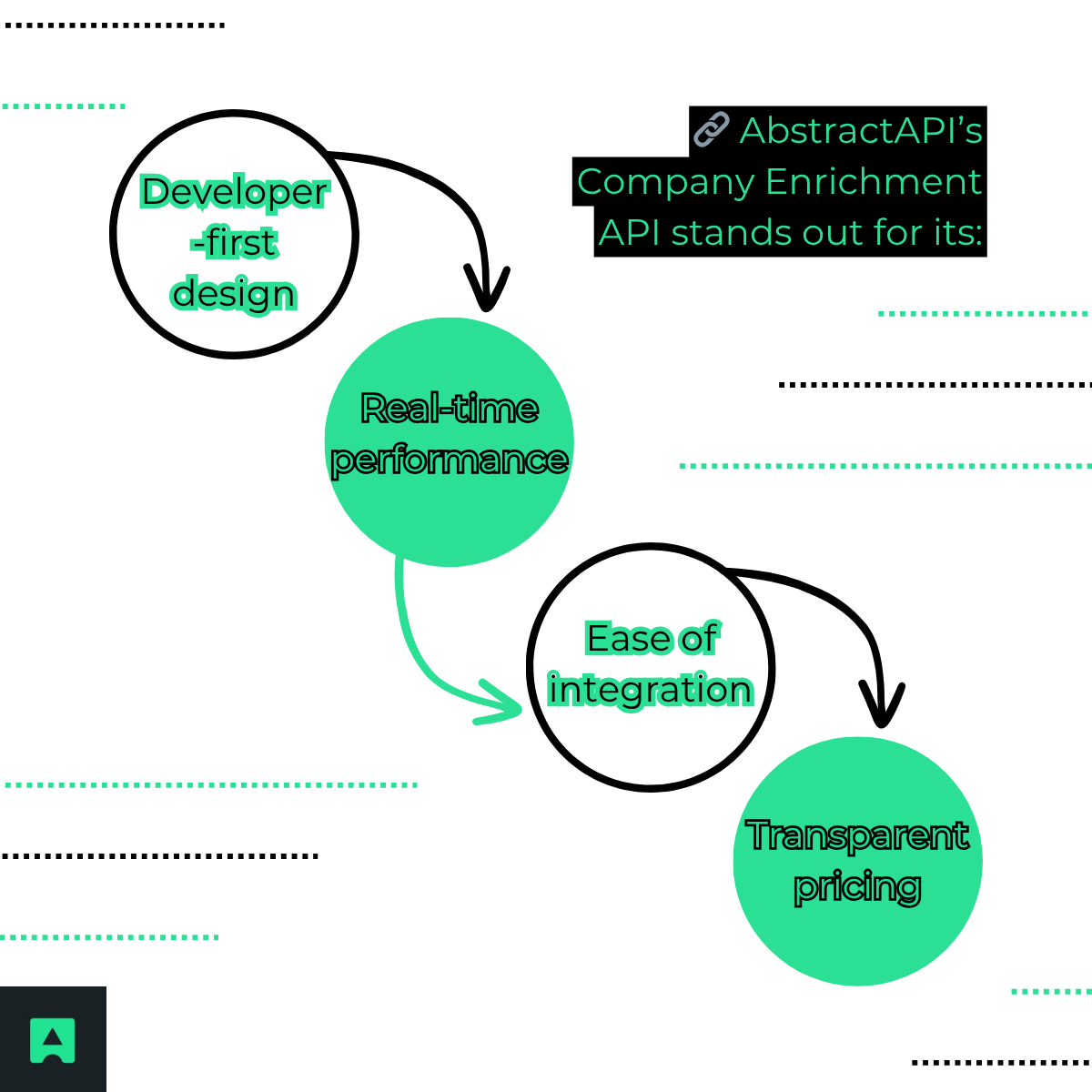
- Simplicity: Easy-to-use REST API with clear docs and fast setup
- Speed: Sub-second response times, perfect for real-time use
- Coverage: Global business data, sourced from trusted providers
- Free Tier: Generous limits to help you prototype quickly
🎯 Use Case Examples
- Automatically enrich leads when users sign up for a free trial
- Display company profiles inside your CRM or sales dashboard
- Perform background checks during user onboarding
- Trigger custom workflows when companies match your ICP
💻 Code Example (Python)
import requests
api_key = "YOUR_API_KEY"
email = "alex.smith@startuphub.io"
response = requests.get(
f"https://companyenrichment.abstractapi.com/v1/?api_key={api_key}&email={email}"
)
print(response.json())
📬 You'll get back enriched fields like:
- company_name
- industry
- employee_range
- linkedin_url
- hq_country
- and more
🧮 Choosing Your Enrichment Strategy — Real-Time API vs. Manual/Batched Approaches
Choosing the right data enrichment approach isn't just a technical decision—it's a strategic one. The method you choose determines how fast your team can act on data, how scalable your operations are, and how seamlessly enrichment fits into your daily workflows.
There are two main approaches to enrichment:
- Real-Time API Enrichment (e.g., using AbstractAPI)
- Manual or Batch Enrichment (e.g., CSV uploads to enrichment tools)
Let's break down how they compare across core dimensions:
| Feature | Real-Time API (like AbstractAPI) | Manual Lookups / Batch Upload |
|---|---|---|
| Speed | Instant (milliseconds) | Slow (hours or even days) |
| Use Case | Lead scoring, onboarding, personalization | One-time list cleaning, market research |
| Integration | Fully automated and embedded in workflows | Manual data import/export required |
| Scalability | High—supports millions of records seamlessly | Limited by team size and manual effort |
🧠 Real-Time API: Designed for Speed, Scale & Automation
Real-time APIs like AbstractAPI are perfect for modern, cloud-native applications and internal tools. You send a single request with an email or domain, and receive enriched data in milliseconds.
🔗 Ideal when you need:
- Enrichment to happen during sign-up, form submission, or CRM entry
- Dynamic lead scoring based on company size or industry
- Enriched personalization for web content or emails
- Minimal operational overhead
Because it's fully automated, your team saves time, avoids manual errors, and gets enrichment at scale, even with thousands of records a day.
🗃️ Manual or Batch Enrichment: Good for One-Offs, But Limited
Manual upload tools or batch enrichment jobs are useful when:
- You're cleaning up legacy contact lists
- You need to enrich a few static spreadsheets
- You don't require real-time insight
However, these methods are resource-intensive and prone to human error. Plus, they don't scale easily—every new list requires a new upload.
⏳ If your workflows rely on real-time data (e.g., scoring a lead when they request a demo), batch enrichment simply can't keep up.
🚀 Bottom Line:
- If your goal is to build automated, intelligent systems that respond to data in real time, an enrichment API is the superior choice.
The AbstractAPI Company Enrichment API lets you integrate enrichment directly into your application logic—helping you move faster and smarter, with zero manual work.
📊 Comparison Table: Enrichment via API vs. Manual Processes
No changes here per your request.
🧭 Final Thoughts: Data Enrichment Is a Growth Imperative
In the modern digital landscape, enrichment is no longer optional—it's mission-critical.
Whether you're building a smarter product, targeting the right customers, or ensuring compliance, contextual, enriched data empowers teams to move faster and more confidently.
💡 For teams that need enriched business data at their fingertips—without the bloat or complexity—AbstractAPI is a powerful ally in your growth toolkit.
🔗 Further Reading:
Frequently Asked Questions
What is data enrichment and how is it different from data quality improvement?
Data enrichment is the process of enhancing an existing dataset by appending new fields from external sources: for example, adding a company's industry, employee count, or revenue to a record that only contains a domain name. Data quality improvement, by contrast, focuses on cleaning, standardizing, and validating data you already have. Enrichment builds on top of quality work by filling in information that was never there in the first place.
When should I use a real-time API for enrichment instead of a batch process?
Real-time API enrichment is the right choice when your workflow needs immediate results: such as enriching a lead the moment a form is submitted or routing a CRM record as soon as it is created. Batch processing works for one-time list clean-ups where latency is not critical, but it can take hours or days to complete and does not scale well for continuous, high-volume data pipelines.
What kinds of fields does a company enrichment API typically return?
A company enrichment API typically returns firmographic data such as the company's name, industry classification, employee range, estimated revenue, and LinkedIn URL. These fields are retrieved in a structured JSON response and can be appended directly to your existing records. Having this data lets sales and marketing teams qualify and segment leads without any manual research.
How do I integrate a data enrichment API in Python?
The basic pattern is to make an HTTP GET or POST request to the API endpoint, passing a company domain or identifier as a parameter along with your API key. The API returns a JSON object containing the enriched fields, which you then parse and store against the original record. Abstract's Company Enrichment API follows this pattern and returns results in milliseconds, making it straightforward to drop into an existing data pipeline.
How does AI improve data enrichment compared to traditional lookup methods?
AI-powered enrichment uses machine learning to predict unknown attributes, analyze unstructured text, and validate data across multiple sources simultaneously. Traditional lookup methods rely on static databases that can go stale, while modern AI approaches can synthesize real-time signals to fill gaps even when a direct match is unavailable. The result is higher match rates and more contextually accurate data, especially for smaller or newer companies that may not appear in legacy data vendors.
What are the main business use cases for data enrichment?
The three primary use cases are sales, marketing, and compliance. Sales teams use enriched data to prioritize leads by company size, industry, or job title rather than chasing unqualified contacts. Marketing teams use it to build hyper-targeted segments for personalized campaigns. Compliance and fraud teams use it to run Know Your Business (KYB) checks and cross-reference records against watchlists, all without building and maintaining the underlying data infrastructure themselves.
