


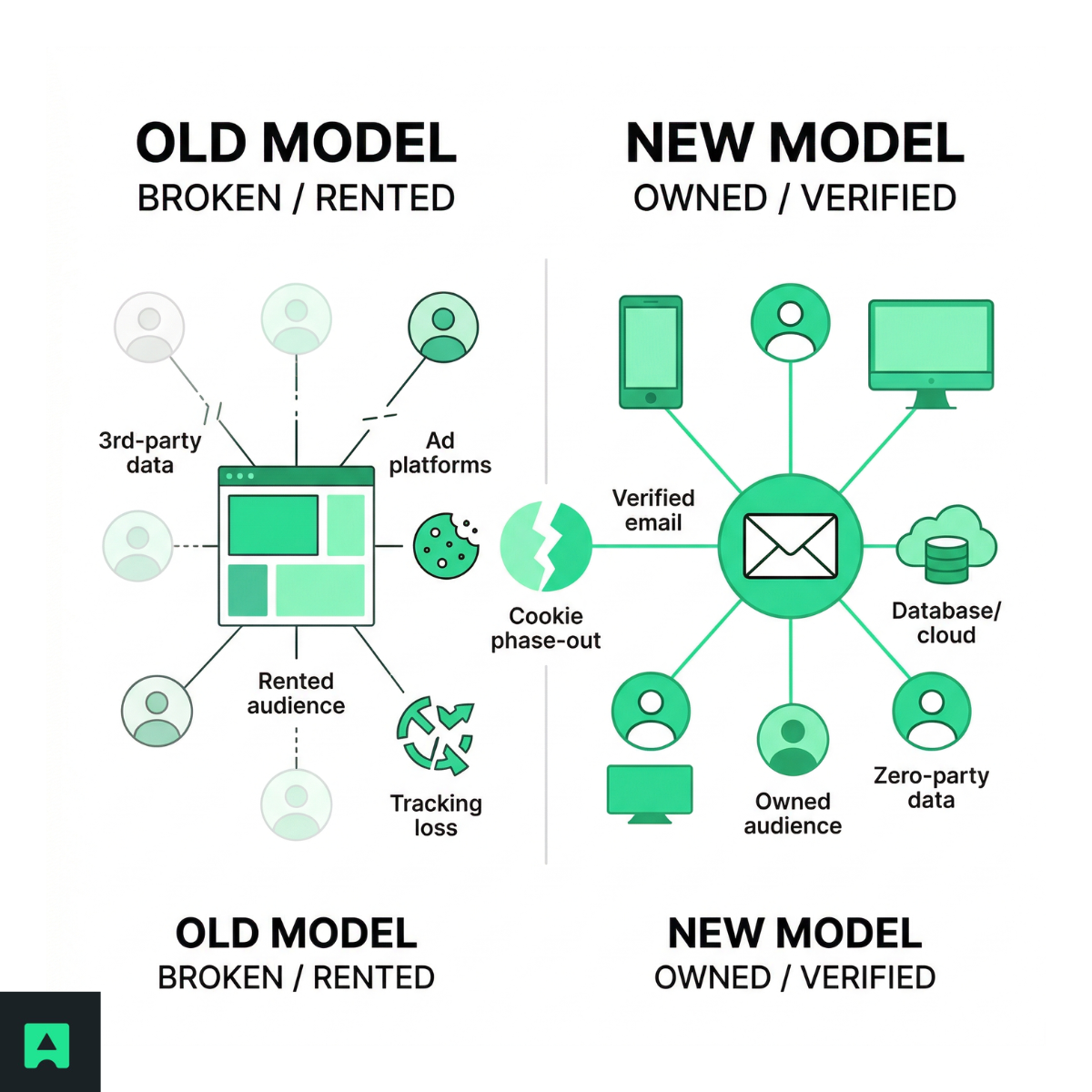
Why the Problem Matters: From Rented Reach to Owned Identity
The shift away from third-party cookies isn't just technical, it's economic.
Email has a median ROI of $36 per dollar spent (Litmus, 2024) — roughly 4x what paid social delivers. But that number assumes you're sending to real inboxes. The moment you add unverified contacts, those economics break down: bounce rates climb, domain reputation drops, and your deliverability to legitimate contacts suffers too.
The Email Address as the "Digital Passport"
An email address is the only identifier that survives a browser reset, a device switch, and a platform policy change. A cookie lives in one browser on one device. An email lives with the person. That's why it's become the anchor for identity resolution across devices and channels.
The Universal Key to Identity Resolution
A verified email connects fragmented user behavior into a single identity.
It allows you to:
- Recognize the same user across mobile, desktop, and apps
- Connect anonymous browsing to known profiles
- Link online activity with offline purchases
Without it, your data stays fragmented. With it, you gain a unified customer view—the foundation of any modern marketing or analytics stack.
Quality vs. Ghost Audiences
Let's compare two assets:
- 100,000 anonymous website visitors (pixel-based)
- 10,000 verified email addresses
The first is ghost data—you can't reliably reach or identify them.
The second is a real, owned audience.
- Smaller, verified audiences consistently outperform larger, anonymous ones.
The Stability of First-Party Data
Platforms evolve. Algorithms change. Costs fluctuate.
But the email inbox remains one of the most stable digital environments available to brands.
That's why many teams now treat email as a persistent identifier—one that survives platform changes and enables long-term relationship building.
Why Zero Party Data Email Marketing Fails Without Verification
Zero-party data is only as valuable as its accuracy.
And today, that accuracy is under pressure.
The Gating Arms Race
As brands offer:
- Discounts
- Whitepapers
- Exclusive content
Users increasingly respond with:
- Disposable email addresses (DEAs)
- Fake or mistyped emails
- Burner accounts
The Cost of Fake Zero-Party Data
If a significant portion of your list is invalid, your personalization engines train on ghost users and your CRM segments become unreliable:
- Personalization engines optimize on bad inputs
- AI models learn from non-existent users
- CRM segmentation becomes misleading
It's similar to training a model on corrupted data—you don't just get worse outcomes, you get confidently wrong decisions.
A fake email in your database is like issuing a passport to someone who doesn't exist.
The Hidden "Dirty Data" Tax
Bad email data creates a silent cost layer:
- Inflated audience sizes
- Misleading campaign performance
- Wasted email sends and ad spend
- Damaged deliverability
For CMOs and growth teams, this leads to one critical issue:
- You can't confidently answer: What's actually driving results?
Step-by-Step Solution: Build a Verified Lead Acquisition System
To make zero party data email marketing work in 2026, verification must happen at the point of entry, not after.
1. Capture Emails at High-Intent Moments
Focus on moments where users expect value:
- Checkout flows
- Newsletter signups
- Content downloads
- Account creation
2. Verify Emails in Real Time
Use a solution like Abstract's Email Verification API
Emails are validated instantly—typically in milliseconds—without disrupting the user experience.
Key checks include:
- Detecting temporary or disposable email addresses
- Confirming the mailbox exists (SMTP validation)
- Assessing deliverability risk
For implementation details, see:
→ Abstract Email Validation API documentation
→ How to Verify Emails in Real Time
3. Enforce Value Exchange
If an email fails validation, prompt the user in real time:
- "It looks like this is a temporary email."
- "Please use a valid email to receive your download."
This creates a simple but powerful rule:
- Access to high-value content requires a high-quality identifier.
4. Store Only Verified Emails
Only allow validated emails into:
- Your CRM
- Marketing automation platforms
- Data warehouse
This ensures your first-party data foundation stays clean from day one.
Understanding the Results: What Clean Data Unlocks
Once your data is verified at the source, every downstream system becomes more reliable.
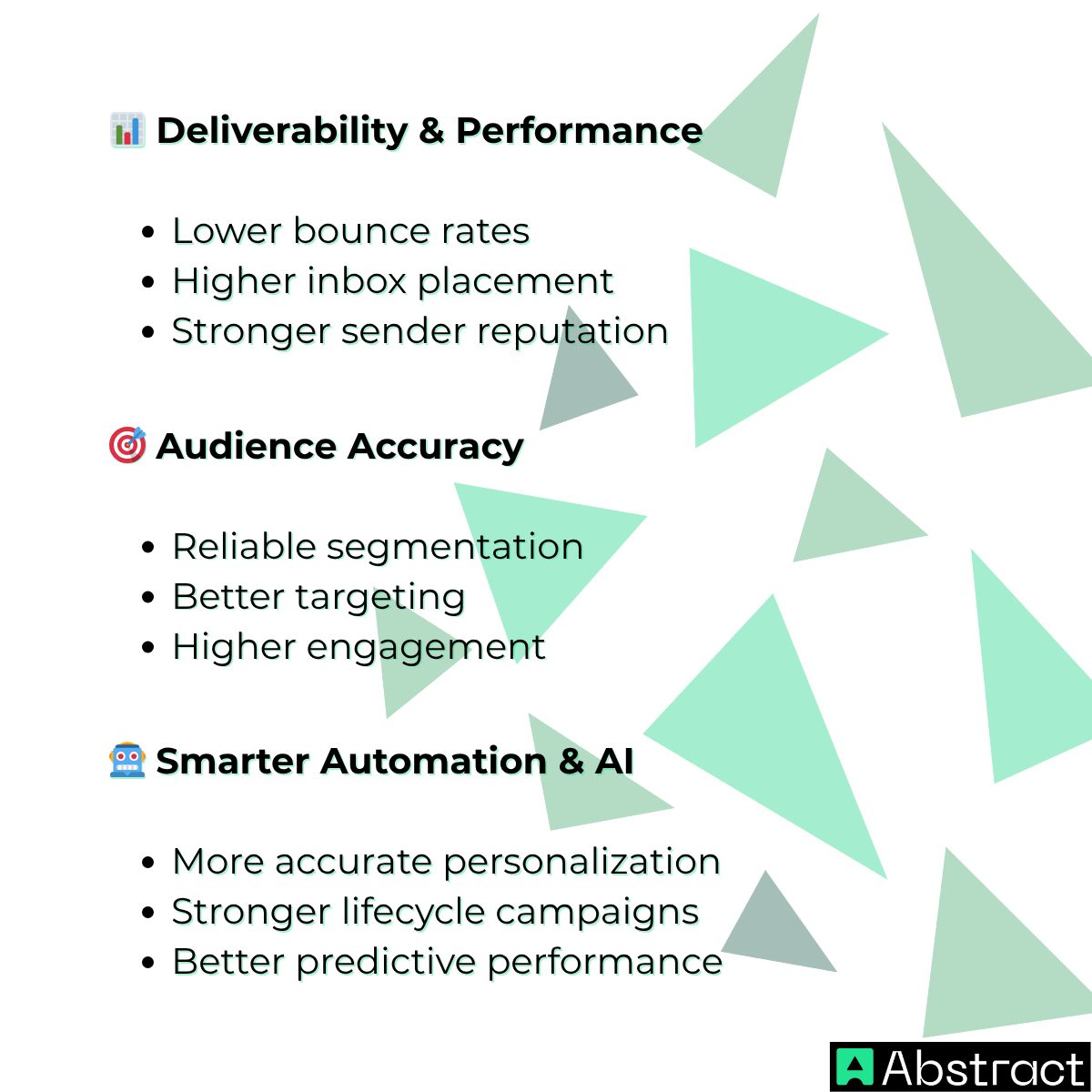
Clean data doesn't just improve performance, it restores confidence in your decision-making.
Practical Use Cases
| Use Case | Challenge | With Verified Emails | Why it matters |
|---|---|---|---|
| E-commerce: Build High-Quality Customer Assets | Discount-driven signups using fake or disposable emails | Capture and store only verified customer emails at checkout or signup | More accurate customer profiles, better retention, and higher LTV |
| SaaS: Strengthen Product-Led Growth | Fake trial accounts and unreachable users | Ensure only real, reachable users enter your onboarding funnel | Improved activation rates and more effective lifecycle campaigns |
| Marketing Teams: Replace Cookie-Based Targeting | Loss of third-party tracking and unreliable audience data | Use verified emails as persistent identifiers across platforms | Stronger audience matching and more reliable lookalike campaigns |
| Privacy-First Personalization | Personalization based on incomplete or inaccurate data | Leverage clean zero-party data for segmentation and messaging | Better user experience, higher engagement, and compliance confidence |
Conclusion: Who Owns the Relationship?
In 2026, competitive advantage won't come from collecting more data.
It will come from maintaining better data.
The email address has become the most reliable Universal ID in marketing—but only if it's verified.
Without verification at the point of capture, your first-party data strategy is built on bad inputs — and every downstream system, from personalization to lookalike audiences, inherits those errors with confidence. The fix is one step, applied early: validate every email before it enters your CRM.
And like any valuable asset, it requires protection.
An email verification API acts as a control layer—ensuring that the data entering your systems is accurate, usable, and trustworthy from the start.
Don't build your 2026 marketing strategy on unreliable data.
Start verifying emails at the point of capture, eliminate invalid users instantly, and turn your audience into a durable, revenue-generating asset.
- Get your free Abstract API key and start protecting your first-party data today.
Frequently Asked Questions
Why are verified emails considered a top marketing asset in 2026?
Third-party cookies are no longer a reliable way to track and reach audiences, so brands need data they actually own. A verified email list gives you a direct, persistent channel to real people, one that isn't controlled by ad platforms or browser policies. Email also delivers a median ROI of $36 per dollar spent, far outpacing paid social.
What is zero-party data and how does it relate to email verification?
Zero-party data is information a customer deliberately shares with you, such as an email address entered at signup or checkout. Unlike third-party tracking data, you own it outright. Email verification ensures the addresses you collect are real and reachable, so your zero-party data stays accurate and actionable rather than filling your CRM with dead ends.
What is the "dirty data tax" and how does it hurt my email program?
The dirty data tax refers to the hidden costs of keeping invalid email addresses in your database: higher bounce rates, damaged sender reputation, wasted ad spend on lookalike audiences built from fake contacts, and broken personalization. These costs compound over time and are largely invisible until a campaign significantly underperforms or your domain gets flagged.
When should I validate email addresses: at signup or in bulk after the fact?
Real-time validation at the point of capture (checkout, signup form, lead magnet) is the most effective approach. Catching invalid or disposable addresses the moment they're entered prevents bad data from ever entering your system. Bulk verification is useful for cleaning existing lists, but it can't fully replace catching problems at the source.
How does a smaller verified list outperform a larger unverified one?
Deliverability depends on your sender reputation, which is driven by engagement rates. A list of 10,000 verified contacts with genuine interest will generate far better open rates, click rates, and conversion than 100,000 addresses that include invalid, disposable, or disengaged accounts. ISPs reward senders who consistently reach real inboxes and penalize those with high bounce rates.
How do I detect and block disposable email addresses at signup?
An email verification API like Abstract's checks each address in milliseconds against known disposable email providers and also performs SMTP validation to confirm the mailbox exists. Integrating this check directly into your signup form (before the address is accepted) blocks throwaway addresses before they reach your database, keeping your list clean from day one.
