


The Data Gravity Problem: ETL Is the Bottleneck
The real-world scenario
You're managing:
- Hundreds of millions (or billions) of web log rows
- A Snowflake warehouse used by BI, ML, and analytics teams
- A requirement to add country and city columns based on IP addresses
The old way (ETL)
Traditionally, teams would:
- Export IPs from Snowflake to S3
- Run a Python enrichment job on EC2
- Call a third-party IP geolocation API
- Write results back into Snowflake
This approach fails at enterprise scale:
❌ Slow and operationally complex
❌ Expands your security attack surface
❌ Creates stale, batch-only data
❌ Breaks data lineage and governance
The modern way (ELT)
Instead of moving data to the API, bring the API to the data.
Using Snowflake External Access Integrations, we can call Abstract API directly from inside Snowflake, enriching data in place with SQL-driven workflows.
Architecture Shift: Proxy-Based vs Native Snowflake Access
- Terminology note: This article references "External Functions" in the headline for historical and SEO reasons. In practice, the implementation uses External Access Integrations, the modern and recommended evolution of External Functions in Snowflake.
Legacy approach: External Functions + Proxy
Historically, Snowflake External Functions required:
- AWS Lambda or Azure Functions
- API Gateway
- IAM role orchestration
- Additional networking layers
This proxy-based architecture added:
- Latency
- Cold starts
- Operational overhead
- Debugging complexity
Modern approach: External Access Integrations (Recommended)
Snowflake's External Access Integrations allow Python UDFs running inside Snowflake to securely access the public internet—without any proxy.
The modern enrichment flow
Snowflake Table (IP addresses)
↓
Vectorized Python UDF (batch processing)
↓
↓
Enriched columns (Country, City, Postal Code)
Why this wins at enterprise scale
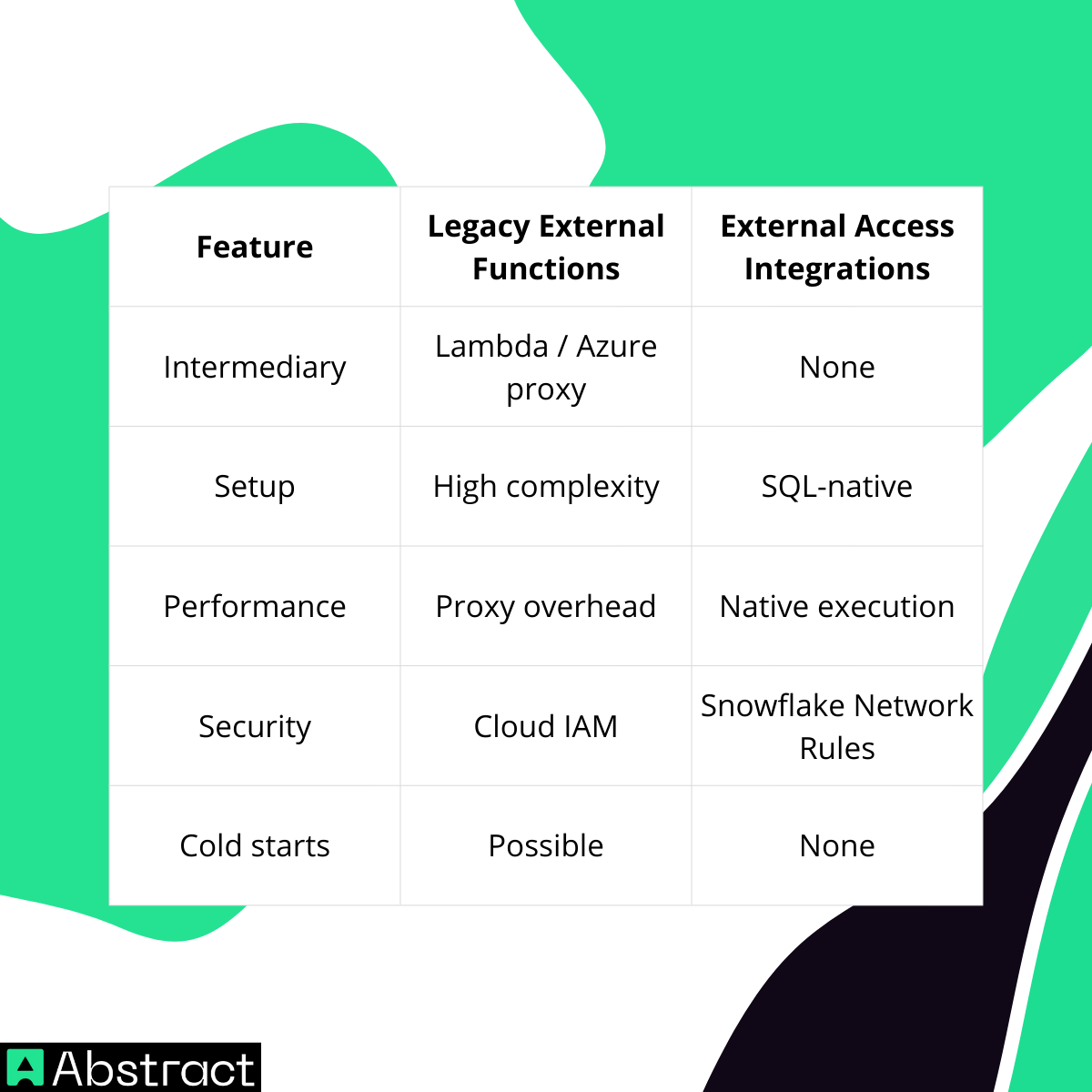
Security Setup: The Enterprise Configuration Model 🔐
Enterprise enrichment starts with controlled egress.
Snowflake enforces this using three explicit, auditable objects.
Network Rule (Egress Control)
Defines exactly which external domains Snowflake is allowed to reach.
CREATE OR REPLACE NETWORK RULE abstract_api_network_rule
MODE = EGRESS
TYPE = HOST_PORT
VALUE_LIST = ('ipgeolocation.abstractapi.com');
This ensures Snowflake cannot access the open internet, only Abstract API.
Secret Object (API Key Management)
Hardcoding API keys violates every enterprise security policy.
Snowflake Secrets encrypt and isolate credentials securely.
CREATE OR REPLACE SECRET abstract_api_key
TYPE = GENERIC_STRING
SECRET_STRING = 'YOUR_ABSTRACT_API_KEY_HERE';
External Access Integration (The Binder)
Binds network rules and secrets into a single governed object.
CREATE OR REPLACE EXTERNAL ACCESS INTEGRATION abstract_enrichment_integration
ALLOWED_NETWORK_RULES = (abstract_api_network_rule)
ALLOWED_AUTHENTICATION_SECRETS = (abstract_api_key)
ENABLED = TRUE;
This is what you grant to analytics engineers—not raw network access.
The Vectorized Python UDF: The Performance Multiplier 🏎️💨
The critical mistake to avoid
❌ Scalar Python UDFs
A scalar UDF makes one API call per row.
- 1M rows × 100ms per request = ~27 hours
- Completely unusable at scale
The correct solution: Vectorized UDFs + asyncio
Snowflake vectorized UDFs:
- Receive data as a pandas.Series
- Process batches (e.g., 500–1000 IPs)
- Return results as a vector
⚠️ Important nuance: Abstract API validates one IP per request. Vectorization does not mean bulk requests—it means parallel orchestration.
Python implementation (production-grade)
import _snowflake
import pandas as pd
import asyncio
import aiohttp
from _snowflake import vectorized
api_key = _snowflake.get_generic_secret_string('abstract_api_key')
async def fetch_ip_data(session, ip):
url = f"https://ipgeolocation.abstractapi.com/v1/?api_key={api_key}&ip_address={ip}"
try:
async with session.get(url, timeout=5) as response:
if response.status == 200:
return await response.json()
elif response.status == 429:
return {"status": "rate_limited"}
return {"status": f"error_{response.status}"}
except Exception:
return {"status": "timeout"}
async def process_batch(ips):
async with aiohttp.ClientSession() as session:
tasks = [fetch_ip_data(session, ip) for ip in ips]
return await asyncio.gather(*tasks)
@vectorized(input=pd.Series)
def enrich_ip_intelligence(ips):
loop = asyncio.get_event_loop()
results = loop.run_until_complete(process_batch(ips.tolist()))
return pd.Series([str(r) for r in results])
Managing Scale, Cost, and Reliability 💰📉
1. Cache once, enrich forever (IP Dimension Table)
Web logs are highly repetitive.
Best practice:
- Create DIM_IP_GEOLOCATION
- Enrich only new IPs
- Join back to logs
This pattern routinely reduces API usage by 80–90%.
2. Batch size tuning
Avoid timeouts by controlling batch size.
CREATE OR REPLACE FUNCTION ENRICH_IP_INTELLIGENCE(ip_address STRING)
RETURNS STRING
LANGUAGE PYTHON
RUNTIME_VERSION = '3.8'
PACKAGES = ('pandas', 'aiohttp')
HANDLER = 'enrich_ip_intelligence'
EXTERNAL_ACCESS_INTEGRATIONS = (abstract_enrichment_integration)
SECRETS = ('abstract_api_key' = abstract_api_key)
MAX_BATCH_SIZE_ROWS = 500;
3. Incremental enrichment with Streams & Tasks
For continuous ingestion:
- Use Snowflake Streams to detect new IPs
- Use Tasks to enrich incrementally
- Avoid reprocessing historical data
This approach integrates cleanly with dbt models and enterprise ELT pipelines.
The Magic Moment: SQL-Based Enrichment ✨
UPDATE WEB_LOGS
SET
COUNTRY = PARSE_JSON(ENRICH_IP_INTELLIGENCE(IP_ADDRESS)):country::string,
CITY = PARSE_JSON(ENRICH_IP_INTELLIGENCE(IP_ADDRESS)):city::string
WHERE COUNTRY IS NULL;
- Millions of rows enriched.
- No exports.
- No proxies.
- Pure SQL.
Conclusion: Snowflake as a Live Enrichment Engine 🎯
By combining:
- Snowflake External Access Integrations
- Vectorized Python UDFs
- Abstract API's high-scale IP intelligence
You've transformed Snowflake into a native, enterprise-grade data enrichment engine.
Key takeaways
- Don't export data—enrich in place
- Avoid proxies—use External Access Integrations
- Vectorize everything
- Cache IP intelligence
- Scale safely with concurrency-aware APIs
👉 Get your Abstract API key and start enriching your Snowflake IP geolocation data today.
👉 For billions of rows or historical backfills, contact Abstract API for dedicated high-throughput rate limits.
Frequently Asked Questions
What is Snowflake External Access Integration and why use it for IP geolocation?
Snowflake External Access Integrations let Python UDFs call external APIs directly from inside the warehouse, without the proxies or AWS Lambda functions that older External Functions required. For IP geolocation, this means you can enrich hundreds of millions of rows in place rather than exporting data to an outside pipeline, which reduces latency and keeps data lineage intact.
What is the difference between a scalar Python UDF and a vectorized UDF in Snowflake?
A scalar UDF makes one request per row, which at 1 million rows would take roughly 27 hours. A vectorized UDF receives a pandas Series of values and uses asyncio to fire hundreds of requests concurrently, cutting the same job down to minutes. For any IP geolocation enrichment beyond a few thousand rows, vectorized UDFs are essential.
How do you handle rate limits when calling a geolocation API from a Snowflake UDF?
Set MAX_BATCH_SIZE_ROWS to around 500 in your UDF definition to keep batches manageable and prevent timeouts. Use asyncio.gather() to send requests in parallel within each batch rather than sequentially. Caching enriched results in a dimension table (such as DIM_IP_GEOLOCATION) means repeated IPs are never re-queried, cutting requests by 80-90% on typical log data.
Why is it better to enrich IP data inside Snowflake rather than exporting it first?
Exporting large datasets expands your security attack surface and typically forces a batch-only workflow that produces stale results. Enriching inside Snowflake keeps the data in a governed environment, preserves lineage, and allows near-real-time enrichment using Snowflake Streams and Tasks on new rows as they arrive.
What are Network Rules and Secret objects in the Snowflake External Access setup?
A Network Rule defines which external domains your UDF is allowed to reach (for example, ipgeolocation.abstractapi.com), acting as an egress allowlist. A Secret object stores your API key encrypted within Snowflake so credentials are never hard-coded in function bodies. Together they are bound into an External Access Integration that you attach to your UDF at creation time.
How does an IP dimension table reduce geolocation API costs in Snowflake?
A dimension table stores each unique IP alongside its enriched fields (country, city, latitude, longitude, and so on) after the first lookup. Before calling the external API, a JOIN or MERGE checks whether the IP already exists in the table. On datasets with repeated IP addresses (such as user activity logs), this pattern typically eliminates 80-90% of requests while still keeping the enriched data fresh for new IPs.
