


The Problem with the Static Status Quo
The legacy geo-blocking workflow usually looks like this:

This model breaks down fast:
- Accuracy: IP data becomes stale continuously, not weekly.
- Maintenance: Cronjobs fail. Files corrupt. Formats change.
- Rigidity: Updating rules often requires config reloads or fleet-wide syncs.
Legacy modules like ngx_http_geoip_module are fast, but they are always behind reality.
The Modern Alternative: Just-in-Time Geolocation at the Edge
Instead of managing databases, we move to a Just-in-Time lookup model.
Using OpenResty, we perform an asynchronous lookup against AbstractAPI only once per IP address, then cache the result in Nginx shared memory (RAM). Every subsequent request from that IP is evaluated locally, without touching the network.
This architecture is:
- Zero-maintenance – No files, no cronjobs, no recompiles
- Real-time – Always backed by fresh API data
- Extremely fast – After the first request, decisions happen in microseconds
Most importantly, this logic runs before the request ever reaches your application.
Architecture Overview: The Intelligent Edge
The flow follows a classic cache-aside pattern, implemented directly inside the Nginx event loop:
- Incoming Request
A client hits your Nginx edge or load balancer.
- Shared Memory Lookup
Nginx checks lua_shared_dict (atomic, in-RAM storage) using the client IP.
- Cache HIT
Country code is found → allow or deny immediately.
Latency: ~0ms
- Cache MISS
Nginx performs a non-blocking HTTP request to AbstractAPI.
- Ingestion
The country code is cached in shared memory with a TTL (e.g., 24h).
- Enforcement
Request is proxied upstream or terminated with 403 Forbidden.
Once cached, performance is statistically indistinguishable from native modules.
Prerequisites & Setup
Why OpenResty (Not Vanilla Nginx)
While vanilla Nginx can embed Lua, OpenResty is purpose-built for this use case. It bundles:
- Nginx
- LuaJIT
- Non-blocking I/O libraries
- Tight integration with the event loop
This is mandatory for high-performance API integration.
Install OpenResty
sudo apt-get install openresty
Dependencies
We use lua-resty-http.
This is critical. Standard Lua sockets (socket.http) block the worker process and will destroy throughput. lua-resty-http is fully event-driven and safe at scale.
Get an API Key
Sign up at AbstractAPI and generate an IP Geolocation API key. Each Nginx instance will use it for cache misses.
The Implementation: A Lua-Powered Firewall
Configure Shared Memory
Inside the http block of nginx.conf:
- ngx.shared.DICT is atomic, lock-free, and shared across all workers.
The Lua Logic (geo_logic.lua)
local _M = {}
function _M.check_access()
local cache = ngx.shared.ip_cache
local client_ip = ngx.var.remote_addr
-- 1. Check shared memory
local country = cache:get(client_ip)
if not country then
-- 2. Cache MISS: query AbstractAPI
local http = require "resty.http"
local cjson = require "cjson.safe"
local httpc = http.new()
httpc:set_timeout(1000)
local res, err = httpc:request_uri(
"https://ipgeolocation.abstractapi.com/v1/",
{
query = {
api_key = "YOUR_ABSTRACT_API_KEY",
ip_address = client_ip
},
method = "GET",
ssl_verify = false -- enable with proper CA certs in production
}
)
if res and res.status == 200 then
local body = cjson.decode(res.body)
if body and body.country_code then
country = body.country_code
cache:set(client_ip, country, 86400) -- 24h TTL
end
else
-- Fail-open: preserve availability
ngx.log(ngx.ERR, "AbstractAPI lookup failed: ", err)
return
end
end
-- 3. Enforcement
local blocked = { CN = true, RU = true }
if blocked[country] then
ngx.log(ngx.WARN, "Blocked IP ", client_ip, " from ", country)
ngx.exit(ngx.HTTP_FORBIDDEN)
end
end
return _M
This logic runs before your application sees the request.
Performance Tuning for High Traffic
Keepalive Connections
Each cache miss involves TLS negotiation. To reduce overhead, connections should be reused.
- Note: request_uri() manages connections internally. For extreme scale and maximum control, advanced setups may prefer httpc:connect() + request() to explicitly manage keepalive pools.
Conceptually:
httpc:set_keepalive(60000, 10)
This reduces latency on cache misses by reusing encrypted connections.
Fail-Open vs. Fail-Closed
You must choose your failure mode:
- Fail-Open (Recommended)
If the API is unreachable, allow traffic. Prioritizes availability and UX.
- Fail-Closed
Block on failure. Suitable for regulated or high-security environments.
This decision should match your threat model.
Cache Eviction Strategy
Consumer IPs rotate frequently via DHCP (often within 24–48 hours). A 24-hour TTL strikes a balance between accuracy and cache efficiency, preventing false positives when IPs change hands.
Nginx Module vs. API-Driven Geo-Blocking
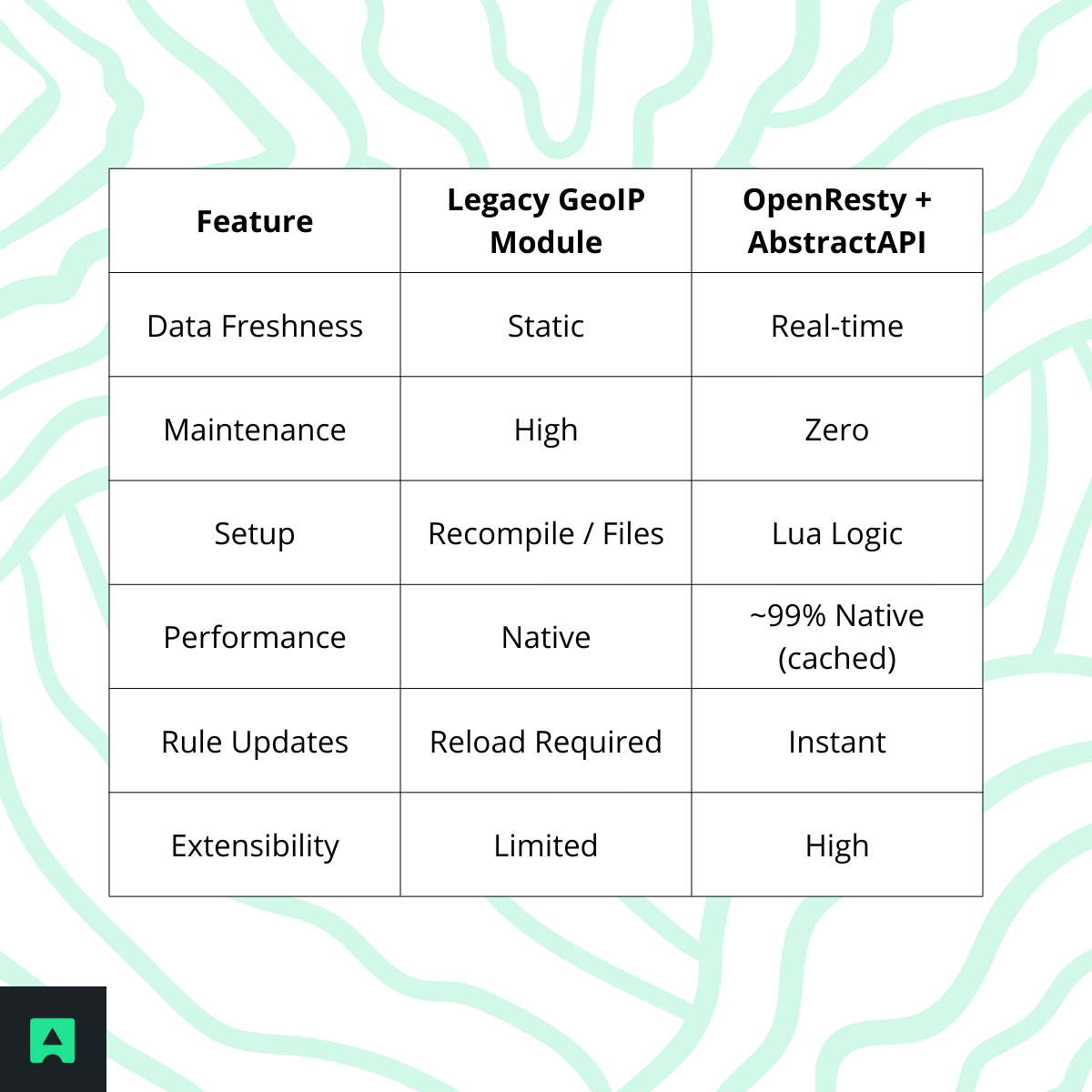
After the first request, performance differences are negligible in real-world traffic.
Strategic Advantages of the Lua Approach
By enforcing geo-blocking at the Nginx layer, you are practicing Defense in Depth. Malicious or unwanted traffic is rejected before it consumes:
- Application threads
- Database connections
- Cache capacity
Using AbstractAPI also unlocks future logic: ASN blocking, data-center detection, VPN/proxy signals — all without changing your infrastructure model.
Conclusion
We've moved geo-blocking from a brittle, file-based system into a real-time, edge-native firewall.
With OpenResty and AbstractAPI, you get:
- Always-fresh IP intelligence
- Sub-millisecond enforcement
- Zero operational overhead
This is how modern infrastructure protects itself — fast, accurate, and invisible to legitimate users.
Ready to harden your edge? Secure your infrastructure with Abstract's real-time IP Intelligence data. 🛡️
Frequently Asked Questions
What is OpenResty and why use it instead of vanilla Nginx for geo-blocking?
OpenResty is a purpose-built Nginx distribution that bundles Lua, LuaJIT, and event-driven libraries like lua-resty-http. Unlike vanilla Nginx, it lets you run custom business logic (such as IP geolocation lookups) directly inside the Nginx event loop without blocking worker processes. For geo-blocking, this means you can query a real-time API and cache the result in shared memory, all within the request cycle.
Why not just use Nginx's built-in GeoIP module with a static database?
Static databases like MaxMind GeoLite2 require regular updates and are always somewhat behind reality: IP ownership changes continuously as cloud providers and ISPs rotate addresses. The ngx_http_geoip_module approach also requires cronjob-based database management, which is maintenance-heavy and prone to corruption. An API-driven approach like the one using Abstract ensures real-time accuracy on every cache miss without manual database refreshes.
How does caching prevent the API latency from hurting performance?
The implementation uses a cache-aside pattern with Nginx shared memory (lua_shared_dict) and a 24-hour TTL. On the first request for a given IP, the system calls the geolocation API and stores the result; all subsequent requests for that IP are served from in-memory cache with no network overhead. This means the latency cost is paid only once per IP per day, and in practice performance is comparable to a local database lookup for repeat visitors.
What is the difference between fail-open and fail-closed geo-blocking strategies?
Fail-open means that if the geolocation API is unavailable, requests are allowed through, prioritizing availability over security. Fail-closed means blocked traffic stays blocked even if the API cannot be reached, prioritizing security over uptime. The guide recommends choosing your failure mode explicitly based on your use case: fail-open suits applications where availability is critical, while fail-closed suits compliance or fraud-prevention scenarios.
Why must lua-resty-http be used instead of standard Lua sockets in Nginx?
Standard Lua socket libraries are synchronous and will block the entire Nginx worker process while waiting for a network response, destroying throughput under load. lua-resty-http is fully non-blocking and integrates with Nginx's event loop, so other requests continue to be processed while a geolocation request is in flight. Using blocking sockets in a high-concurrency Nginx setup is one of the most common performance mistakes in this type of integration.
How do you specify which countries to block in the Nginx/OpenResty configuration?
Country codes are defined in a Lua table inside the access_by_lua_block directive, for example: local blocked = { CN = true, RU = true }. When the geolocation API returns a country code for the client IP, the script checks it against this table and returns a 403 if it matches. This approach makes it easy to add or remove countries without restarting Nginx; you only need to reload the Lua configuration.
