
The Best Cryptocurrency APIs for 2026: From Institutional Data to Multichain Infrastructure

The crypto landscape has undergone a massive transformation. In the early days, a "crypto API" was just a tool to fetch the price of Bitcoin for a personal project. Fast forward to 2026, and the narrative has shifted entirely. 🚀
With the maturation of Spot ETFs, the implementation of MiCA (Markets in Crypto-Assets) regulations in Europe, and the explosion of Layer 2 networks like Base and Arbitrum, crypto APIs are now the backbone of institutional-grade financial infrastructure.
Whether you are building a high-frequency trading bot, a compliant fintech app, or a simple e-commerce checkout, choosing the right provider is no longer optional — it's a legal and technical requirement. 🛡️
In this guide, we break down the top cryptocurrency APIs for 2026, categorized by their utility, infrastructure, and ease of use.
Understanding the 2026 Split: Data vs. Infrastructure
Before picking a provider, you must understand the two primary categories of APIs in the current market:
Data Aggregators (Price Feeds):
- These services collect data from hundreds of exchanges to provide market prices, volumes, and historical trends. Examples include CoinGecko and CoinMarketCap. For regulated trading desks and audit-grade reporting, institutional data specialists like Kaiko or CoinAPI are often layered on top to guarantee clean, compliant, and traceable market data.
Node Providers (Blockchain Infrastructure):
- These provide direct access to blockchains themselves. If you need to read a smart contract, check a wallet balance, or send a transaction on Ethereum or Base, you need an RPC (Remote Procedure Call) node provider like Alchemy.
The "Big 6" Vendor Cheat Sheet
| Vendor | Category | 2026 Identity | Best For |
|---|---|---|---|
| CoinGecko | Data | The Independent Standard | Neutrality and long-tail token coverage |
| CoinMarketCap | Data | The Liquidity Giant | Deep liquidity data and trading bot signals |
| Alchemy | Infra | The "AWS of Web3" | dApp developers needing reliable RPC nodes |
| Moralis | Infra / Data | The Cross-Chain Powerhouse | Real-time Streams and indexing |
| Coinbase Cloud | Infra | The Institutional Choice | Bank-grade reliability and Base L2 integration |
| Abstract API | Utility | The Simple Converter | Non-crypto apps needing easy exchange rates |
CoinGecko: The Neutrality Leader 🦎
As regulations tighten, data independence matters. CoinGecko remains the gold standard for developers who want to avoid conflicts of interest from exchange-owned aggregators. It's the go-to for tax software and compliance-heavy apps thanks to its massive coverage of long-tail tokens.
For real-time trading, CoinGecko also provides WebSocket feeds, which are essential in 2026 where REST polling introduces unacceptable latency for live market strategies.
CoinMarketCap: Deep Liquidity Insights 📊
Owned by Binance, CoinMarketCap (CMC) is the heavy hitter for market depth. If your application needs liquidity data, exchange-level volumes, or order-book-driven signals, CMC remains unmatched.
CMC also offers WebSocket streaming endpoints, which trading bots rely on to receive tick-level updates without REST latency bottlenecks.
- Pricing Note: In 2026, CMC pricing remains credit-heavy — meaning high-frequency calls can become expensive quickly.
Looking for a simpler way? If you don't need deep liquidity metrics and just want to convert BTC to USD for a checkout page, AbstractAPI's Exchange Rate API offers a much lighter footprint without the credit-heavy complexity of enterprise data platforms.
🔎 CoinGecko vs CoinMarketCap API Pricing in 2026
Both CoinGecko and CoinMarketCap dominate crypto price aggregation — but they serve different economic models.
CoinGecko focuses on broad token coverage and neutrality, making it ideal for compliance and reporting tools. CoinMarketCap focuses on liquidity depth and exchange-grade data, optimized for trading operations. In both cases, WebSocket access has become mandatory for any latency-sensitive use case, while REST endpoints remain sufficient for dashboards and reporting.
Alchemy: The Backbone of Ethereum & L2s 🧪
You cannot build a dApp in 2026 without a node provider. Alchemy is the industry leader for RPC access and has perfected infrastructure for Layer 2 networks like Arbitrum, Optimism, and Base.
The Compute Units (CU) Model
Unlike REST APIs that charge per request, Alchemy uses Compute Units.
A simple block read is cheap.
A complex smart-contract trace consumes significantly more CUs.
This model reflects real infrastructure cost — and is now the industry standard for Web3 node pricing.
Moralis: Streamlining the Multichain 🌊
Moralis has dominated 2026 with its Streams API. Instead of polling an endpoint to check if a transaction arrived, Moralis pushes blockchain events to your backend via webhooks.
This is essential for cross-chain indexing, payment confirmation systems, and real-time portfolio tracking.
Coinbase Cloud: The Institutional Gateway 🏛️
For fintechs that must satisfy auditors and regulators, Coinbase Cloud is the safest infrastructure choice. They operate the primary infrastructure behind the Base network and often provide subsidized tiers for builders on Base L2.
If your roadmap involves regulated on-chain financial products, Coinbase Cloud is built for that reality.
Technical Implementation: Two Ways to Connect
Option A: The Simple Utility Approach (AbstractAPI)
Perfect for e-commerce or SaaS dashboards that need crypto prices without importing heavy blockchain libraries.
import requests
# 2026 Use Case: Displaying crypto prices on an e-commerce checkout
api_key = "YOUR_ABSTRACT_KEY"
base_currency = "USD"
target_currency = "BTC"
response = requests.get(
f"https://exchange-rates.abstractapi.com/v1/live?api_key={api_key}&base={base_currency}&target={target_currency}"
)
rate = response.json()['exchange_rates'][target_currency]
print(f"Current Rate: 1 {base_currency} = {rate} {target_currency}")
- Returns clean, lightweight JSON — no blockchain overhead required.
Option B: The Web3 Infrastructure Approach (Alchemy)
Use this if you are building a decentralized application and need direct blockchain access.
from web3 import Web3
w3 = Web3(Web3.HTTPProvider('https://eth-mainnet.g.alchemy.com/v2/YOUR_KEY'))
latest_block = w3.eth.get_block('latest')
print(f"Latest Ethereum Block: {latest_block['number']}")
- Reading a block consumes Compute Units — a fundamental cost model in Web3 infrastructure.
Critical Do's and Don'ts for 2026
✅ Use WebSockets (WSS) for trading — REST APIs are too slow for real-time bots
✅ Prioritize Layer 2 support — most activity now happens on Base and Arbitrum
✅ Plan for compliance — institutional data providers like Kaiko or CoinAPI ensure audit-grade records
❌ Don't assume "request = cost" — node providers charge by Compute Units
❌ Don't treat blockchain nodes like price APIs — infrastructure queries are fundamentally heavier
🎯 Final Verdict: Which API Should You Choose?
The best API depends on what you're building.
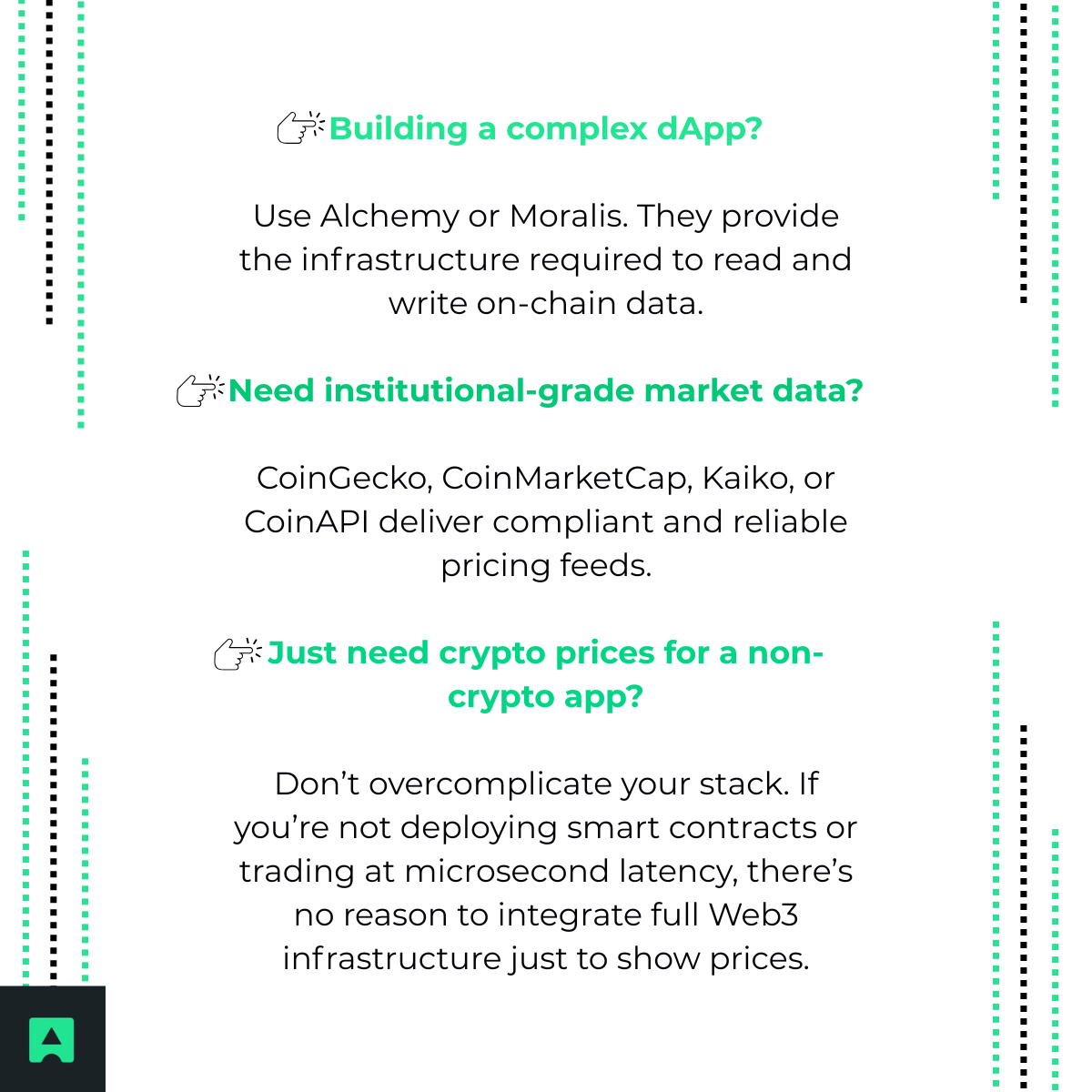
Use AbstractAPI's Exchange Rate API — lightweight, fast, and zero blockchain complexity. ⚡
Ready to integrate crypto prices in seconds? Get your free AbstractAPI key today.
Need to pull data from cryptocurrency sites? The Web Scraping API makes it easy to extract structured data from any web page. Explore more developer tools at AbstractAPI.
Frequently Asked Questions
What is the difference between a crypto data API and a blockchain node provider?
Crypto data APIs like CoinGecko and CoinMarketCap aggregate market prices and trading volumes from multiple exchanges and serve that data over REST or WebSocket endpoints. Blockchain node providers like Alchemy give you direct RPC access to a blockchain, letting you read on-chain state and broadcast transactions. Which one you need depends on whether you are building a price dashboard or a full on-chain application.
When should I use REST polling versus WebSocket connections for crypto price data?
REST polling works well for dashboards, reporting tools, and non-time-sensitive currency conversions where a short data lag is acceptable. WebSocket connections are required for trading bots and real-time price feeds where low latency matters. By 2026 most production trading infrastructure has shifted to WebSockets because REST polling introduces too much delay for live markets.
What is a lightweight crypto API and when is it the right choice?
A lightweight crypto API, like Abstract's exchange rate endpoint, focuses on simple currency conversion without exposing blockchain complexity or Compute Unit pricing models. It is the right choice when your application only needs to convert a cryptocurrency value to fiat, embed a price widget, or support checkout flows, and does not need on-chain data, wallet balances, or DeFi positions.
Do cryptocurrency APIs support Layer 2 networks like Base and Arbitrum?
Layer 2 networks such as Base and Arbitrum now handle the majority of transaction volume, so modern infrastructure providers like Alchemy and Moralis have added explicit L2 support. If your project interacts with L2 activity, verify that your chosen API or node provider lists those networks in its supported chain documentation before committing to an integration.
How do I choose a crypto API that meets compliance requirements?
Compliance needs have grown since spot ETF maturity and MiCA regulations came into force in Europe. For audit-grade use cases (such as institutional reporting or regulated financial products), prioritize providers that offer verifiable, exchange-sourced data with historical records, like Kaiko. General aggregators like CoinGecko are sufficient for most product features but may not satisfy regulatory audit requirements on their own.
How are crypto API costs typically structured, and what should I watch out for?
Data aggregators usually charge by request volume on a tiered monthly plan, which is straightforward to estimate. Infrastructure providers like Alchemy use a Compute Units model where each RPC method consumes a different number of units, so complex queries cost more than simple ones. A common mistake is budgeting for infrastructure APIs the same way you would a simple REST data feed; always review the Compute Unit cost table for the specific methods your app calls most frequently.
CEO at Abstract API

