


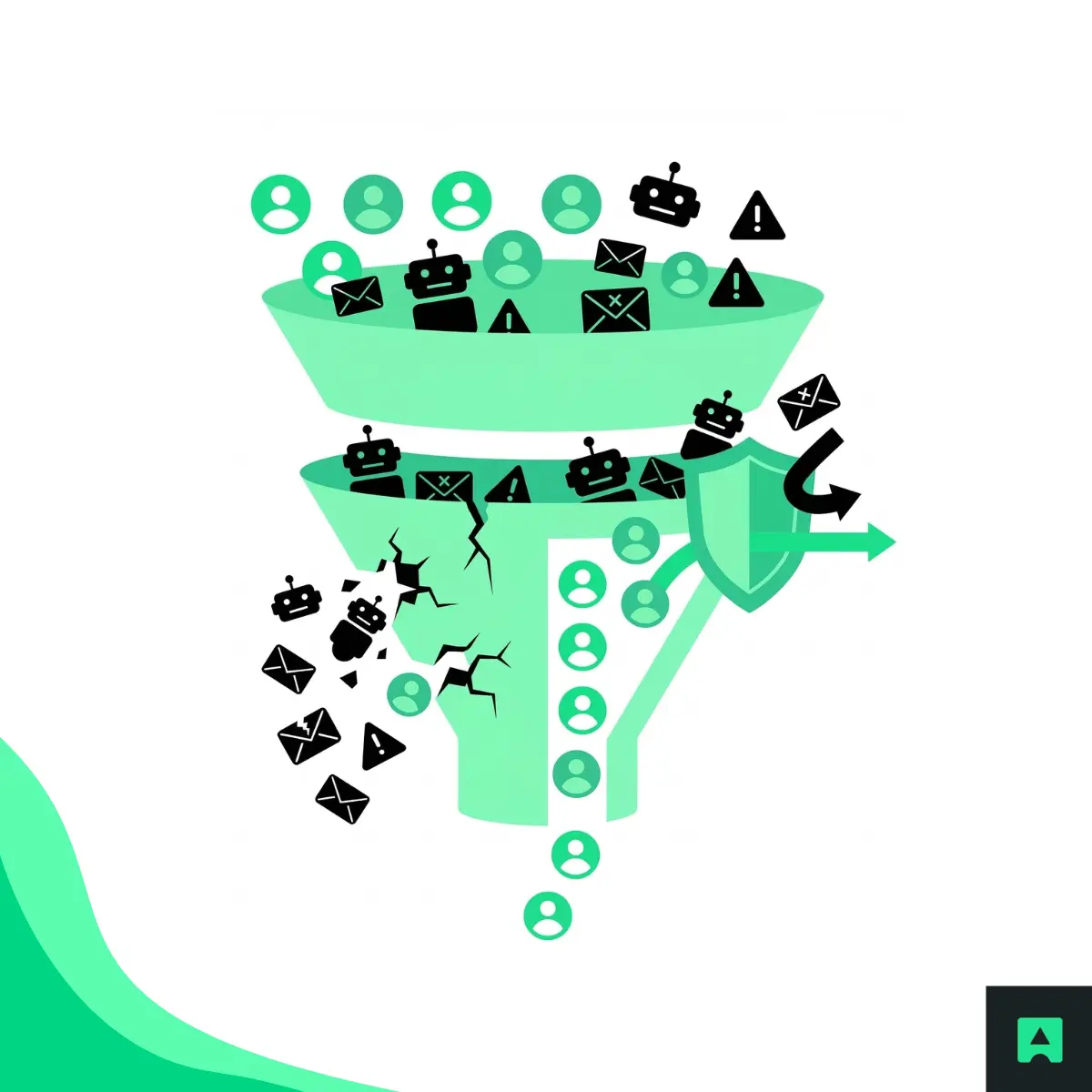
The "Lead Tax": How Bad Data Erodes Your Marketing Budget
💡 Executive Takeaway
- Invalid leads increase your effective cost per lead (eCPL)
- You're paying for leads that will never convert
- Poor data quality directly impacts margin and acquisition efficiency
CPL vs. Effective CPL (eCPL)
Most teams track Cost Per Lead (CPL).
But CPL assumes every lead is valid.
If 20% of your leads are fake or undeliverable, your true cost is much higher.
Example:
- CPL: $50
- Invalid Leads: 20%
- Valid Leads: 80%
Your effective CPL (eCPL) becomes: $50 ÷ 0.8 = $62.50
That's a 25% increase in acquisition cost—without changing your ad spend.
This is where email validation ROI becomes measurable: every invalid lead you prevent directly reduces CAC.
CRM Cost Inflation ("SaaS Bloat")
Most platforms charge based on contact volume:
- HubSpot
- Salesforce
- Braze
- Marketo
That means bad data doesn't just hurt performance—it increases your software costs.
Example:
- Total contacts: 50,000
- Invalid contacts: 10% (5,000)
- Cost per contact/year: $0.50
👉 Annual waste: $2,500
Now multiply that across:
- email sends
- enrichment tools
- automation workflows
Bad data silently drives CRM cost optimization challenges across your entire stack.
Leaky Funnel vs. Validated Funnel
| Metric | Leaky Funnel | Validated Funnel |
|---|---|---|
| Leads Generated | 1,000 | 1,000 |
| Invalid Emails | 200 | 20 |
| Valid Leads | 800 | 980 |
| Cost Per Lead | $50 | $50 |
| Effective CPL | $62.50 | $51.02 |
| CRM Contacts Stored | 1,000 | 980 |
Small improvements in lead quality vs quantity produce outsized gains in marketing efficiency and CAC reduction.
The Downstream Damage: Opportunity Cost You Don't See
💡 Executive Takeaway
- Bad data reduces deliverability and revenue reach
- Sales teams lose time on non-existent prospects
- Poor data quality slows pipeline velocity and scalability
The Deliverability Death Spiral
Email deliverability is driven by sender reputation.
High bounce rates from invalid emails signal low-quality sending behavior.
That leads to:
- Emails landing in spam
- Lower inbox placement
- Reduced engagement from real customers
Over time, even your best-performing campaigns lose effectiveness.
In other words, bad data doesn't just waste leads—it reduces the ROI of your entire email channel.
Sales Velocity Loss
Every invalid lead that reaches your CRM creates friction for Sales.
Instead of closing deals, SDRs spend time:
- verifying domains
- researching fake contacts
- chasing unresponsive emails
If each SDR wastes just 1 hour/day on bad leads, that's:
- ~20 hours/month
- ~240 hours/year
That's lost pipeline, lost revenue, and reduced team efficiency.
Email Validation ROI: The Framework (With Real Numbers)
💡 Executive Takeaway
- Email validation reduces CAC across three levers: ad spend, CRM costs, and sales productivity
- It often delivers multi-thousand percent ROI
- Payback is typically near-instant
The ROI Formula
ROI = Cost of API(Saved Ad Spend+Reduced CRM Fees+SDR Time Reclaimed )− Cost of API / Cost of API
Real-World ROI Example
Let's model a typical growth team:
- Monthly leads: 10,000
- Invalid rate: 15%
- Cost per lead: $40
Without validation:
- 1,500 bad leads/month
- Monthly wasted spend: $60,000
- Annual wasted spend: $720,000
Additional costs:
- CRM overhead: $8,000/year
- SDR time loss: ~$25,000/year
Total recoverable value: 👉 ~$753,000/year
Estimated validation cost: 👉 ~$2,000–$5,000/year
Result: 👉 Email validation ROI = 15,000%+
This is why validation should be treated as a growth investment—not a technical expense.
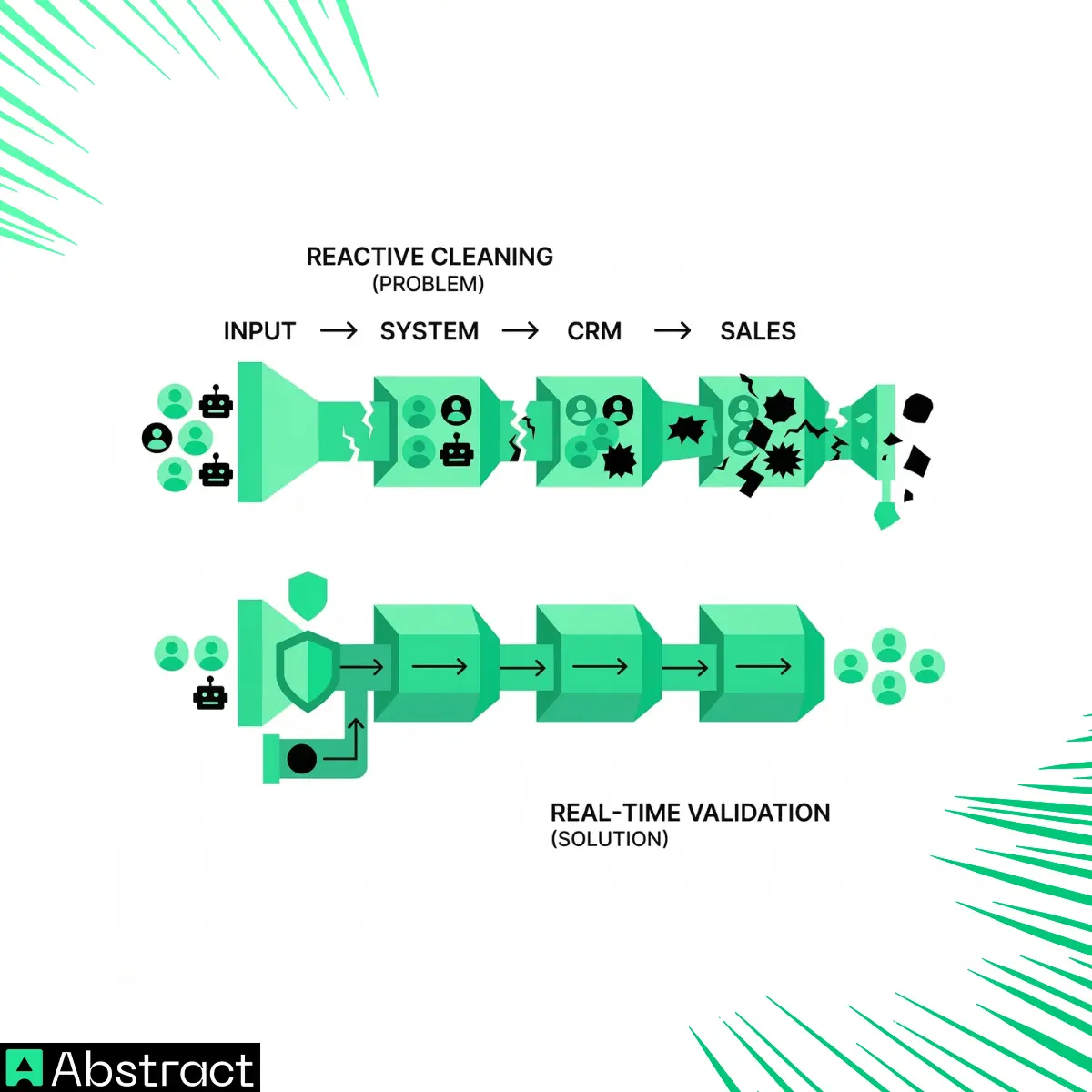
Real-Time vs. Bulk Cleaning: Prevention Wins
💡 Executive Takeaway
- Reactive cleaning fixes symptoms
- Real-time validation prevents budget loss
- Prevention improves scalability and margin
Bulk cleaning happens after the damage is done:
- Ad spend already wasted
- CRM already inflated
- Sales already slowed
Real-time validation stops bad data at the point of entry.
It protects:
- CAC
- pipeline quality
- marketing efficiency
- long-term deliverability
How Lead Quality Impacts CAC (Visual Model)
As lead quality increases, CAC consistently decreases because:
- fewer wasted leads
- higher conversion rates
- better sales efficiency
👉 Better data = better unit economics
Strategic Implementation: Real-Time Validation for Growth Teams
💡 Executive Takeaway
- Validation runs silently in your forms
- No friction for users
- Immediate impact on CAC and pipeline quality
Step 1: Validate Emails at Form Submission
When a user submits a form:
- Email is sent to a validation API (like AbstractAPI)
- The API checks:
- Syntax
- domain validity
- MX records
- disposable providers
- deliverability signals
The response is returned in milliseconds.
Step 2: Filter or Flag Leads
Based on validation:
Accept
- Deliverable emails
- Business domains
Flag
- Suspicious or disposable emails
Reject
- Invalid or undeliverable emails
This ensures only high-quality leads enter your CRM.
Step 3: Route Leads Dynamically
Use validation data to improve pipeline efficiency:
- Verified leads → Immediate Sales follow-up
- Medium confidence → Nurture workflows
- Risky emails → Low-priority tracks
This improves conversion rates and sales velocity.
Pro Tip
Use validation signals to score leads before they hit your CRM.
This allows you to optimize for lead quality vs quantity, which is the fastest lever to reduce customer acquisition cost.
Conclusion: Efficiency Is the New Growth
Growth is no longer about volume—it's about efficiency and profitability.
Bad data creates hidden costs across your organization:
- inflated CAC
- wasted ad spend
- higher CRM costs
- reduced deliverability
- slower sales cycles
But with real-time validation, you can eliminate this inefficiency at the source.
Email validation ROI isn't theoretical—it's immediate, measurable, and scalable.
For modern growth teams, marketing data hygiene is a competitive advantage.
Call to Action
Want to stop paying for leads that will never convert?
Start improving your email validation ROI today.
👉 Get a free API key and start validating your leads in real time with AbstractAPI's Email Validation API.
Eliminate wasted CAC, improve pipeline quality, and turn your data into a growth asset—not a liability.
Frequently Asked Questions
What is the ROI of real-time email validation?
Real-time email validation can deliver a 15,000%+ return on investment in modeled scenarios where invalid lead rates run around 15%. The math comes from comparing annual API costs (typically $2,000-$5,000) against the budget recovered by eliminating wasted ad spend, CRM seat fees on dead contacts, and SDR time spent chasing bad leads.
How does bad email data increase customer acquisition cost (CAC)?
When invalid emails enter your funnel, every dollar spent to acquire them is wasted: the lead can never convert. This inflates your effective cost per lead (eCPL) by 25% or more above what your dashboard shows, because standard CPL calculations count all leads rather than only deliverable ones. Reducing the invalid rate directly lowers true CAC.
What does real-time validation check that a regex check does not?
A regex check only confirms the email follows the correct format (e.g., name@domain.com). Real-time validation goes further by querying MX records to confirm the domain actually receives mail, checking against lists of known disposable email providers, and testing deliverability signals, catching bad emails that are syntactically valid but will still bounce or never be read.
When should I validate email addresses: at signup or in a nightly batch job?
Validate at the point of form submission, not after the fact. Reactive bulk cleaning catches bad data only after it has already skewed your metrics, inflated your CRM, and potentially damaged your sender reputation through bounces. Real-time validation at the API level prevents bad data from entering your system in the first place.
How much time do sales teams lose to invalid contact data?
SDRs spend roughly 20 hours per month verifying and discarding fraudulent or undeliverable contacts pulled from marketing lists. Validating emails upstream means sales reps spend that time on outreach to real prospects instead of manually cleaning data before a sequence can even start.
What is the ROI formula for calculating email validation savings?
A straightforward way to calculate it is: (Saved Ad Spend + Reduced CRM Fees + SDR Time Reclaimed − API Cost) ÷ API Cost. For an organization losing roughly $753,000 annually to bad data, even a modest API spend of a few thousand dollars per year returns hundreds of times its cost once the three savings categories are totaled.
