
Best Sentiment Analysis APIs in 2026: From Simple Scores to Intent Recognition

A modern sentiment analysis API is no longer just a text sentiment analysis API that tags sentences as positive or negative. In 2026, sentiment analysis has evolved into intent recognition. Teams now choose between deterministic APIs that deliver fast, consistent results and generative models that reason about context, emotion, and motivation.
This guide reviews the best sentiment analysis APIs available today, explains how the technology works, and helps developers and product teams choose the right approach for their use case.
The 2026 Shift: From Sentiment Labels to Intent Recognition
Older sentiment tools answered one question: is this text positive or negative?
Modern systems answer a better one: what is the user actually reacting to, and why?
This shift has split the market into two clear categories.
Deterministic APIs: Fast, Cheap, Consistent
APIs like Google Cloud Natural Language and Amazon Comprehend use trained classifiers. They are predictable, low-latency, and easy to operate at scale. For dashboards, alerts, and batch processing, consistency matters more than nuance.
Generative LLMs: Slower but Smarter
Large language models such as GPT-4o or Gemini 1.5 Flash analyze sentiment by reasoning over context. They handle sarcasm, mixed emotions, and vague complaints better, but results can vary between runs.
Choosing between them is not about accuracy alone. It is about speed, cost, and operational reliability.
Why Aspect-Based Sentiment Analysis Is Now the Standard
Aspect-based sentiment analysis API features are no longer optional. Knowing that a review is negative is not useful unless you know why.
Consider this example:
- "The phone is beautiful, but the battery barely lasts a day."
Overall sentiment is mixed. Aspect-based analysis reveals:
- Positive aspect: design
- Negative aspect: battery life
Platforms like Amazon Comprehend and Google Cloud Natural Language now treat aspect or entity sentiment as a core capability rather than an advanced add-on.
The Big 6 Sentiment Analysis APIs Compared
Google Cloud Natural Language: The Hybrid Giant
Google Cloud Natural Language excels at entity sentiment. It breaks complex sentences into structured insights like "food positive, service negative." In 2026, it also integrates with Gemini models, allowing teams to combine deterministic analysis with generative reasoning.
Best for teams already on GCP who need structured sentiment at scale.
Amazon Comprehend: The Scaler
Amazon Comprehend focuses on throughput and enterprise features. Its targeted sentiment and strong aspect-based sentiment analysis API capabilities make it ideal for processing millions of documents. Built-in PII redaction helps teams stay GDPR compliant by removing names and phone numbers before analysis.
Best for large AWS-based workloads and privacy-sensitive data.
OpenAI and Gemini: The Reasoning Engines
OpenAI and Gemini represent the LLM-first approach. These models perform zero-shot sentiment analysis without predefined labels. Gemini 1.5 Flash stands out in 2026 for its low cost per token, often rivaling traditional APIs for short text analysis.
Best for nuanced feedback, exploratory analysis, and unstructured user input.
MonkeyLearn: The No-Code Studio
MonkeyLearn targets business users. It offers a UI for training custom classifiers without writing code. This makes it appealing for marketing and CX teams, though pricing starts around $299 per month.
Best for non-technical teams that need consistent custom models.
MeaningCloud: The Linguist
MeaningCloud stands out for irony detection and polarity disagreement. It is one of the few APIs that explicitly flags sarcasm. Its free tier is generous enough for testing and small projects.
Best for language-heavy analysis and social media monitoring.
AbstractAPI: The Developer Utility
AbstractAPI focuses on simplicity. It provides a lightweight REST endpoint that returns clean JSON without requiring a cloud account or model training. For many developers, this is enough.
Best for fast integration and predictable sentiment scoring.
Top Free and Low-Cost Sentiment Analysis APIs
Many teams search specifically for a sentiment analysis API free option or a free NLP API for Python during prototyping.
Common options include:
- MeaningCloud's free tier for testing irony detection
- Google Cloud Natural Language with limited free usage
- Gemini 1.5 Flash, which can be cheaper than traditional APIs for short prompts
Free tiers are useful, but production systems should be evaluated on consistency and long-term cost.
How a Text Sentiment Analysis API Works
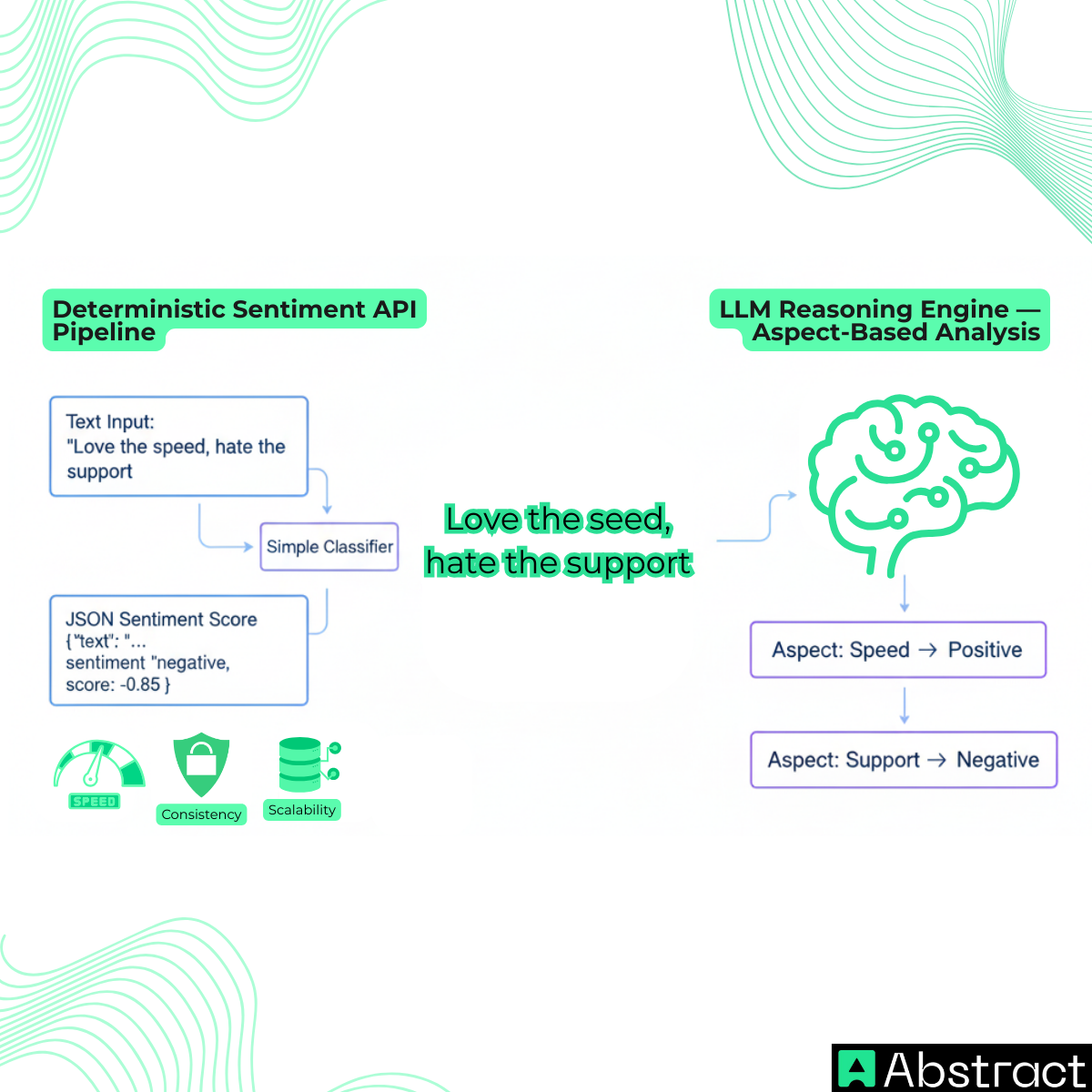
A text analysis API typically follows a deterministic pipeline:
- Tokenize and normalize input text
- Run it through a trained classifier
- Return a sentiment score or label
This approach is fast and repeatable.
LLM-based sentiment analysis works differently. The model reasons over the text and generates an answer. This allows deeper understanding, but introduces variability and higher latency.
Advanced Capabilities: Beyond Text
Aspect-Based and Targeted Sentiment
Aspect based sentiment analysis API features are essential for product reviews, support tickets, and surveys. Without them, teams cannot prioritize what to fix.
Real-Time Emotion Detection and Multimodal Inputs
Sentiment is no longer text-only. Audio APIs like AssemblyAI and video-capable models such as Gemini Pro can detect anger or frustration from tone of voice, something text APIs often miss.
Build vs Buy: LLMs vs APIs
Google NLP vs MonkeyLearn
Google NLP offers scale and structured outputs. MonkeyLearn offers consistency and customization through its UI. The choice depends on whether your team prefers infrastructure or tooling.
Sentiment Analysis Using LLM vs API
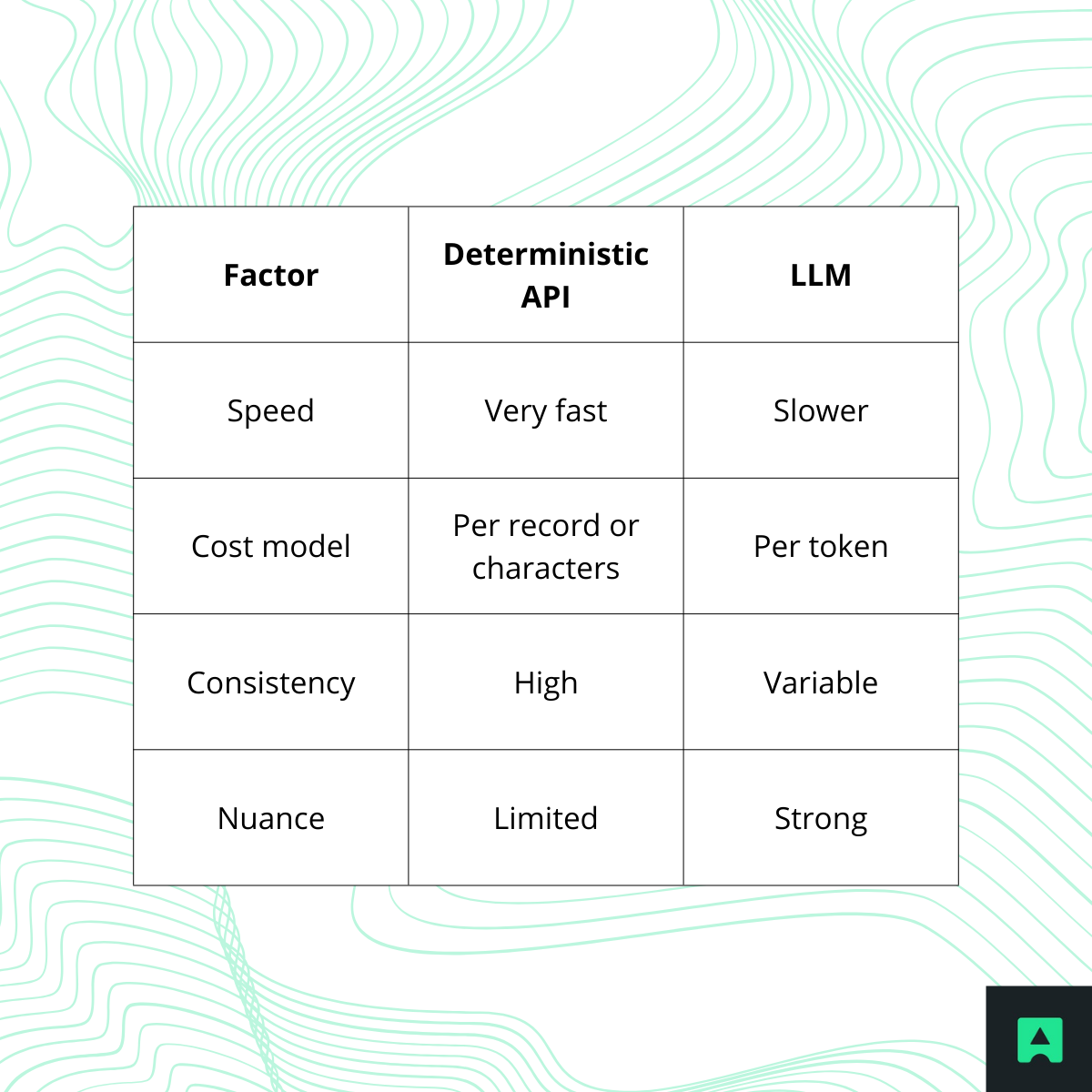
For short text, token pricing in 2026 can make LLMs surprisingly affordable. For dashboards and alerts, APIs remain safer.
Code Examples: Two Approaches
Using an LLM for Reasoning-Based Sentiment
# 2026 Trend: Using Generative AI for reasoning-based sentiment
import google.generativeai as genai
model = genai.GenerativeModel('gemini-1.5-flash')
response = model.generate_content(
"Analyze the sentiment of this review and extract the specific aspect mentioned: "
"'The app is blazing fast, but the support team is totally useless.'"
"Return JSON: {sentiment: string, aspect_positive: string, aspect_negative: string}"
)
print(response.text)
Using a Standard Sentiment Analysis API
import requests
response = requests.post(
"https://sentiment.abstractapi.com/v1/?api_key=ABS_KEY",
json={"text": "I love the product but hate the price."}
)
print(response.json())
The Complexity Cost of LLMs
LLMs require prompt management, retries, and monitoring for output drift. This complexity often outweighs their benefits for simple sentiment scoring.
Need a simple, reliable sentiment score without managing prompts or cloud infrastructure?
Final Thoughts
There is no single best sentiment analysis API in 2026. The right choice depends on whether you need speed and consistency or deep understanding and flexibility. Many mature systems use both.
Frequently Asked Questions
What is a sentiment analysis API?
A sentiment analysis API is a web service that accepts text as input and returns a score or label indicating whether the sentiment is positive, negative, neutral, or mixed. Developers use these APIs to analyze product reviews, support tickets, survey responses, and social media posts without building their own NLP models.
What is the difference between a deterministic sentiment API and an LLM-based approach?
Deterministic APIs like Google Cloud Natural Language and Amazon Comprehend return consistent, predictable results and are well-suited for high-volume batch processing. LLM-based approaches using models like OpenAI or Gemini can reason about context and nuance, but introduce prompt management overhead and output variability. In 2026, LLMs are increasingly cost-competitive for short text, making them viable for cases where deeper understanding matters.
What is aspect-based sentiment analysis and when do I need it?
Aspect-based sentiment analysis breaks down sentiment by specific features of a product or service, for example, flagging that a review is positive about design but negative about battery life. You need it when aggregate positive/negative scores are too coarse for your use case, such as product feedback dashboards or competitive analysis. APIs like Google Cloud Natural Language and MeaningCloud support this out of the box.
Which sentiment analysis API should I choose for my project?
The right choice depends on your priorities. Google Cloud Natural Language and Amazon Comprehend are strong picks if you need reliable infrastructure, multilingual support, and predictable pricing. MonkeyLearn suits teams that want a no-code UI alongside an API, though it starts at $299/month. MeaningCloud and Google Cloud Natural Language both offer free tiers for getting started.
How is intent recognition different from sentiment analysis?
Sentiment analysis tells you whether text is positive, negative, or neutral. Intent recognition goes a step further by identifying why a user feels that way or what action they want to take, for example, distinguishing a complaint that implies a refund request from one that is just venting. Modern APIs and LLM-based tools increasingly combine both capabilities in a single call.
What are common use cases for sentiment analysis APIs?
Common use cases include monitoring product reviews, triaging customer support tickets by urgency, analyzing survey responses at scale, and tracking brand sentiment on social media. Developers also use sentiment APIs to trigger real-time dashboard alerts when negative feedback spikes, or to route support messages to the right team based on tone and topic.
CEO at Abstract API

