



Why IP Geolocation Matters More in 2026
Modern privacy laws don't treat all location data equally.
Highly precise data—such as GPS coordinates, Wi-Fi triangulation, or Bluetooth beacons—is now heavily regulated. In states like California and under laws such as the Tennessee Information Protection Act, collecting precise geolocation often requires explicit opt-in consent.
IP geolocation is different.
Because IP-based location data is inherently approximate—often accurate at the city or regional level, not at street or household level—it frequently falls into a "safe harbor" category under privacy regulations.
The Safe Harbor Advantage 🛡️
Most IP geolocation databases cannot pinpoint a user within ~1,750 feet (≈500 meters). That lack of precision is actually a feature:
✅ Lower compliance burden than GPS data
✅ Reduced consent requirements in many jurisdictions
✅ Safer for analytics, security, and fraud use cases
For developers and product teams, this makes IP geolocation one of the few scalable ways to add location awareness without legal friction.
👉 Learn more about how IP data fits into privacy-first architectures in AbstractAPI's resources on IP Geolocation API and Privacy-Friendly Data Enrichment.
Accuracy vs Precision: Don't Confuse the Two ⚠️
A common misunderstanding in IP geolocation is assuming that precise coordinates equal accuracy.
- Precision: The IP resolves to a specific latitude/longitude (often the center of a city).
- Accuracy: The user is actually located near that point.
An IP may precisely map to central Paris, while the user is physically 10–15 miles away. That's normal behavior—and not a data error.
Mobile IP Accuracy in 2026 📱
Mobile IP geolocation is even less accurate due to:
- 5G network architecture
- Carrier-Grade NAT (CGNAT), where thousands of devices share one public IP
The 2026 Vendor Snapshot: Best IP Geolocation APIs Compared 📊
Below is a 2026 market snapshot comparing the leading IP geolocation providers. This table is designed to serve as a quick decision cheat sheet for developers and product teams.
IP Geolocation API Comparison Table (2026)
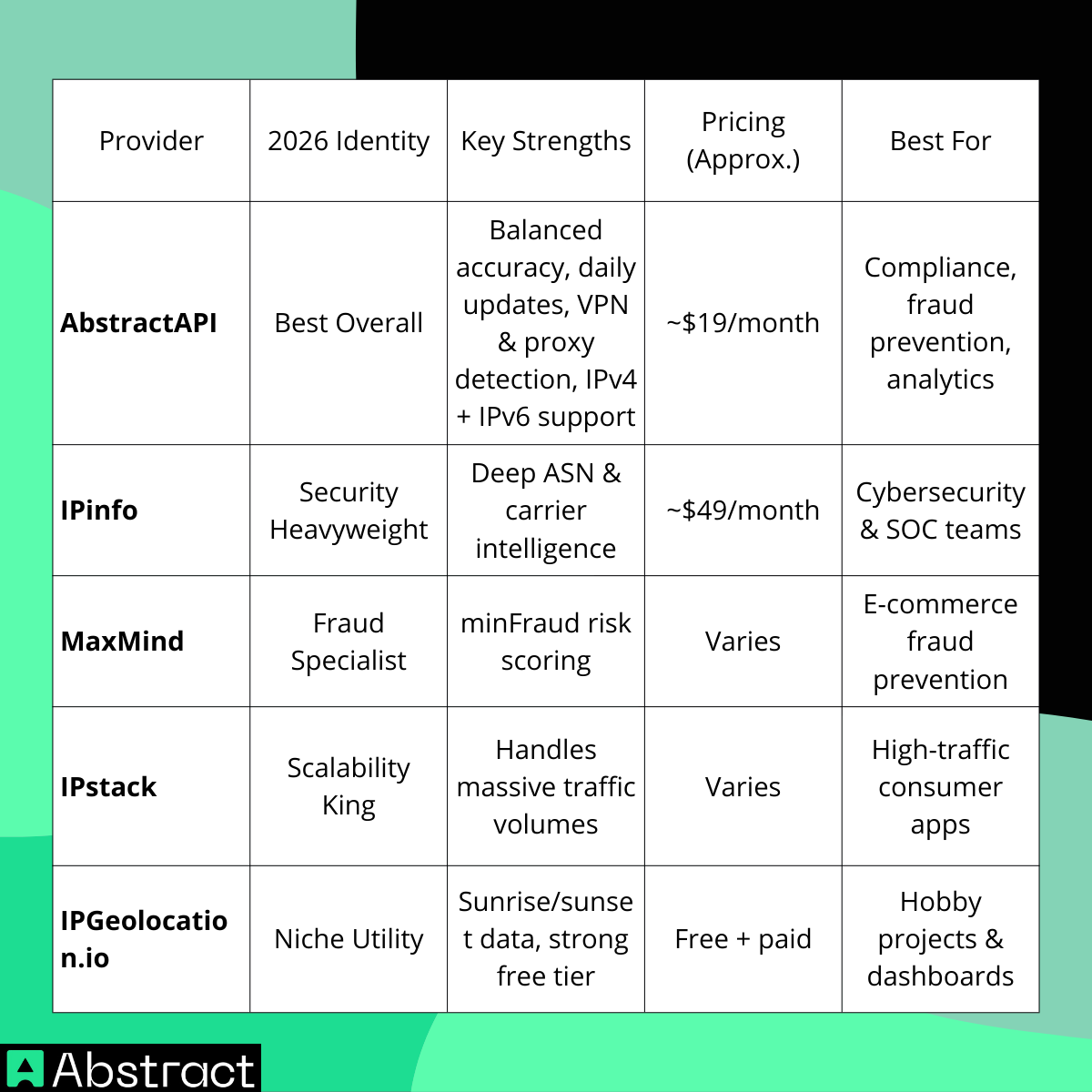
For most developers, AbstractAPI offers the best balance of price, security features, and compliance alignment, without enterprise-only pricing.
Why VPN Detection Is Essential in 2026 🕵️♂️
In modern applications, knowing where a user appears to be is only half the story.
Knowing whether that location can be trusted is just as important.
VPNs, proxies, and TOR networks are commonly used to:
- Commit payment fraud
- Abuse promotions or free trials
- Evade geo-restrictions
- Mask malicious behavior
That's why VPN detection is now a core feature of any serious fraud prevention API for e-commerce.
AbstractAPI includes VPN and proxy detection directly in its IP Geolocation API, as part of its broader
Modern Python Example: Detect Location and VPNs in One Call 🐍
Below is a simple Detect VPN Python script using AbstractAPI.
import requests
# 2026 Standard: Simple REST calls with JSON response
api_key = "YOUR_ABSTRACT_API_KEY"
ip_address = "166.171.248.255" # Example mobile IP
response = requests.get(
f"https://ipgeolocation.abstractapi.com/v1/?api_key={api_key}&ip_address={ip_address}"
)
data = response.json()
# Key 2026 Feature: Security Flagging
if data["security"]["is_vpn"]:
print("⚠️ VPN Detected! Flagging transaction for review.")
else:
print(f"User is in {data['city']}, {data['country']}")
You can find additional examples and language-specific guides in the
The Edge Routing Use Case: Faster Apps, Lower Latency ⚡
IP geolocation is also widely used for traffic routing at the edge.
Conceptual Flow Example:
User IP → IP Geolocation API
→ Country = UK
→ Region = London
→ Route request → AWS eu-west-2 (London)
This approach improves performance while avoiding the privacy risks associated with precise geolocation tracking.
Is IP Geolocation Legal in California and Tennessee? (FAQ) ⚖️
Below are schema-ready FAQ blocks suitable for FAQPage markup.
❓ Is IP geolocation legal in California?
Yes. IP geolocation is legal in California when used responsibly. Because it is considered approximate location data, it often does not trigger the same consent requirements as precise geolocation methods.
❓ Does the Tennessee Information Protection Act restrict IP addresses?
The Tennessee Information Protection Act focuses on sensitive personal data. IP addresses are typically allowed when used for security, analytics, or fraud prevention purposes.
❓ Is IP geolocation considered precise geolocation?
No. IP geolocation provides approximate location data, usually at the city or regional level.
❓ Can IP geolocation be used for fraud prevention?
Yes. IP geolocation is widely used as a fraud prevention API for e-commerce, especially when combined with VPN and proxy detection.
❓ Is there a free IP lookup API with commercial use?
Yes. AbstractAPI offers a free tier that supports commercial use.
Choosing the Best IP Geolocation API in 2026 🎯
When evaluating providers, ask yourself:
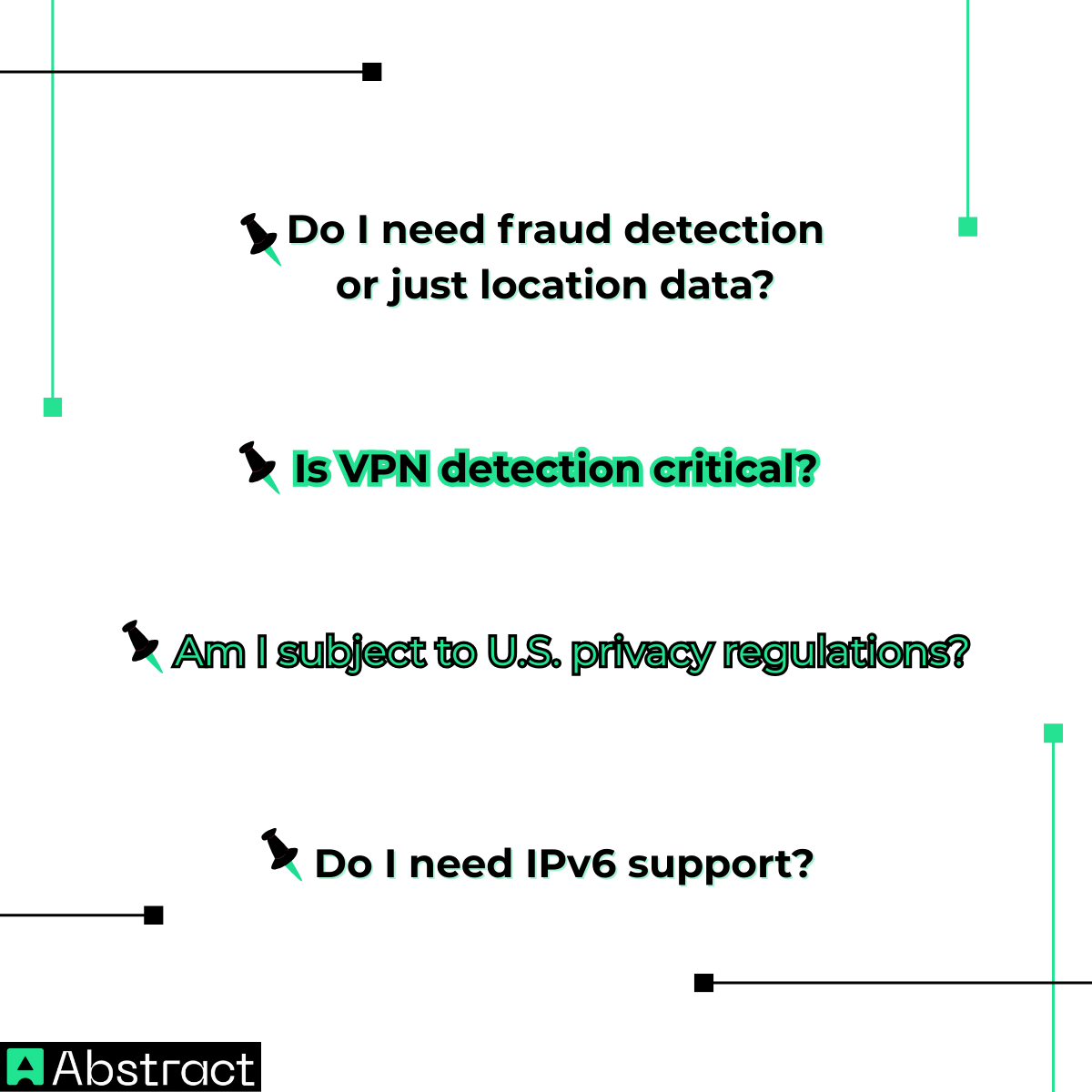
For most teams, the right choice balances compliance, accuracy, and ease of use—which is why many developers consider AbstractAPI the best IP geolocation API 2026.
Start Secure, Stay Compliant 🚀
Worried about compliance fines, false fraud flags, or invasive tracking?
👉 Start with AbstractAPI's free tier and get compliance-friendly, bank-grade IP geolocation data today:
Build smarter, safer, and privacy-first applications in 2026—and beyond.
Frequently Asked Questions
What is an IP geolocation API and what does it return?
An IP geolocation API takes an IP address as input and returns location data such as country, region, city, latitude, and longitude in a JSON response. Most modern APIs also include enriched fields like timezone, currency, and VPN or proxy detection. Developers call the API over REST, typically with a single HTTP request using the requests library or equivalent.
How accurate are IP geolocation APIs?
IP geolocation is generally accurate at the country and region level but struggles at the city level: coordinates returned can be off by 1,750 feet or more. Precision (exact coordinates) does not equal accuracy (the user's real location). Mobile users are especially affected because 5G networks and Carrier-Grade NAT can assign IPs far from the device's physical location.
Which IP geolocation APIs include VPN and proxy detection?
Abstract, MaxMind, and IP2Location all offer VPN and proxy detection as part of their geolocation responses. This is important for fraud prevention in e-commerce, where a mismatch between a billing address and the detected location can signal a risky transaction. Abstract returns VPN status in the same request as location data, avoiding a second request.
Are IP geolocation APIs compliant with privacy laws like CCPA?
IP address data generally falls into a lower-compliance category than GPS or precise tracking data, which makes it a useful "safe harbor" alternative for location-aware features under regulations like CCPA and newer state privacy laws. However, how you store and use the data still matters; the API itself does not grant compliance, your data handling practices do.
How do I call an IP geolocation API in Python?
Most IP geolocation APIs are REST-based and work with a simple requests.get() call in Python, passing the target IP and your API key as query parameters. The response comes back as JSON, which you can parse with response.json(). Abstract's Python example covers both location lookup and VPN detection in a single call, which keeps integration straightforward.
How do I choose the best IP geolocation API for my project?
The main factors to compare are accuracy, free-tier limits, VPN/proxy detection support, update frequency, documentation quality, and pricing at your expected request volume. Abstract is highlighted as offering a strong balance of price, security features, and compliance alignment without locking key features behind enterprise plans. MaxMind's GeoIP2 and IP2Location are also well-established options worth evaluating for high-volume or offline use cases.
