


The HTTP Status Code 418 was defined in 1998 as one of the traditional IETF April Fools' jokes and is not expected to be implemented by actual HTTP servers.
What Is HTTP Status Code 418? HTTP 418 I'm a Teapot Meaning, Security Uses, and RFC 2324 Explanation
The 418 status code, officially known as HTTP 418 I'm a teapot, is one of the most unique HTTP response codes ever defined. While it originated as a joke, the http 418 i'm a teapot response has evolved into a legitimate tool used in security honeypots, bot detection, and developer testing environments.
In 2026, the http status code 418 is permanently reserved and actively used by developers and Web Application Firewalls (WAFs) to detect and trap malicious automated traffic.
In this guide, you’ll learn:
- The 418 error meaning
- Its origin in RFC 2324
- Why it still exists today
- When to use HTTP 418
- How it supports modern application security
To understand how it fits into the broader HTTP ecosystem, see AbstractAPI’s
HTTP Status Codes Guide which explains all standard client and server responses.
What Is HTTP Error 418? 418 Status Code Meaning Explained
The HTTP error 418 response means:
This indicates that the server is intentionally refusing to perform the requested operation.
Unlike traditional client errors such as:
The 418 error meaning is symbolic and deliberate.
It is not typically caused by client mistakes, but instead is intentionally returned by the server—often for security or bot detection purposes.
RFC 2324 Explanation: The Origin of HTTP 418 and HTCPCP
The http status code 418 was introduced in RFC 2324, published by the Internet Engineering Task Force (IETF) in 1998.
This document defined the fictional:
Hyper Text Coffee Pot Control Protocol (HTCPCP)
The protocol humorously described how HTTP could control coffee machines.
In the specification, the 418 code was defined for this scenario:
Client request: BREW coffee
Server response: 418 I'm a teapot
Meaning: The server cannot brew coffee because it is a teapot.
Although originally intended as humor, the code became widely adopted by developers.
Why HTTP 418 Is Permanently Reserved (RFC 9110)
Due to its popularity and cultural significance, the IETF permanently reserved the code in RFC 9110.
This means:
- It will never be reassigned
- It remains part of the HTTP standard
- It is officially recognized but not used for conventional errors
HTTP 418 is now the only humorous status code permanently protected in the protocol.
When to Use HTTP 418 in Modern Applications
Understanding when to use HTTP 418 is essential for modern developers.
The 418 response code should be used intentionally, not as a replacement for real client errors.
Common valid use cases include:
- Security honeypots
- Bot detection systems
- Hidden endpoints
- Developer testing
- Easter eggs
It should not be used for actual application errors. Standard codes like 400, 403, or 500 should be used instead.
Using HTTP 418 for Bot Detection and Security Honeypots
One of the most important modern uses of http 418 security implementations is bot detection.
Automated attackers frequently scan applications for sensitive endpoints such as:
/admin
/wp-login.php
/phpmyadmin
Legitimate users never access these paths on most applications.
When a bot accesses these endpoints, the server may respond: HTTP/1.1 418 I'm a teapot
This allows the system to:
- Identify malicious automation
- Log attacker behavior
- Trigger security alerts
- Block malicious IP addresses
Many Web Application Firewalls (WAFs) use HTTP 418 as part of honeypot and bot-detection strategies.
FastAPI Honeypot Example: Returning HTTP 418
Developers can easily implement honeypots using modern frameworks like FastAPI:
from fastapi import FastAPI, Response
app = FastAPI()
@app.get("/admin")
def fake_admin_panel():
# Security honeypot endpoint
return Response(
content="I'm a teapot, not an admin panel.",
status_code=418
)
If accessed, the server responds: HTTP/1.1 418 I'm a teapot
This indicates suspicious activity.
Node.js Example: Returning HTTP 418
Node.js and Express support HTTP 418 natively: res.status(418).send("I'm a teapot");
This works in:
- Express.js
- Fastify
- NestJS
Real HTTP 418 Response Example
Example raw HTTP response:
HTTP/1.1 418 I'm a teapot
Content-Type: text/plain
I'm a teapot
You can test this using curl: curl -i https://example.com/admin
HTTP 418 Security Warning: Seeing 418 in Logs May Indicate Bot Activity
If your application logs contain 418 response codes, your server may be detecting malicious scanners.
To properly analyze and block attackers, you need visibility into the source IP.
AbstractAPI’s IP Intelligence API helps you:
- Detect bots automatically
- Identify proxies and VPNs
- Assess IP reputation
- Block malicious traffic
Learn more about the IP Intelligence API to strengthen your application security.
You can also explore the full HTTP Status Code 418 Guide for additional implementation details.
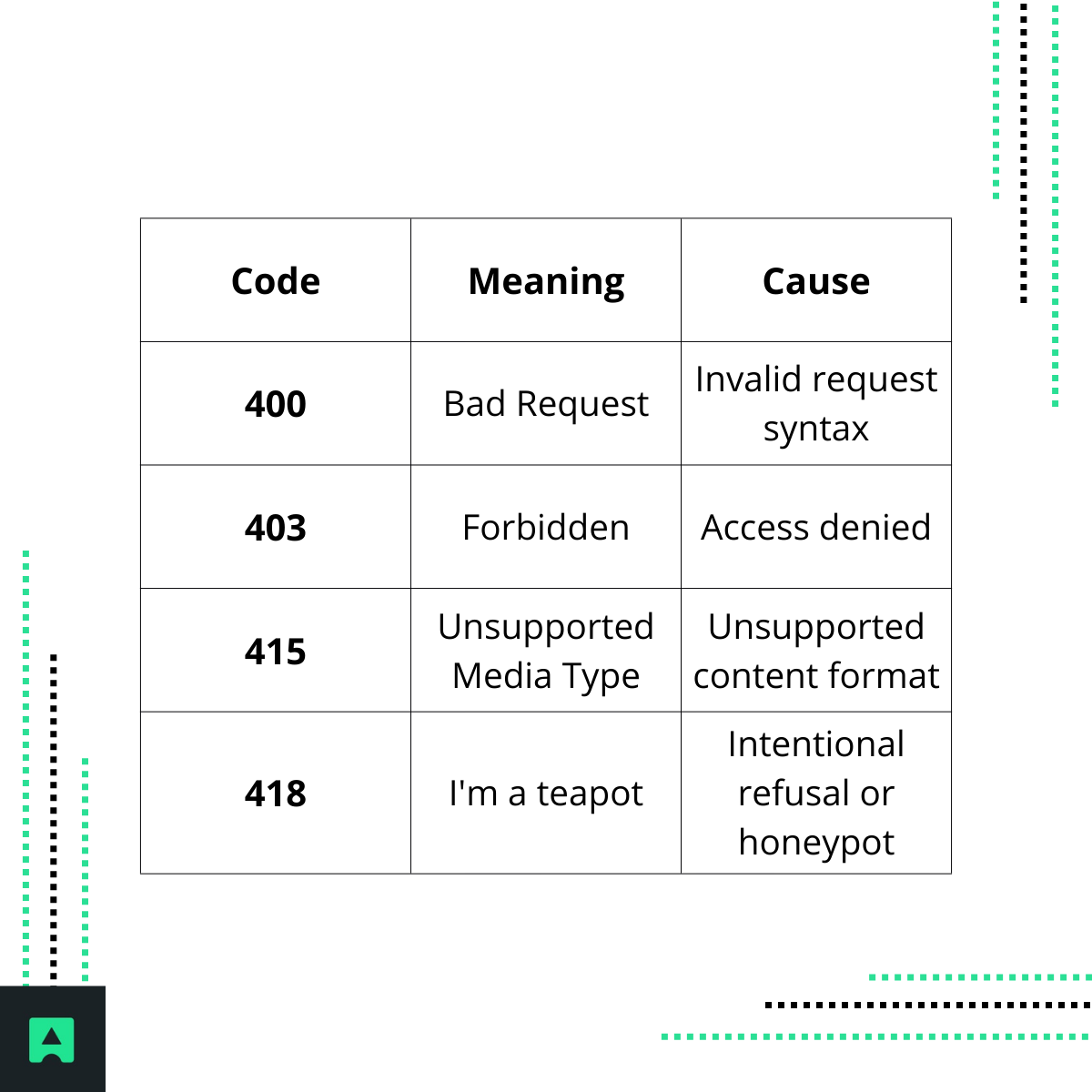
HTTP 418 vs Other HTTP Client Error Codes
Here is how 418 compares to standard HTTP errors:

HTTP 418 vs Other HTTP Client Error Codes
The key distinction: HTTP 418 is intentional and controlled.
Best Practices for Using HTTP Status Code 418

Recommended uses:
Use 418 for:
- Honeypot endpoints
- Bot detection
- Security monitoring
- Controlled developer testing
Avoid using it for:
- Legitimate application failures
- Authentication errors
- User-facing production errors
Use standard HTTP codes for real failures.
FAQ: HTTP 418 Status Code
Is HTTP 418 a real status code?
Yes. It is officially reserved in RFC 9110.
What causes HTTP 418?
It is intentionally returned by servers, usually for honeypots or bot detection.
Is HTTP 418 used in production?
Yes. Many developers and security systems use it.
Can browsers receive HTTP 418?
Yes. Browsers display it like any other HTTP response.
Conclusion: HTTP 418 Is Now a Real Security Tool
The HTTP 418 I'm a teapot status code has evolved from a joke into a meaningful part of modern web infrastructure.
Today, it serves as:
- A permanent part of HTTP
- A developer culture symbol
- A security honeypot tool
- A bot detection mechanism
If you see HTTP 418 in your logs, it likely means your application is successfully detecting unwanted traffic.
To learn more, explore AbstractAPI’s complete HTTP Status Codes documentation and strengthen your application security.
