



The 2026 Reality: A2P 10DLC Compliance Is Mandatory
If you send SMS to US users, A2P 10DLC registration is not optional anymore.
Every legitimate SMS API now requires you to associate outbound messages with a registered Brand and Campaign ID, usually configured through:
- A RegistrationId (Plivo, Bird, Sinch, etc.)
- Or a MessagingServiceSid (Twilio)
This links each message to a vetted 10DLC campaign approved by carriers — ensuring deliverability and preventing filtering or blocking.
If you're still sending messages without registration, your traffic is either already being filtered — or will be soon.
The Biggest 2026 Threat: SMS Pumping Fraud
SMS pumping fraud occurs when attackers exploit sign-up or OTP flows to send large volumes of SMS messages to premium numbers they control. You pay for the traffic — they collect the payout.
If your SMS provider doesn't offer pumping protection or risk scoring, you are exposed.
This is why modern architectures now separate:
Validation (intelligence) → Sending (delivery)
We'll show the stack approach shortly.
The Big 6 SMS APIs in 2026
| Vendor | 2026 Identity Key | Strengths | Best For |
|---|---|---|---|
| Twilio | The Gold Standard | Fraud Guard with 100% SMS pumping insurance, enterprise workflows, MessagingServiceSid for 10DLC | Enterprises needing maximum security |
| Bird (MessageBird) | The Price Warrior | Claims 40–90% cheaper than Twilio, CRM and marketing automation focus | High-volume growth teams |
| Plivo | The Efficiency Engine | Developer-first APIs, Powerpack for number pooling, ~$0.0050 per msg | Cost-efficient OTP and bulk messaging |
| Telesign | The Identity Fortress | Real-time risk scoring before sending, owned by BICS carrier network | Fraud prevention and risk intelligence |
| Sinch | The Global Backbone | 600+ direct carrier connections, stable international routing | Multinational applications |
| Vonage | The Verification Hybrid | Verify API with pay-per-conversion authentication | OTP and login verification flows |
Twilio vs Plivo vs Bird Pricing Snapshot (2026)
- Twilio: ~$0.0079 per US outbound SMS
- Plivo: ~$0.0050 per US outbound SMS
- Bird: Aggressively discounted enterprise rates (often 40–90% lower than Twilio)
On price alone, Bird and Plivo win.
On security and enterprise compliance tooling, Twilio leads.
But all three still charge you for every message you attempt to send — even if the number is fake, landline, or fraudulent.
That's where the validation layer comes in.
Stop Paying for Invalid Numbers
Tired of paying for undelivered SMS or fake sign-ups?
Before triggering an expensive OTP, validate the phone number first.
AbstractAPI's Phone Number Validation API identifies:
- Invalid numbers
- Landlines (can't receive SMS)
- Carrier and line type check
- Country and formatting
- Risk signals
This simple step alone can cut SMS costs by 20–30% and dramatically reduce pumping fraud exposure.
The Stack Approach: Validation Before Sending
Modern messaging stacks in 2026 look like this:
AbstractAPI Phone Validation → SMS API (Twilio / Plivo / Bird)
This ensures you only send costly SMS messages to real mobile numbers.
Free Phone Number Validation API Python Example:
import requests
# Step 1: Validate with AbstractAPI (low cost intelligence layer)
validation = requests.get(
"https://phonevalidation.abstractapi.com/v1/?api_key=YOUR_API_KEY&phone=+14155552671"
)
data = validation.json()
# Step 2: Only send SMS if number is valid and mobile
if data['valid'] and data['type'] == 'Mobile':
print("Valid mobile number. Sending SMS via your SMS API...")
# sms_client.send_message(...)
else:
print("Skipping SMS. Invalid number or landline detected.")
This approach directly addresses:
- Prevent SMS pumping fraud
- Reduce OTP waste
- Improve deliverability metrics
- Lower messaging spend
Silent Network Authentication: The Future Beyond OTP
OTPs are becoming a friction point for users and a cost center for developers.
The next evolution is Silent Network Authentication (SNA) — where user identity is verified directly through carrier network signals, without entering a code.
This emerging Silent network authentication API model improves:
- Login conversion rates
- Security against SIM swap attacks
- Reduction in SMS OTP costs
Expect all major SMS and identity providers to roll out SNA-based verification flows throughout 2026 and beyond.
Flash Calls and iOS: Don't Make This Mistake
Flash call verification — reading the last digits of an incoming call — works in Android-heavy markets.
However:
Apple blocks app access to call logs.
That makes flash calls unreliable or impossible for iOS users.
For universal coverage in 2026, stick with:
- SMS OTP
- Silent Network Authentication
- App-based verification
Which SMS API Should You Choose?
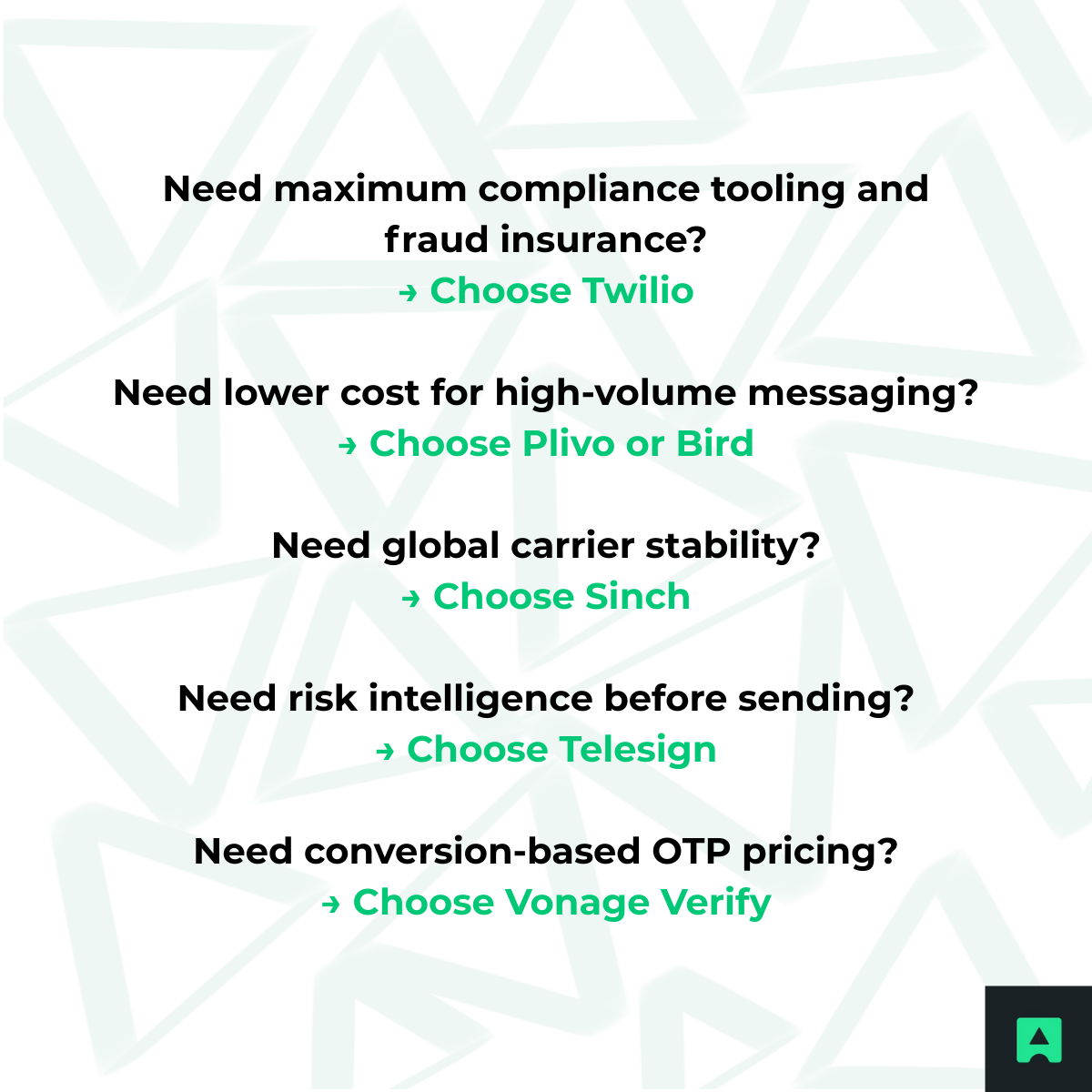
But regardless of provider:
Never send an SMS before validating the number.
That single step is now the most effective defense against wasted spend and SMS pumping fraud.
Build a Smarter Messaging Stack
Before you send your next OTP, make sure the number is real.
AbstractAPI's Phone Validation API helps you:
- Improve SMS deliverability
- Cut messaging costs
- Stop fraud before it triggers a billable event
Frequently Asked Questions
What is A2P 10DLC and do I need to register for it?
A2P 10DLC (Application-to-Person 10-Digit Long Code) is the US carrier registration system for business SMS traffic. As of 2026, registration is mandatory (not optional) for any application sending messages to US phone numbers, and non-compliance fines can reach $10,000 per violation. Every major SMS API provider (Twilio, Plivo, Bird, Sinch, Vonage, Telesign) supports the registration process, so check your chosen provider's onboarding docs before sending your first message.
Which SMS API is cheapest for high-volume sending?
Twilio's US outbound base rate is roughly $0.0079 per message, but Bird and Plivo both undercut that significantly: Plivo sits around $0.0050 per message and Bird can be 40-90% cheaper than Twilio at enterprise volumes. For cost-conscious teams, Plivo is a common first step because its API surface intentionally mirrors Twilio's, keeping migration effort low. Always factor in carrier surcharges on top of the base rate when comparing true all-in costs.
What is SMS pumping fraud and how do I protect against it?
SMS pumping fraud happens when attackers exploit your OTP or authentication flow to trigger large volumes of messages to premium-rate numbers they control, running up charges at your expense. The best defense is choosing a provider with built-in pumping protection and risk scoring: Twilio offers Fraud Guard with SMS pumping insurance, and Telesign specializes in real-time risk scoring. Pairing any SMS API with phone number validation before sending (to flag high-risk or suspicious numbers) adds another layer of protection before charges are incurred.
Why should I validate phone numbers before sending SMS?
Sending to invalid, deactivated, or landline numbers wastes money and harms your sender reputation with carriers. Running numbers through a phone validation API first (such as Abstract's Phone Validation) screens out unreachable numbers before the message is ever dispatched. This validation-first architecture can reduce SMS costs by 20-30% and blocks fraudulent or bot-generated numbers from triggering charges in your OTP or notification flows.
Should I use flash call verification instead of SMS OTP?
Flash call verification (a brief call that auto-detects the caller ID) works on Android but fails on iOS because Apple restricts access to call logs. If your user base includes iOS devices, SMS OTP, Silent Network Authentication (SNA), or app-based authenticators are safer universal choices. SNA in particular is gaining traction in 2026 as a post-OTP method: it verifies identity at the carrier level without requiring the user to enter a code, improving conversion while lowering SMS volume.
Which SMS API has the best global coverage?
Sinch leads on raw carrier reach with 600+ direct carrier connections, making it a strong choice for applications that need reliable delivery across many countries and carriers. Twilio also covers 150+ countries and is a safe default for global use cases. For any provider, verify direct-route coverage for your highest-priority markets before committing, since some providers use gray routes in certain regions that can hurt deliverability.
